KELA. The Social Insurance Institution of Finland, Kela, is familiar to me from my previous studies and especially in matters related to children.In my earlier life, I have received support from Kela for childbirth and childcare. For example, such support includes home care allowance and parental leave, formerly known as maternity leave. Currently, I receive child allowance from Kela, but the allowance for my eldest child will end this year when they turn 17. I have also received general housing allowance to support my housing costs in my earlier life.Using the online service OmaKela is very familiar to me. It’s not a daily task, but I occasionally check things like the child allowance payment schedule.
In my current situation, I am increasingly managing matters for my parents, who are retired. This includes handling applications for medical travel reimbursements through OmaKela on their behalf.After starting my master’s degree studies at a university of applied sciences, I paid the student healthcare fee to Kela for the Student Health Service.
I have great respect for the Finnish social security system and the support it provides to citizens. I consider it a crucial and essential pillar of an equal society. I believe Kela’s services have become much more efficient since transitioning to digital formats. I find handling my Kela matters easy and convenient. I obtained a European Health Insurance Card for myself and my children a few years ago.
OmaKanta.Omakanta is a Finnish nationwide online service where I can access my health information daily, and I use the service frequently. I check my health records, health visits, and laboratory results.Additionally, I can manage matters for my three children under 18 in Omakanta. My two older children also have their own digital identification tools. We have made a power of attorney for future situations so that I can take care of my parents’ affairs if they are no longer able to do so themselves. It is important to consider this for the future.
Keva. Keva is a Finnish public pension institution and the largest pension provider in Finland. I reviewed my personal information on Keva’s website, and my lowest retirement age is 66 years and 10 months. On the other hand, my target retirement age is 68 years and 9 months. The upper age limit for pension accrual is 70 years. So, there are 25 years until my target retirement age. There is still a long way to go. Additionally, accumulating a pension motivates me to continue working. I also feel that it motivates me to advance in my career.
Digital shops. I think I’m quite a poor online shopper. Somehow, I don’t find online stores appealing. For example, when it comes to clothing, I prefer to see the item and try it on before making a purchase decision. Additionally, I find online shopping somewhat vague. I always want to ensure the security and reliability of an online store. I’m very particular about data security.
However, I have ordered certain sportswear from a specific store that has become familiar to me, which makes me feel confident when placing an order. Also, last fall, I dared to order winter tires for my car. The service was excellent and fast. Thet became cheaper through online shopping. Of course, installation is required, so these things need to be arranged separately. I have usually bought tires and installation, i.e. the whole package, from a local tire shop.
I travel relatively little, but for example, when booking a hotel room in Finland, I have mostly ended up on the hotels’ own websites and made my reservation there. For this task, I visited Trivago’s website and explored accommodation options in Tahko. The Sokos Hotel in Tahko has been recently renovated and updated. When comparing the prices for the upcoming Easter period directly on the Break Sokos Hotel Tahko’s own website and the options provided by Trivago, where the cheapest offer is found through Booking.com, the more affordable price for an Easter stay is available on the hotel’s own website. The room offer through Booking.com is 40 euros more expensive.
As I mentioned, I am quite particular about the information available. Additionally, I always want to ensure the reliability of an online store. This has influenced the fact that I don’t use online shopping services very extensively. However, I do search for information about store offerings and compare prices. I do that more often than making purchases online.
My application, OmaSavo. I explored my employer’s relatively new digital platform, OmaSavo, which belongs to the Wellbeing Services County of North Savo. I started by looking into electronic forms, which are available through the Suomi.fi messaging service. Since I handle patient complaints in my work, I explored the electronic forms as a customer and specifically examined the patient complaint form. Through the Wellbeing Services County of North Savo´s electronic customer service, patients can submit patient complaints to the Records Office, from where they are forwarded to our administration for processing. Using electronic services as a customer requires strong identification.
In my opinion, when considering, for example, older people, the process through the OmaSavo platform might be somewhat complex. Through the OmaSavo platform, users can access the Suomi.fi messaging service, where they can submit various requests, including the patient complaints mentioned earlier, claims for rectification, compensation applications, as well as requests for clarification on data processing and correction requests for patient records.
Digitalization and digital gap. Many services, including banking, healthcare, and government assistance, are increasingly digital-only. Those without access or digital skills may struggle to apply for benefits, schedule medical appointments, or manage finances online
I find the challenges of digitalization particularly significant in the social and healthcare sector, where I also work. Since Finland’s population structure is changing, and has already changed, we have a large proportion of elderly citizens, some of whose digital skills are not on the same level as younger generations. The digitalization of many services poses challenges and risks for the elderly population, including the potential for them not to have their matters handled equally compared to citizens who are familiar with and find digital interactions easy.
This is a topic I feel very personally connected to, as I increasingly assist my retired parents with managing their digital affairs.Therefore, when developing digitalization, which naturally speeds up transactions and brings cost savings, it is important to also consider the population groups who are unable to use digital services. I believe that services should still be provided for them, where they can engage in face-to-face interactions with a person. However, alternative ways to handle matters will likely need to be developed, especially as distances grow longer due to the reduction of service networks caused by financial challenges. In such cases, the aging population will have to travel longer distances to access services, which, on the other hand, may not necessarily be a good thing.
Digital services need to be made as easy to use and user-friendly as possible, and guidance and assistance must be available for those who need it.
Digital Competence Test. My test results:
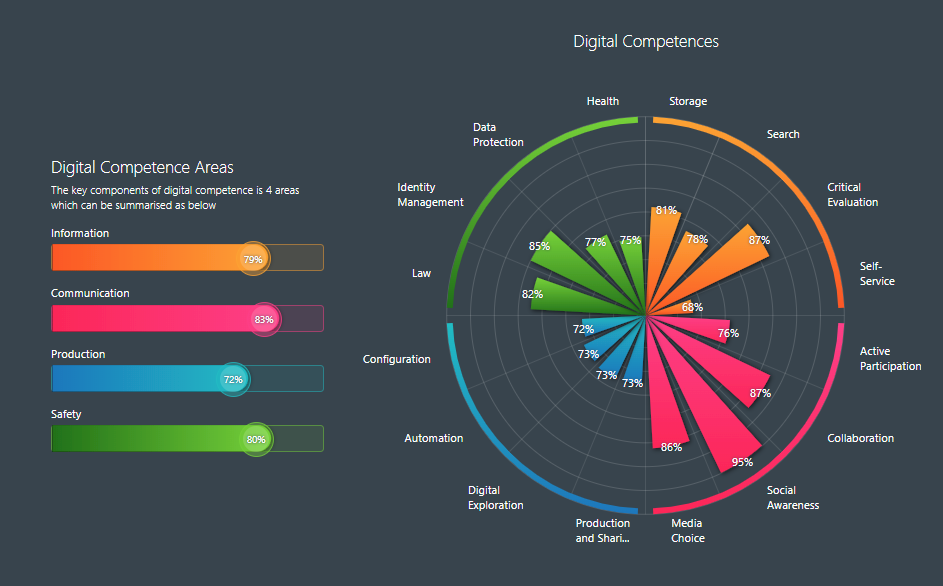
My three competences with the highest score are: 1. Social Awareness: Ability to reconcile behavior, tone, language and technology with regard to context and social relations. 2. Collaboration: Ability to use technologies and media for teamwork, coordination and collaboration processes. 3. Critical Evaluation: Ability to process, understand and critically evaluate digital information when sent and received. And the three competences with the lowest score are: 1. Self-Service: Ability and desire to seek out and benefit from self-service solutions online (and this completely surprised me). 2. Configuration: Ability to adjust applications and devices to their own personal preferences, as well as to solve technical problems or tasks. 3. Production and Sharing: Ability to create, assemble parts and modify content in many different formats. E.g. images, text, video or sound.
I found the digital competence test very interesting. I am aware of my skills and the areas for improvement. Still, some of the test results surprised me. In my work in the social and healthcare sector, I feel that I know a lot about data security. My job consists solely of working on a computer. There are several systems to manage. Data protection and information security are the most important aspects of my work. And I feel that my IT skills in my work are excellent.
My Journey of Learning. These assignments and writing the blog have once again broadened my understanding of the opportunities and challenges of digitalization. It has been interesting to read other blogs about digitalization and notice the similarities with my own thoughts. Additionally, the test partially surprised me. In my work in social and healthcare administration, I am constantly dealing with digitalization. I know how much life has changed with the advent of digitalization. It has certainly made things easier and sped up processes, especially if one’s digital skills are at a good level. Still, I see it as very important to consider people for whom the opportunities of digitalization are not nearly as easy to utilize, compared to, for example, my own generation. Or to those who, for instance, use electronic systems daily as part of their work.
I commented these blogs:
Leave a Reply