
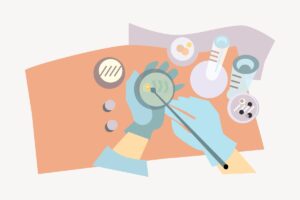
I work in a small clinical microbiology laboratory. In our laboratory we use traditional culture methods as well as modern PCR methods. Clinical microbiology has remained relatively unchanged and has always been manual, but the situation is now changing due to increasing automation and rapid technological development. Customer demands for faster response times for microbiological tests and the need to increase production efficiency are also contributing to the change.
Traditional culture testing has been the ‘gold standard’ for a long time, but its biggest disadvantage is that the microbes must stay alive before cultivation and different microbes have different growth requirements, which include growth times, atmospheres, temperatures and growth media, not to mention the wide range of follow-up tests. PCR (nucleic acid amplification) based tests and methods have developed at a rapid pace recently and are therefore not so expensive anymore. Don’t get me wrong, PCR testing is still more expensive than traditional culture testing, but it has the advantage of speed, sensitivity, specificity and ever-increasing automation and technology that reduce the need for staff presence. In addition, it is often possible to identify multiple pathogens from a single sample. Many PCR tests are performed in parallel with culture testing.
Although nucleic acid amplification methods will continue to develop rapidly in the future, they will never replace all traditional culture testing, because culture testing provides information about the effectiveness of antimicrobial drugs, their changes over time, and the development of resistance to antibiotics. For example: while a multiplex PCR can tell a clinician within hours exactly which pathogen is in a blood culture, it cannot tell them if that pathogen is actively mutating against a specific antibiotic in real-time. For that we need culture samples!
While the routine work performed in the laboratory (test range and cultures) has remained relatively unchanged for the past twenty years, laboratory systems have undergone an enormous change with the development of technology. I have been lucky enough to have two coworkers eho have been working in clinical microbiology for 40 years. I asked them what kind of laboratory systems and processes were in use when they started their careers.
The short answer was that everything was done manually. Patient samples arriving at the laboratory were inlabbed by useing pen and paper, each workstation had its own physical worklist. The completed testanswers were sent by mail in handwritten form, with one copy of the same answer going to the patient, one remaining in the laboratory archive and one going to the billing department. The work involved a lot of writing by hand and was slow. In the next stage, computers and printers were introduced, which made the work a bit easier and faster – at least worklists could be printed out. With the introduction of the patient information system, the work became even faster, the possibility of error went down, because the need for manual work decreased. Gradually, the number of analyzers and various devices got up, and a laboratory information system was introduced that connected the devices to a patient information system, meaning the results were automatically transferred to the computer. At some point, sending test results by mail stopped and the answers were transferred electronically. From the perspective of those workers, digitalization has been quite a feat!
When I started at my current workplace 4 years ago, we were still using an old patient information system that was developed in 1992. The program looked and felt like it was from the stone age, but it was surprisingly handy and versatile once you got to know it enough. However, the software fell behind and was replaced by a new laboratory system.
Now we have a modern and fully digital work environment – handwriting has been reduced to a minimum, a label is always printed on everything with the necessary information on it, all devices are connected to the system, auto-validation of results are in use. The system itself has utilized automation. Every movement and click made in the system leaves a digital trace.
In my opinion, the goal of digital development has been to speed up and make work more efficient and to minimize human errors. It is easy for a young employee to use a new system, even though it is sometimes too complicated and gives too many options, but more experienced employees still have challenges and difficulties using the program routinely. Are they also losing the competition to digitalization? Or is digitalization failing to design interfaces that respect their workflow?
The laboratory of the future will have much more automation and much fewer employees. There is already a fully automated clinical microbiology line on the market, which, among other things, utilizes artificial intelligence and machine learning. Fortunately, this system is so expensive that it will take a while before it makes financial sense in smaller microbiology laboratories. More information on the subject can be found at: COPAN’s Full Laboratory Automation.
I would like to think that the microbiology laboratory of the future will not be so different from the current one. Of course, there will be more intelligent devices and extensive test repertoire, but alongside it, there will still be traditional, familiarly slow culture testing.
Keywords related to digitalization
*Big data refers to huge amounts of data that cannot be analyzed with traditional database software. Big data can be used to make predictions, insights, and better decisions. It can be used to improve a product, service, or process. It is used to teach artificial intelligence and is utilized in machine learning. For example, streaming service recommendations, phone GPS, predicting health epidemics, or predictive device maintenance based on data is big data. All smart devices or online transactions accumulate big data, which poses a risk of excessive traceability, monitoring, and loss of privacy. Kenneth Coukier (TEDSalon Berlin 2014) spoke about a frightening future where algorithms could predict people’s thoughts, and if you think aggressive thoughts, will you be punished just for thinking them? In addition, artificial intelligence and machine learning will become more skilled, smarter, and more reliable than humans, making it even more important that big data is used only as a tool. In my own field, artificial intelligence and machine learning are utilized in image recognition, thereby speeding up laboratory processes and minimizing errors.
*GDPR, or General Data Protection Regulation, came into force in the European Union in May 2018. It is the toughest privacy and security law in the world, which aims to protect an individuals personal data and give them more ways to control it. Personal data is all information that can be used to identify a person directly or indirectly, for example, a name or an email address, but also phone location data, IP address, patient information, car registration number, etc. The processing of personal data refers to all activities from planning the processing of personal data to deleting personal data. In other words, in practice, all measures are processing of personal data. The advantages of the GDPR regulation are that a persons data cannot be used without their permission, the person must be notified of a data breach, and the person has the right to be forgotten. In addition, the person has the right to check their own data and, if necessary, correct it. The disadvantages of the regulation are the increase in bureaucracy and high costs for companies to be GDPR-compliant. Data collection restrictions are affecting the development of artificial intelligence and machine learning in European companies, which could give other companies a competitive advantage. From the perspective of the average user, GDPR appears as frustrating pop-ups where you must constantly accept cookies and terms of use. Personally, I almost never read notifications, I just tick the box to get rid of them. This undermines the GDPR’s basic principle of informed consent for the processing of personal data.
*Artificial Intelligence. I use artificial intelligence daily at work and in my personal life, and I find it a very useful tool. I use Google Gemini, ChatGPT and Microsoft Copilot interchangeably. I often ask all of them the same question and compare the answers, and depending on the question, I have sometimes received different answers. Most of the time, the answers have been good, timely, and correct. The plus is that AI provides information in its answer that I didn’t know I needed or hadn’t thought of. In addition, you can always ask for the sources of the answers. Sometimes, however, you must ask clarifying questions or guide the conversation to get to the desired answer or topic. Based on my own experience, another disadvantage of artificial intelligence is that, if you talk to it for a long time, it gets stuck on previous questions and answers. According to Google Gemini it is a mix of context window drift and attention bias.
Google Gemini:
”when a chat history gets too long, the AI starts weighing its own previous outputs too heavily, leading to a loop of reinforcing its own biases or getting confused by conflicting constraints you gave it 10 prompts ago”
So it is easier to start a new conversation than to constantly correct the answers it gives. The most important lesson in using AI is to remember that it is a tool and the information it provides cannot be considered an absolute truth.
When writing the GPPR section of this blog post, I used Google Gemini to search for information. It helped me quickly to get easy-to-understand information about the disadvantages of the GDPR regulation.
Self-assessment
The TEDtalk links in the course area were interesting. It was exciting to listen to 10-year-old speeches about the future and technological developments. Fortunately, not all the proposals have been implemented yet. I especially remembered the ‘A Day of Glass‘ video, because in it everyone were constantly glued to some kind of screen. Although the glass screens were beautiful and clinical-looking, I think people already have enough screen time. You don’t need to put all the information on different devices; you don’t need to be constantly so aware of everything around you. Your body and mind need a break from smart devices.
I have not been able to compare the current technological leap with the industrial revolution. And the fact that people at that time had the same fear of machines, automation and job preservation as we do today. Andy Yen said in his own speech (TEDGlobal 2014) that, if we want privacy on the internet, the whole world must want it. I was left wondering if this idea inspired the creation of the GDPR regulation?
It was fun writing this section of the course. The intersection between clinical microbiology and digitalization is an interesting subject with tension between the push for speed and automation versus the irreplaceable value of traditional, manual methods and human expertise.
I commented Bluestream Blog and Patricia Aghangu-Atem blog.