
Digitalization in everyday life
Kela
Kela, or the Social Insurance Institution of Finland, was founded in 1937 and for the first twenty years its task was only to pay national pensions. The current Kela has a much broader scope. It is an organization whose main task is to provide basic security for people covered by Finnish social security in various life situations. Kela’s services may be needed if a person’s livelihood is threatened due to illness, disability, unemployment or old age, as well as the birth of a child or the loss of a guardian. In other words, Kela’s task is to guarantee sufficient livelihood and care. Kela’s social security is based on either living or working in Finland. Social security is built on services and financial benefits.
Over the years, I have used Kela’s services. Starting with the monthly child allowance paid by Kela (until the child turns 17) and home care support until the child turns 3. In 2011, the home care support for one child was 340 euros per month, and the amount of the support in 2026 is 377.68 euros. There has been no significant increase in the amount of support over the past 15 years, even though the cost of living has risen sharply. Other Kela services that I have used include student grants and a state-guaranteed student loan.
OmaKela is Kela’s online service. According to Google’s AI assistant, OmaKela was launched in the 2010s and was intended to replace and expand Kela’s old electronic channels. OmaKela in the 2010s enabled viewing of one’s own information and communication. The service was logged in with bank codes. OmaKela was updated in 2021, now customers can see all current information immediately, such as the processing stages of applications or upcoming payment dates. Another important innovation was that the service works on mobile devices now.
Today, OmaKela has evolved from a straightforward electronic form service into a comprehensive welfare application that allows you to handle almost all Kela matters online. For example, checking information, applying for benefits, sending attachments, reading decisions and reporting changes. Logging in to the service is done securely via the Suomi.fi service.
I already have a European Health Insurance Card (EHIC) because I often travel to EU countries and want to protect myself in case of sudden health-related issues.
OmaKanta
In 2007, the law on electronic prescriptions came into force. It lays the foundation for Kanta services. The introduction of the OmaKanta service began in 2010, when it only contained electronic prescriptions and it was possible to view information about your own electronic prescriptions. Four years later, public healthcare began storing patient data in OmaKanta, and in 2016, private health centres joined with their patient data. Today, OmaKanta also allows you to view your own laboratory and imaging results, diagnoses, corona certificates, social service information, and self-recorded well-being data. In addition, you can make an organ donation and treatment will in OmaKanta.
For this task, I went to the kanta.fi website and logged in via a bank link, which also requires confirmation from a mobile device. This is multi-factor authentication (MFA), because a password alone is no longer enough to protect your information from cybercriminals.
Pension
I was unable to check my pension on the Keva service because Varma handles my pension matters. After MFA identification, it turns out that if I were to leave working life now, my pension would be 518 euros per month. My minimum retirement age is 67 years and 2 months, then the pension amount would be 1792 euros. My target retirement age is 69 years and 4 months, then the pension would be 2089 euros per month. These are small amounts. In addition, in Finland, a pension is taxable income. Veronmaksajat.fi website has a pension income tax calculator 2026, according to which ~18% of the pension of 2089 euros would be deduced, meaning the net pension would only be 1713 euros per month.
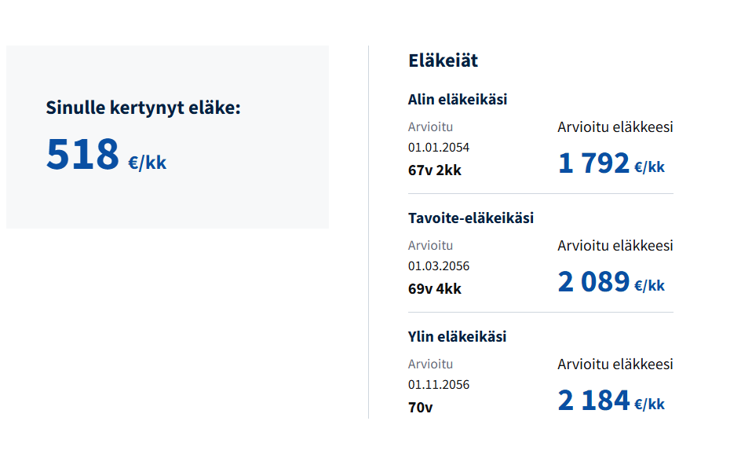
Just thinking that my minimum retirement age is 67 years, makes me shudder. How many of us can afford to be in the workforce for that long? How many of us will stay healthy enough to be in the workforce for that long, considering the different nature of jobs, such as physical work, work that requires concentration, or work that requires constant learning and internalization? How many employers want to keep elderly people working?
Will I even make it to retirement age? And if I do retire at 70, how many good years will I have left? What is the quality of life like, will I be able to make the most of retirement age or have I given my best years to my employer and the state?
I don’t know what the purchasing power of the euro will be in 2054 or 2056, if we still have the euro in use then, but my estimated pension amount is still a small amount. And I do understand that we are still privileged in Finland, because the state pays the pension in the first place. All this makes me think even more about the importance of passive additional income, so that my future livelihood and that of my family are secure.
Digital shopping
Personally, I use digital shopping a lot. I only go to traditional stores to buy everyday items and groceries. Large online stores have a wide selection of goods that are not easily found in brick-and-mortar stores. For example, I have bought books from Amazon.com because they have not yet been on the Finnish market.
When buying online, you need to consider other customers’ reviews, the reliability of the store, and the price-quality ratio. I think Amazon.com is a reliable store; everything I have bought there has matched the product description. The quality of products from Temu and Shein is not always as described. When buying from Chinese giant stores, you also need to consider ethics, copyright, and product safety, but for many, the cheap price of the product is more important. There may be significant differences in the price comparison between online stores and basic stores, because the sales numbers of large online stores are so much better that they can lower prices. Based on my own experience, I can say that if products have significantly large price differences, it is worth reading the product description again and checking the pictures to see if the product is really what it should be and are its quality and size what you are expecting.
The popularity of online stores has exploded because the product selection is diverse. In addition, buying and paying (online banking, Google or Apple Pay, Mobile Pay, etc.) has been made very easy. Everything can be ordered to the nearest mailbox, branch or home. Everything is delivered quickly and contactless, with just a couple of clicks. Shopping is not dependent on opening hours, transport connections or the weather. If you are in a good mood, you buy yourself something wonderful as a gift, if you are in a bad mood, you buy yourself something to cheer yourself up. Although receiving goods has been made easy, making complaints and returning goods is not always a straightforward process. I suspect this is partly due to dishonesty on the part of customers and partly due to dishonesty on the part of merchants. So, it is always worth reading the terms, reviews and experiences carefully!
Application in my field
I work in the laboratory sector, so I chose Terveystalo’s application to evaluate. I think the application is secure. First, you must identify yourself with a bank or mobile certificate, and the next time you use a PIN code or biometric identification. The application is handy and clear. The front page immediately shows information about any new or open events. It contains all your personal information, such as laboratory results, doctor’s appointments, occupational health information. The application uses a symptom map to guide the customer to the right service. And if you can’t find the information you’re looking for in the application, you can always contact Terveystalo by phone.
Digitalization and digital gap
Digitalization has progressed at a breakneck pace and recently the pace has only accelerated. Many people have not kept up with the development, either voluntarily or under duress. In an era when all information is freely available online and your entire life is on your smartphone, it’s easy to be left out if you don’t have the necessary skills or tools. Many services are only available online or in various applications. But if you have never owned a smartphone, if you don’t know what an app is or where to get one, if you don’t know or can’t search for information online, if there is no one to help you in the digital jungle – how will you cope?
Elderly people in particular don’t keep up with the development of digitalization. A good example of this is my grandmother. 20 years ago, there were no smartphones like there are now, but mobile phones were certainly developing in that direction. I gave my old touch-tone phone to my grandmother. She agreed to use it only to make and receive calls. She refused to use the other features of the mobile phone. Once a month, I had to delete all the messages that came to the phone because my grandmother was afraid to do it herself. What if she presses the wrong button and the phone breaks or the data is lost, etc.? Sometimes I feel like elderly people are afraid of digitalization and technological development in the same way that people were afraid of electricity in the late 19th century.
I also have a recent personal experience on the subject. I had to factory reset my phone. This act made me realize how much information we carry with us every day, how much of our daily life is dependent on our phones. It took me all of Sunday to reinstall most of the apps on my phone. I had to log in to each app. Many apps required strong authentication, but I couldn’t get my own bank to work because I don’t have a Finnish passport. I had to physically go to the bank (fortunately, the bank branch is in the same city, what a privilege!) and together with a bank employee, a new mobile key was created. Only then I was able to log in to other essential apps. Savonia authenticator app also didn’t work, meaning I couldn’t log in to Savonia’s systems. The instructions I found online didn’t help because they focused on setting up the app, but I had to reset the app. Once that problem was solved, I couldn’t log into this course area anymore. Fortunately, that problem was also solved with the help of Savonia’s Sanni e-commerce service. I still haven’t gotten all the applications working again. It took me a whole week and an awful lot of nerve cells to get things back to normal and my digital skills are up to date!
Digital Competence Test
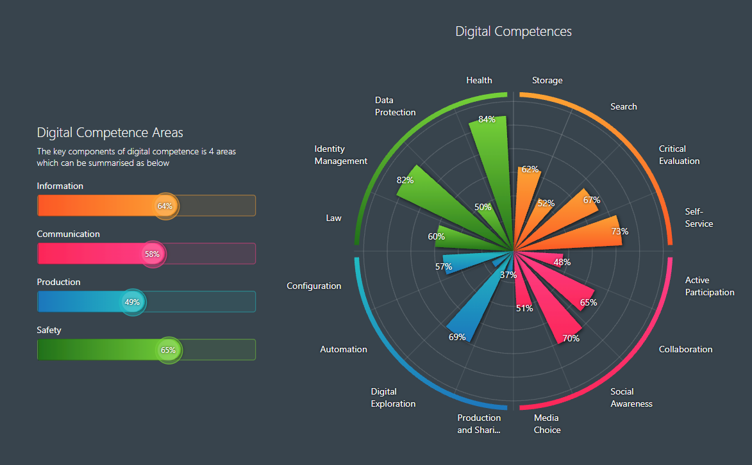
I have never taken a similar test before. According to the results, I have a lot of room for improvement in every area. My test results are below.
Self-assessment
While doing the assignment, I have learned more about Kela, OmaKela and Omakanta. It has been interesting to read other students’ articles, their comparisons, perspectives and experiences. I have learned that although I know a lot about digitalization and can/want to use digital services, the Digital Competence Test showed that I still have a lot to learn so that I can continue to use online services safely. While doing the assignment, I understood what a huge step digitalization has taken in a short time, how big of a part it is in our everyday lives, how unnoticed its importance has grown and how much knowledge and skills are required to survive in the digital jungle. In addition to all the above, I was left wondering how easy it is to be marginalized in today’s world, even though the whole world is in your pocket.
I commented: