DIGI CITIZEN
DIGI CITIZEN SERVICES IN FINLAND
KELA: There was a long time while I was living abroad and didn’t have anything to do with Kela or any of the citizen services in Finland. However, after I moved back to Finland and had my first child, these services became very familiar to me. Out front I got to say the social services that this country provides are outstanding!
The services that I have used by Kela are mostly related to families with children, but also, I’ve used the services for students and paid the semester fees for the healthcare for students in higher education. My experience with all the applications with Kela feels easy, same with the attachments needed, those can be uploaded as pdf’s or as picture files taken with your phone.
This assignment was a great reminder to finally order my European healthcare card; I was also able to order it for my children. This was extremely easy, and they will arrive in two weeks. I was also able to order the Finnish Kela-card for one of my children to replace a lost one.
OMAKANTA: I have used Omakanta regularly ever since moving back to Finland. I delivered both of my children in Finland and there are many health records for myself and for my family. I’ve noticed that Kanta-website has improved through the years, making it more accessible for one’s health information, but I am still looking for it to become more user-friendly. I do like the prescription renewal service through Omakanta, this is an excellent service since there is no need to start looking for phone numbers where to call or whether one should make an appointment for a doctor just to renew basic medications. I also appreciate the idea that all the medical information is collected on one site, whether it’s from the public or private. This allows nationwide interoperability and makes information sharing more accessible.
I accessed Omakanta service with strong identification with my bank credentials. I have uploaded a bank ID application into my phone, and it makes it super easy to scan QR-code at the kanta.fi website and verify login with one’s own phone.
KEVA: This was my first time visiting the Keva website. Thanks to this assignment, I was able to get a clearer picture of what my potential monthly pension from Finland might look like. I haven’t accumulated many working years in Finland yet, as I’ve spent nearly half of my life and working in the U.S.
According to Keva, I’m not eligible to retire at 63. My earliest retirement age would be 66 years and 10 months. I used their calculator to estimate my future pension based on continuing work in Finland until that age, as well as until age of 68. Given that nurses in Finland typically don’t earn very high salaries, and considering my limited Finnish working history, the difference in monthly pension between retiring at 66 years 10 months and 68 years is just over 100 euros.
Although the Finnish pension outlook is a bit discouraging, I’m fortunate to have also accrued retirement benefits from the U.S., which will help support me in the future.
This was a good eye-opening for the future to start understanding what to expect from retirement payments. Additionally, I believe it is important for everyone to save monthly on any retirement account, or other accounts such as funds, bonds, stocks etc., to take advantage of compound interest. I wish anyone would have told me that earlier or even better if high schools had taught this back in days.
COMPARISON OF AMAZON, TEMU AND PRISMA
While browsing Amazon, I noticed that many of the daily goods listed are identical to those found on Temu. I don’t personally prefer using Temu due to concerns about workers’ rights and ethical practices, but I was surprised to see that many of the exact products are also sold on Amazon, and they are even using the same product photos. For instance, a travel tote bag was priced at €26.90 on Amazon, whereas the same exact item was available on Temu for €17.24.
A similar situation occurred last Halloween. I saw the same decorative candy bucket sold at Prisma in Finland for €7.99, at Amazon for €4.99, and at Temu for only €2.49. While I understand that local stores like Prisma have higher operational costs such as rent and employee wages, these price differences are visible to customers and naturally affect their buying habits.
What I find ethically confusing is the general acceptance of purchasing from Amazon or Prisma, while buying from Temu is often criticized, even though the products often come from the same manufacturers. This raises important questions about consumer ethics and how much they really know about the supply chains behind online and store platforms.
In my experience, both Amazon and Temu have been reliable. I’ve had no issues with payments or returns on either platform. While Amazon may seem more trustworthy due to its established reputation and detailed product info, my personal experience with both has been smooth and hassle-free.
MAISA MOBILE APPLICATION
One digital service I use regularly is the Maisa app, which is the official customer portal for HUS (Helsinki University Hospital). I use it both in my professional role as a nurse and as a customer when managing healthcare matters for myself or my children. The app provides a centralized view of essential information such as appointments, test results, and healthcare professionals’ notes. What I appreciate the most is the secure messaging feature, which allows patients to easily communicate with doctors and other professionals involved in their care. The app is user-friendly and makes access to health services more convenient and transparent.
DIGITALIZATION AND DIGITAL GAP – RISKS AND CHALLENGES
As digital services become more common in healthcare, banking, and all public and private services, people who are not using virtual platforms are at risk of being left behind. The digital gap creates inequality, especially for elderly individuals, people with low digital skills, or those without access to updated devices or the internet. These individuals may struggle to book appointments, access health records, or apply for benefits. These tasks are increasingly handled online, and running errands on paper or visiting offices in person can take an extremely long time. Additionally, there are fewer resources available in public and private sectors to offer in-person assistance, making access even harder for those who are digitally excluded.
Often, the support system for the elderly comes from their own family members, but for those who are socially isolated or living alone without family support, the situation is especially difficult. These individuals may be completely excluded from the services they need. It is crucial that such people are assigned a support person who can help with digital matters, ensuring they are not left behind in an increasingly digital society.
DIGITAL COMPETENCY TEST
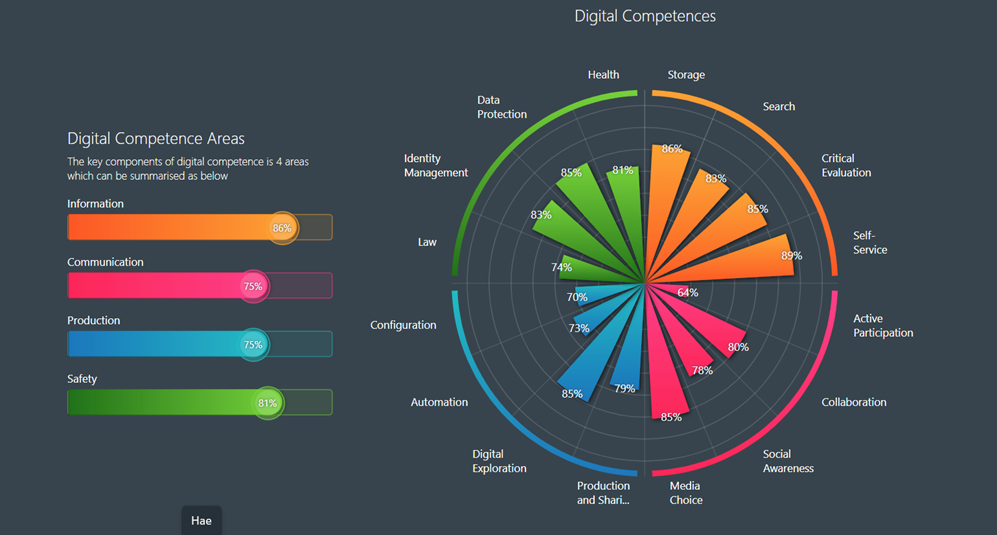
I completed the Digital Competence self-assessment, and it gave me helpful overview of my current strengths and development areas in digital skills. My highest score was in “information” (86%) and “self-service” (89%), which reflects my confidence in searching, evaluating, and managing digital information. This makes sense considering how often I work with patient records and health information systems as a nurse.
I scored 81% in “safety”, which shows that I’m aware of privacy, data protection, and digital well-being, these skills are especially important in healthcare. Both “communication” as well as “production” came in at 75%, indicating I have a solid foundation in using digital tools for teamwork and content creation. However, one area I know I use less actively is “active participation” (64%). For example, I rarely post or comment on social media. My main reason for this is that I’m cautious about how online content might affect me in the future, and I prefer to keep my photos and personal life private.
Overall, the assessment confirmed that I’m digitally competent in my professional environment but also reminded me that there’s always more to learn, especially as new technologies and tools continue to develop rapidly.
SELF EVALUATION
Through these assignments, I gained a deeper understanding of how digitalization is shaping not only healthcare, but everyday life. Writing blog posts helped me reflect on my own experiences with digital tools as a nurse and a consumer. I became more aware of the benefits and limitations of digital services, the importance of data protection, and the challenges faced by those at risk of digital exclusion. The digital competence self-assessment also encouraged me to recognize my strengths, such as information literacy and digital safety, while also identifying areas I could develop further, like becoming more comfortable with digital self-expression.
This course has also been a great experience in terms of building my own website, which is something I have never done before. Creating the blog has helped me step outside of my comfort zone and explore new digital tools in a creative way. Overall, the course has strengthened my confidence in navigating digital environments and highlighted how important continuous learning, the right attitude, and sense of curiosity are in helping us to ongoing changes in the digital world.
Here are the blogs I commented on:
Leave a Reply