Digi Citizen
We are living in a time of constant change, both in working life and at home. Digitalization is advancing rapidly and affects almost every aspect of our daily lives. As a digital citizen, I have broad digital skills and access to the internet through various devices, such as my computer, smartphone, and smart TV. In this blog post, I will share my thoughts and experiences about digitalization and its impacts.
Kela and OmaKanta
I am familiar with the services of Kela, and I use them regularly both for myself and for my family. I have European Health Insurance Card, which make travelling easier and enable us to access healthcare in other EU countries.
I also regularly use OmaKanta, a service where I can view my own health data. As a nurse, I also interact with OmaKanta professionally by transferring patient data from healthcare information systems to the service. This gives me a dual perspective both as a healthcare professional and as a private individual. OmaKanta makes it easy to manage personal health information, such as lab results and prescriptions.
Tracking Pension Accrual
Through Keva’s digital services, I have checked my current pension accrual. Based on my current earnings, I could not yet retire, but I plan to continue building my pension over the next 30 years. I appreciate that pension tracking is made simple and transparent through digital services.
Comparing Online and Local Shop Prices
I compared prices between online and local shops. For example, Tokmanni had garden sandals on sale for 5 €(regular price 10 €). The same type of sandals were available on Temu for 3 €. Temu also provided more detailed product information than Tokmanni’s flyer, including even the seller’s address.
Tokmanni’s website did offer more product details (such as material and size), but the country of origin was not listed. While Temu aims to appear trustworthy, there have been media reports raising concerns about product safety in Chinese online shops, since some materials prohibited in Finland may be used in manufacturing (source: Iltalehti). The amount of product information available varies greatly between different platforms.
My App of Choice: Tempore Onvire
I selected Tempore Onvire as an example of an app I personally use. I occasionally browse the app for temporary nursing jobs. The app shows available shifts, and I can mark my availability on a calendar. When suitable shifts appear, an administrator contacts me by text message.
Tempore Onvire makes it possible to work flexibly according to my life situation. It also provides an opportunity to earn extra income and gain diverse work experience. In my opinion, the app is user-friendly and a great example of how digital solutions can bring flexibility to working life.
The Digital Divide and the Challenges of Digitalization
Although digitalization brings many benefits, it also comes with significant risks and challenges, especially for those who do not use digital services. My father is a good example. He does not have a computer or a smartphone, and he used to handle his banking at a physical branch. Now that the nearest bank branch has closed, managing financial matters has become difficult. My sisters and I now handle his banking through our smartphones. Although my father does not mind, I personally believe that everyone’s finances should remain private, and no one should have to give up their privacy because of digitalization.
I see this as a worrying trend, especially in Finland, where there are many elderly citizens for whom using digital services is difficult or impossible. Banking services, in particular, should still be accessible in person without requiring people to travel long distances.
On the other hand, it is inspiring to see some elderly people in home care becoming enthusiastic about the digital world. Some read news on tablets or use apps like Google Lens to identify plants. This shows that with the right support and opportunities to learn, people of all ages can develop digital skills.
Another important issue is poverty. Not everyone can afford a smartphone for themselves or their children. This increases inequality, as digital skills and access to technology are essential in today’s society for education, work, and everyday life.
I am also concerned about how digitalization affects brain health, concentration, and memory. The constant stream of information can overload the brain. Our brains need downtime, moments of doing nothing, to recover.
Digital Competence Test
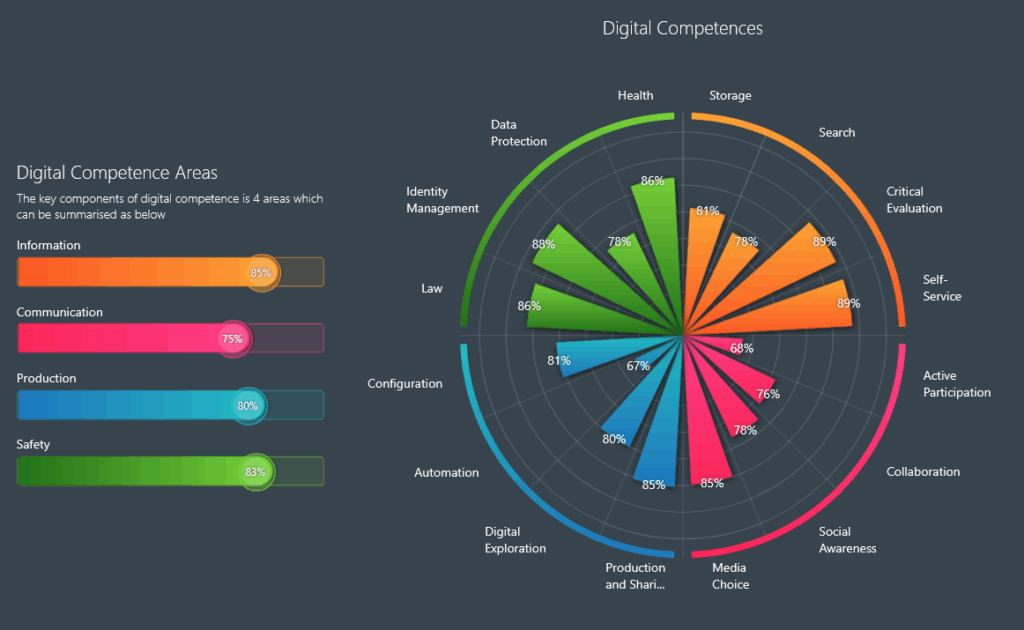
I also completed the Digital Competence Test (https://digital-competence.eu/dc/en/), which showed that I have good skills in using digital services and producing digital content. I find using apps quite easy. One area where I need to pay more attention is choosing strong passwords. However, I am very good at recognizing scam messages and am cautious about where I share sensitive data.
The test gave me confidence that my digital skills are at a good level, although I realized that I lack knowledge about areas such as coding. Fortunately, there are user-friendly tools available that can help with tasks like website updates.
Summary and Self-Reflection
Through these assignments, I once again learned new things about the impacts and challenges of digitalization. Digital services are a strong part of my daily life, as I use them extensively both at work and in my free time. Services like OmaKanta and Kela’s online platforms make managing personal and family matters easier. In working life, Tempore Onvire offers new opportunities for extra income and flexible working. On the other hand, the digital divide remains a real issue. The situation of elderly people, those in weaker economic positions, and the digitally excluded requires attention from society. Services must continue to be available in non-digital formats as well to ensure equality.
I also learned that from a consumer’s perspective, the quality and reliability of information in online shops varies greatly. It is important to approach different services critically and to carefully compare information. Overall, digitalization offers many opportunities, but it should not leave anyone behind. In the future, I hope that services will be developed to become even more accessible and that human aspects will continue to be considered alongside technological development.
Finally, I want to reflect on how algorithms are now highly optimized to hook users to their smartphones. I had to delete TikTok myself because I noticed it was becoming addictive. I do not want to be addicted to my phone. I would rather live in the real world. Still, some tasks, like cleaning, become more enjoyable when I play music, an audiobook, or a podcast through a smart device. On the other hand, this constant stimulation leaves less space for my own creative thinking. Nowadays, I also try to ensure that I sometimes allow myself to feel bored because boredom can be valuable too.
My Comments:
Tiina Ukkonen
Aunt Hanna’s site
Johanna’s site
Leave a Reply