Introduction: Digital Healthcare in my country
Digital citizenship refers to many aspects of society. In this blog, I will discuss my thoughts on the benefits, obstacles and risks of digital change in my field; healthcare. These risks are global, but I will start with a description of the national digitalization of healthcare and social security in my country.
The national health insurance system
In my country, a universal national health insurance system was implemented in 1995. This system aligned with the National Health Insurance Law, where all residents must enroll in one of four nonprofit health funds. The health funds provide a “standardized basket of essential services”; including primary care, hospitalizations, surgeries, maternity care, mental health, and many prescription drugs. These are funded by a progressive income-related health insurance contribution. Residents who are unemployed or of low income either do not have to pay or pay symbolic sums, supplemented by government revenue.
The national health ministry has promoted advanced digitalization of its health and social security services. The main nationwide initiative is for a FHIR-standard interoperability (via the 2024 Medical Information Mobilization Law), platform, such as the Innovative Healthcare Data Sharing System for seamless exchange between HMOs and hospitals, and extensive online portals at the National Insurance Institute enabling digital claims, contribution payments, HMO switches, and benefit applications, complemented by widespread adoption of telehealth, big data analytics, and AI-driven tools across the four health funds.
Harmonization efforts focus on creating unified data infrastructures, while aligning regulatory frameworks for machine learning-based technologies and promoting integrated access between health services (under the universal basket) and social security benefits, reducing fragmentation and enhancing efficiency in a system where health funds and the National Insurance Institute increasingly coordinate digitally for citizen-centric delivery.
Benefits of the Digital Transformation in Healthcare
I am a dedicated supporter of the digital transformation in healthcare and the internet accessible working environment, which facilitates collective action, communication and networking. Examples of such benefits include;
- Citizen mobility is fascilitated by the harmonization and continuity of data stored in national registries, allowing citizens the ability to relocate without medical care gaps and the freedom of choice of caregivers.
- It allows telemedicine which in turn; reduces pollution and saves work hours.
- Patients no longer have to carry to appointments their heavy folders of past medical reports and results, since this data exists in the electronic health record (EHR), with less risk of overlooking allergies or critical comorbidities.
- Doctors from all subspecialties can create a team consultation with ease via Teams and other GDPR-compliant group meetings.
- The digital transformation enhances the AI revolution which can be used to notify family physicians of critical test abnormalities or assist with reading pathology and imaging tests.
- Further benefits continue to unfold.
Digital Shops: An example of a digital shop provider on healthcare
PharmaMarket: https://www.pharmamarket.eu/en/ and Arzneiprivate https://www.arzneiprivat.de/?language_code=en are two samples of online phramacy shops in the EU.
European regulations https://europa.eu/youreurope/citizens/health/prescription-medicine-abroad/buying-medicines-online/index_en.htm state that the types of non-prescription medicine that you can purchase online depend on the EU country to which you want the medicine shipped. Different countries allow different types of medicine to be sold over the internet.
The EU recommends that before you attempt to make a purchase, you ought to check the national registers of the online medicine retailers to make sure that the retailer you are buying from is authorised in its home country to sell medicine online. Only the flags of the EU countries plus Norway, Iceland and Lichtenstein can be used. A logo displaying the EU flag, for example, would be fraudulent. In Arzneiprivat, a country flag appears on the upper right hand field, allowing only the products allowed by the specific country to be displayed. On the other hand, on the site Pharma market, no flag is displayed and medications with considerable potential side effects are listed, such as Hydrocrtisone cream, which ought to be sold with a pharmacists guidance. https://www.pharmamarket.eu/en/conforma-hydrocortisone-1-30-g.html
Thoughts and Comments on the Risks of Digitalization in Healthcare
Despite a wide range of benefits, some adverse effects and consequences of this transformation should not be overlooked. The digital environment affects both the consumers of medical services and the medical providers.

Digital transformation in healthcare can increase inequity; the example of online appointment scheduling
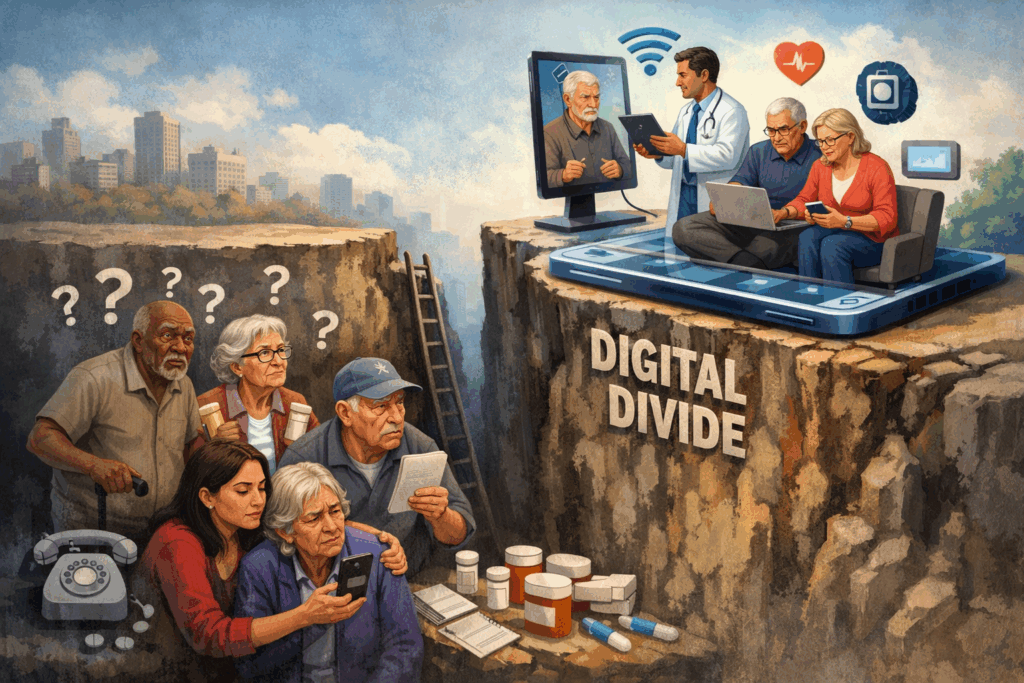
One service much in use in our healthcare is the online and mobile application for making physician appointments (either in person or via telemedicine). Much has been written on inequity in digital citizenship. In medicine, technological inequity stems from many factors including generational technological literacy gaps, language proficiency, technophobia, or lack of resources. Such inequity in the field of medicine widens existing gaps between newcomers, elderly individuals and medically challenged individuals. Unfortunately, these might well be the very groups with the highest need for medical access. Thus patients with poor skills or access to online appointment scheduling are at risk of delayed diagnosis and treatment.
Digitalization of health data carries critical privacy risks
Data protection and privacy are critical for safe implementation of digital services for social welfare and healthcare, such as Kanta and other national digital health services.
Digital transformation in healthcare and its effects on mental well-being and personal adaptation
Even if all safety and privacy measures are implemented in digitalized healthservices, many challenges remain. One example is the risk to psychological well-being. Individuals exposed to information from their medical records might experience anxiety and often report great concern for their prognosis.
Such fears may stem from a wide range of exposures, such as trivial blood test abnormalities which, when presented by a healthcare professional, can be put in context,, or anxiety stemming from reading the results of an MRI scan or pathology report, which ought to be presented by a specialist to allow gradual understanding and acceptance of consequences. Thus, health data must not only be strictly protected to ensure privacy but might need protection from unwanted emotional consequences.
The effects of the digital transformation on healthcare providers
Healthcare professionals themselves are often adversely affected by the free flow of digital information. Patients requesting a doctor’s appointment might have already accessed their test results online (either using AI tools to probe test results, or having discussed them with variably qualified individuals on social media). Such discussions might lead to preconceptions prohibiting open and adequate communication with their healthcare provider. As a physician, I have encountered patients who have discussed on social media the possibility of malignancy based on minor test abnormalities of no consequence. I have met with families starting an unnecessary process of assisted-living adjustment based on a brain MRI report stating: “mild cortical atrophy.” These are just a very few examples of the ways the digital transformation affects both the consumer and the provider in the health sector.
Summary and self-reflection
The digital transformation has affected most aspects of modern life. The participants of this course showcase the myriad aspects of how digitalization has affected everyday life. The course has offered me a first glimpse at blog design and WordPress. I have limited design skills, so was truly impressed with the outstanding designs my course colleagues displayed. It was also very interesting to read the thoughts of people from a wide range of fields, from finance, to web design and more.
In my blog, I focused on healthcare. In healthcare, digitalization helps decrease diagnostic and therapeutic errors, facilitates citizens mobility, and ensures fair and open access to medical data, which remains a citizen’s basic right. However, risks and challenges are considerable, and often overlooked. Being a wise digital citizen and consumer of health data will require a lengthy secondary process of techno-education to reduce inequity, and attention on behalf of leaders and social support systems, to alleviate misinterpretation and adjustment to exposure.
Here are the results of the digital competence test required by this course: https://digital-competence.eu/dc/en/report/?uri=dbfa048d245151c31f2b6c086243cafb