
Kela
Kela is an independent public institution responsible for managing the basic social security of people living in Finland. Kela helps in various life situations. Kela’s customers include all residents of Finland as well as those living abroad who are covered by the Finnish social security system.
I have also personally benefited from Kela’s services in different situations during adulthood. During my studies at university of applied sciences, I received student financial aid and housing allowance from Kela. During my studies, I also had to take out a small student loan, part of which Kela compensated when I graduated on time. I have two children, so I received parental allowance and childcare allowance for both. Kela also provides a maternity package to all Finnish residents, which we received for both of our children. Currently, Kela pays us child benefit, which is a benefit entitled to every Finnish resident. Our whole family also has a European health care card.
OmaKanta
OmaKanta is a national online service where you can view your own health information at any time. In OmaKanta you can read treatment-related records, renew prescriptions, check the results of laboratory and X-ray tests, review vaccination information, and much more. You can securely log in to OmaKanta using your personal online banking credentials through kanta.fi website.
Keva
From Keva’s website, I found out that I still have quite a bit of my career ahead of me. My earliest retirement age is 67 years and 9 months. The estimated pension amount at that time would be about 60% of my current income. If I continue working until the age of 70, my pension will increase nearly 10%. I was surprised that just a couple of extra years would result in such a significant increase. However, I have to admit that the idea of working until 70 is not particularly appealing.
Online shops
I personally usually prefer actual stores. I turn to online shopping only when I can’t find what I’m looking for in physical stores. Or if I find that an item is a lot cheaper online. For example, buying clothes online can be tricky because it’s difficult to estimate the size. Mistaken purchases happen easily, and the hassle of returns is enough of a burden that I often don’t bother returning the items.
For hotel bookings I prefer to use the hotel’s own website directly. When traveling within Finland, we typically choose Scandic hotels, and the booking is always cheaper when done directly through the Scandic website compared to platforms like Trivago or Booking.com. While the mentioned websites are likely reliable, I still tend to favor the original service provider’s site.
Terveyskylä
Terveyskylä (Health Village) is a Finnish online health service portal offering information on various health-related topics, medical specialties and healthcare services in Finland. It’s developed by university hospitals in Finland. The platform serves as an important resource for both healthcare professionals and the general public.
For my line of work Terveyskylä provides detailed descriptions of radiology and imaging procedures. You can access information on various diagnostic imaging techniques, such as X-rays, MRI’s, and CT scans, as well as the related patient care considerations. The site provides patients with easy-to-understand information about procedures and imaging they may undergo. You could direct patients to Terveyskylä for pre-examination education, helping them feel more comfortable and informed before undergoing radiological procedures.
Digital Gap
The digital gap refers to the divide between people who have access to digital technologies, such as the internet and virtual services, and those who do not. This gap can be influenced by factors such as age, financial resources, education, or geographical location. The digital divide can lead to inequality, for example, in terms of job opportunities, access to information, and availability of services. Without access to digital services, people may be excluded from important societal functions and opportunities.
Today a lot of healthcare services are digital, such as online appointment booking, telemedicine or online health records. People without access to these services may face difficulties in obtaining timely care or information about their health, leading to delays in diagnosis or treatment. Additionally, those who cannot utilize digital healthcare services need to invest more time and resources in physical visits and phone consultations.
All in all, the digital gap can increase inequality, with some benefiting from faster and more convenient digital solutions, while others are left without these opportunities.
Digital competences
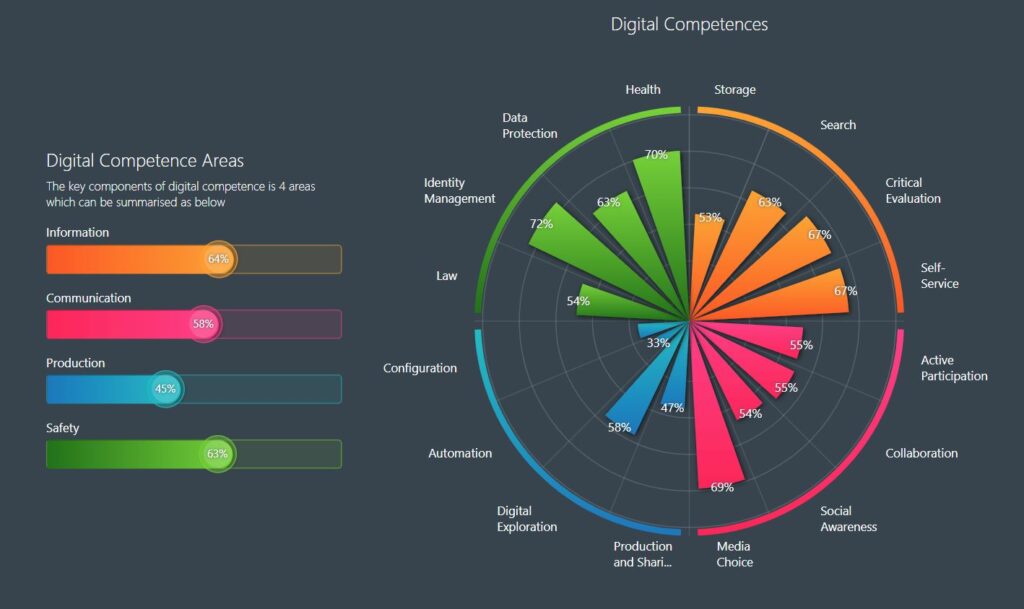
The results of my digital competence test below
Self evaluation
As a digital citizen, I recognize that I have good digital skills and access to digital tools, but I also see areas where I could improve.
One of my strengths lies in digital communication. I frequently use digital platforms like e-mail, messaging apps, and social media to collaborate with colleagues, connect with friends, and manage family interactions. I am active in learning and adapting to new technologies, which helps me keep pace with advancements. I’m also aware of the importance of digital etiquette and I practice it by being respectful in both personal and professional contexts.
While i feel confident in my abilities as a digital citizen, I also see areas for growth, particularly in digital health. In terms of wellness, I find myself spending long hours on digital devices. I could balance screen time better to maintain both physical and mental well-being, also keeping in mind that i am setting an example for my kids.
I commented
One response to “DIGI CITIZEN”
-
Thank you for your interesting writing! I was especially delighted by your thoughts on digital well-being. I also spend too much time on digital devices and would like to learn how to be unreachable from time to time.

Leave a Reply