DIGI CITIZEN
1. Kela and Its Digital Services
The Social Insurance Institution of Finland, known as Kela, is an independent public organization responsible for implementing Finland’s social security system under the supervision of the Finnish Parliament. Its task is to provide various basic social security benefits for citizens, including pensions, family benefits, student financial aid, health insurance reimbursements, and housing-related benefits.(Eläketurvakeskus n.d.)
Kela’s operations are mainly funded by state resources. The organization has its own administration, which is monitored and supervised by representatives appointed by the Parliament. Kela’s aim is to ensure that everyone receives the social security benefits they are entitled to in a timely, smooth, and equal manner. (Eläketurvakeskus n.d.)
Digitalization has significantly changed Kela’s services, and nowadays a large part of customer interaction takes place online. Through Kela’s electronic services, customers can apply for benefits, submit required attachments, follow the processing of their applications, review decisions, and communicate securely with Kela. Online services make accessing benefits easier and reduce the need to visit Kela offices in person. (Eläketurvakeskus n.d.)
European Health Insurance Card
The European Health Insurance Card is free of charge and can be obtained by people who are covered by Finnish health insurance or whose healthcare costs are the responsibility of Finland. The card is valid in EU and EEA countries, as well as Switzerland and the United Kingdom. It allows travelers to receive medically necessary healthcare under the same conditions and at the same customer fees as local residents. The card is especially useful if a person becomes suddenly ill or has an accident while travelling abroad. (Kela 2026.)
My family has personal experience of the benefits of this card. We travelled to Hungary when our first child was under two years old. During the trip, our child developed a high fever, and we needed to seek medical care. Thanks to the European Health Insurance Card, we were able to access a public hospital quickly and were then referred to a children’s hospital. Our child received the necessary treatment promptly, and we did not have to pay additional healthcare costs. This experience helped me understand how important and valuable the card can be, especially for families with children travelling abroad.
However, it is important to remember that the European Health Insurance Card does not replace travel insurance. The card provides access to public healthcare services in the destination country, while travel insurance may cover costs such as private healthcare, trip cancellations, or possible transportation back to Finland. (Kela 2026.)
Applying for the card is easy through OmaKela, and it can also be ordered for children (Kela 2026). As a mother of two young children, I consider it important that my whole family’s healthcare protection is arranged before travelling. Our trip to Hungary showed in practice how valuable the European Health Insurance Card can be in an unexpected illness situation.
Omakela as Part of Digital Services
OmaKela is Kela’s main electronic service, allowing customers to manage their Kela-related matters easily online whenever it is most convenient for them. The service can be used on both computers and mobile devices. Login takes place securely through Suomi.fi identification, for example by using online banking credentials, a mobile certificate, or an electronic identity card. (Kela 2026.)
In OmaKela, users can manage many different matters, such as applying for benefits and allowances, submitting attachments electronically, reviewing decisions and other documents sent by Kela, and reporting changes in their life situation. Users can also update their contact information, send messages to Kela specialists, and follow the progress of their applications. (Kela 2026.)
The front page of the service provides an overview of unfinished applications, new decisions, and other important notifications. This makes monitoring personal matters easier and reduces the need for paper documents. (Kela 2026.)
My evaluation of Kelas`s Services
Among Kela’s services, I mainly use OmaKela, where I can manage my affairs electronically, check my personal information, and read decisions I have received. I also use medicine reimbursements, which reduce the cost of prescription medicines at pharmacies. After the birth of my children, I received parental benefits during parental leave, and my family also receives child benefits for children under 17 years old. When necessary, I can also receive health insurance reimbursements, such as sickness allowance or travel reimbursements. In addition, I use the European Health Insurance Card, which allows me to receive necessary healthcare during temporary stays in EU and EEA countries.
In my opinion, Kela’s digital services are clear and easy to use. Managing matters can be done regardless of time and location, which saves time. However, the services require digital skills and strong identification, which may create challenges especially for elderly people or those who use digital services less frequently.
2. OmaKanta and Accessing Personal Health Data
OmaKanta is a nationwide electronic service maintained by Kela and is part of the Kanta Services. It allows citizens to view their own health and wellbeing information and monitor their health status. The purpose of the service is to make health information more accessible and encourage people to participate actively in managing their own health. (Kela 2026.)
OmaKanta contains a wide range of health information, such as electronic prescriptions, laboratory test results, patient records, and information about healthcare visits. Users can also save their own wellbeing information in the service, such as blood pressure, weight, and blood glucose monitoring results. In addition, users can create a living will and an organ donation will through the service. (Kela 2026.)
I accessed the service through the Kanta.fi website by using Suomi.fi identification and online banking credentials. Strong identification ensures that health information is protected and available only to the user themselves. The service can also be used through a free mobile application (Kela 2026).
In OmaKanta, I was able to find my current and previous prescriptions, laboratory test results, notes made by doctors and nurses, vaccination information, and details of the healthcare units where I have received treatment. As a laboratory technician, I find it especially useful that laboratory results are easily available. This allows me to review them without needing to contact healthcare services separately, and it supports patients’ ability to follow their own health status.
My Evaluation of OmaKanta`s Services
As a mother of two young children, I consider it especially important that I can also access my underage children’s health information as their guardian through OmaKanta. The service makes it easier to monitor prescriptions, vaccinations, and healthcare visits, which makes managing children’s health matters more convenient.
In my opinion, OmaKanta is a very functional and useful digital healthcare service because it is available around the clock and all important health information can be found in one place. This saves time for both patients and healthcare professionals. From the perspective of digital citizenship, the service promotes electronic communication, access to information, and the opportunity to actively participate in managing one’s own health.
However, one challenge is that not all users are familiar with electronic services or understand the medical terminology used in health records. Overall, OmaKanta is a secure and easy-to-use service that I use regularly to check my own and my children’s health information, such as prescriptions, laboratory results, and other healthcare-related details. My experiences with the service have been very positive.
3. Pension Estimate in Keva`s Service
Keva is responsible for pension matters for public sector employees in Finland. Its customers include employees of wellbeing services counties, municipalities, the state, the Evangelical Lutheran Church, Kela, and the Bank of Finland. In addition to managing pension matters, Keva supports occupational wellbeing and work ability by providing expert services for employers and promoting longer working careers. (Keva 2026.)
As part of this assignment, I explored Keva’s website and its electronic pension services. This helped me understand how the Finnish pension system works in the public sector and what kinds of digital services pension providers offer to their customers.
I work as a nurse and laboratory technician in the private sector, so my own pension matters are managed by the pension insurance company Varma rather than Keva. Therefore, I examined my own pension estimate through Varma’s online service using strong identification. In the service, I was able to review my employment and income information and estimate the amount of my future old-age pension.
In my opinion, electronic pension services are clear and useful. Reviewing pension information online is easy and does not require contacting customer service. These services help users understand how their career, income level, and years of employment affect their future pension amount.
Although retirement age is still far away for me, I found this task useful. Looking at my pension estimate helped me understand how my pension security is formed and how the length of my working career affects my future financial situation. It also reminded me of the importance of maintaining work ability throughout my entire career.
Overall, the experience was positive. I was surprised by how easily pension matters and pension estimates can be reviewed electronically. Digital services make the pension system more transparent and help people plan their financial future well before retirement age.
4. Evaluation of an Onlone Store: Booking.com and Car Rental
I chose Booking.com as the digital service to evaluate from the perspective of digital commerce. I have used Booking.com regularly, especially for planning city trips and booking accommodation. Through the service, I have found accommodation options in different destinations and easily compared prices, locations, and customer experiences. Most recently, in May, I used the service when planning a trip to Scotland and found affordable flight options through it.
For a more detailed evaluation, I chose car rental services offered through Booking.com because this is a service that is less familiar to me. I have never personally rented a car through a digital service, so I wanted to explore how clearly this type of service works and what kind of information is provided to consumers before making a purchase decision.
I examined car rental options from Kuopio Airport. One available option was, for example, a Skoda Scala or a similar medium-sized car for one day. The service provider was Avis.
The price of the car rental through Booking.com appeared competitive compared with prices offered by local car rental companies. One of the main advantages of digital services is that users can compare offers, prices, and conditions from several different companies in one place. This makes decision-making easier and saves time compared with searching for information from each service provider separately.
Based on my own experiences with hotel bookings, I consider the possibility of comparing prices one of the most important benefits of Booking.com. The service allows users to quickly see different options and choose a solution that fits their budget and personal needs.
Evaluation of the Information Provided to Consumers
Booking.com provides consumers with comprehensive information before making a reservation. In the case of car rental, the service provided information about the size of the vehicle, number of passengers, luggage capacity, transmission type, pick-up and return locations, and rental conditions. Information about insurance, excess fees, cancellation policies, and possible additional services was also available.
In my opinion, the information was presented clearly, allowing consumers to form a good overall understanding of the service before making a decision. Customer reviews are especially useful because they help users evaluate the reliability of the service provider.
Reliability
I consider Booking.com a reliable digital commerce service. I have personally used it several times for hotel bookings, and my experiences have been positive. Reliability is supported by clear booking information, secure payment methods, customer reviews, and the possibility of checking details about service providers.
In this case, the car rental provider was Avis, which is an internationally recognized car rental company. Although I do not have personal experience with renting a car, the information available through the service gave me a good understanding of what the booking process involves.
However, consumers should always carefully read information related to insurance, excess fees, and possible additional costs before completing a reservation
My Evaluation
In my opinion, Booking.com is a good example of a digital service that makes everyday life easier and supports the purchase of travel-related services. Based on my own experiences, the service has been easy to use, especially when booking hotels and planning trips.
Examining car rental services also showed that the platform provides comprehensive information about services that users may not have used before. Digital commerce platforms can therefore make purchasing decisions easier by providing comparison opportunities, transparent information, and customer experiences in one place.
5. Digital Service in My Own Field: SYNLAB Laboratory Manual
I chose SYNLAB’s laboratory manual as the digital service to evaluate because I work as a laboratory technician and use it in my daily work to find information related to laboratory tests. The laboratory manual is a digital service in my field that contains test-specific information, sample collection and handling instructions, patient instructions, sample transportation guidelines, and information about test abbreviations. The digital format enables fast information retrieval and reduces the need for paper-based instructions (SYNLAB n.d.).
I use the laboratory manual especially when I need information about less frequently performed tests or when I want to confirm instructions related to sample collection, sample tubes, storage conditions, or transportation. The service supports daily laboratory work and patient safety because correct procedures help ensure reliable test results.
The reliability of the service is increased by the fact that SYNLAB Finland operates as a FINAS-accredited laboratory according to the SFS-EN ISO 15189 standard. The laboratory manual is updated with information about changes in test selections, methods, and reference values to ensure that users have access to the most up-to-date instructions possible (SYNLAB n.d.).
However, as a digital service, the laboratory manual also has some challenges. Its use depends on functioning information systems and a reliable internet connection. Information is not always updated immediately, and the medical terminology used in the instructions can be difficult to understand without professional knowledge of laboratory science. Even as a professional, I have sometimes needed to contact SYNLAB’s professional support service when instructions have been unclear or when there have been conflicting details.
Overall, I consider SYNLAB’s laboratory manual a useful and reliable digital tool in the laboratory field. It speeds up information retrieval, supports daily work, and contributes to high-quality laboratory services and patient safety. However, effective use of the service requires professional competence and, when necessary, the ability to seek support from experts.
6. Digitalization and the Digital Divide
Digitalization has rapidly changed working life and public services, but not everyone is able to benefit from new digital services in the same way. The digital divide does not only refer to whether a person has access to digital devices and an internet connection, but also to whether they have the skills to use these technologies effectively in their everyday life and work. (Tuomivaara & Alasoini 2020, 9–10.)
People who do not use digital services or who have weaker digital skills may face the risk of being excluded from services and social participation. As more and more services move online, a lack of digital skills can make it more difficult to find information, communicate with authorities, and use different types of services. Digital competence is therefore becoming increasingly important for people’s opportunities to participate in working life and society. (Tuomivaara & Alasoini 2020, 11–13).
The report also highlights the perspective of working life: digital skills influence people’s ability to adapt to changes in working environments and take advantage of the opportunities provided by digitalization. Weaker digital skills may make it more difficult to adopt new digital tools, develop professional competence, and succeed in working life. Digital divides in workplaces can increase inequality between employees and reduce some employees’ opportunities to benefit from digitalization. (Tuomivaara & Alasoini 2020, 11–13.)
The digital divide can increase inequality between those who are able to benefit from the opportunities provided by digitalization and those who have fewer possibilities to do so. The challenge is not only access to technology, but also differences in people’s knowledge, skills, experiences, and motivation to use digital services. Digital divides are also related to how well individuals are able to benefit from digitalization and strengthen their position in society. (Tuomivaara & Alasoini 2020, 16–19.)
7. Digital Competence Test
Results
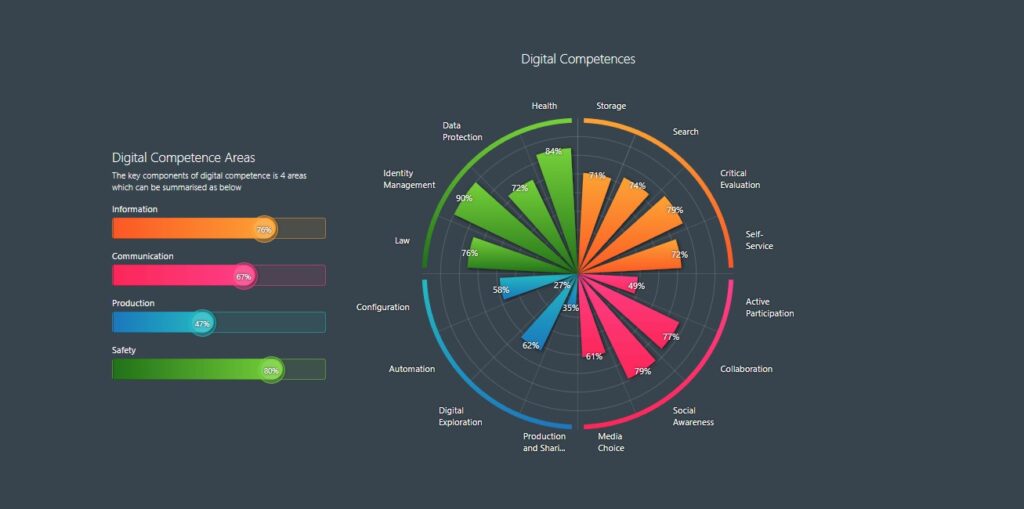
In the Digital Competence Test, I achieved an overall score of 67%, which corresponds to level 4 (intermediate). The result indicates that I am able to use digital services independently and solve some more challenging problems related to digital technologies.
My strongest competence areas were identity management (90%), health-related digital competence (84%), and social awareness (79%). These results are also reflected in my everyday life, as I actively use digital services both at work and in my personal life.
The areas where I have the most room for improvement were automation (27%), content creation and sharing (35%), and active participation (49%). I consider these results realistic because I have less experience with programming, automation, and producing digital content.
8. Self-Reflection
Completing this assignment made me reflect on how important digital services are in my everyday life. As a Registered Nurse and Biomedical Laboratory Scientist, I use various information systems daily in my work, but during this assignment I realized how essential digital services are also in my personal life. In particular, OmaKanta and the European Health Insurance Card are services that have provided practical benefits for my own family.
As a mother of two children, I appreciate the possibility of managing healthcare-related matters quickly online and easily monitoring my own and my children’s health information. The illness situation we experienced during our trip to Hungary demonstrated in practice how important digital services and electronically accessed benefits can be for everyday safety and security.
The assignment also made me think about people for whom using digital services is not equally easy. The digital divide is not only about lacking devices or internet access, but also about differences in skills and opportunities to benefit from digital services.
Overall, this assignment strengthened my understanding that digital skills are an essential civic skill in today’s society, both in working life and during leisure time.
You are welcome to visit my blog as well:https://blogi.savonia.fi/jalkanenheidi/
I have left comments on the following three interesting blog posts:
References
Booking.com n.d. Autonvuokraus kaikenlaisille reissuille. https://www.booking.com/cars/index.fi.html?label=msn-mUA1_phYiW_ZGlp1cp8Uhg-80195816981665%253Atikwd-80195992122177%253Aloc-65%253Aneo%253Amte%253Alp148534%253Adec%253Acid518941068%253Aagid1283131369234981%253Aclkidd40f5669128916c064e93c0296ba3aa1&aid=2369661&adplat=cross_product_bar&selected_currency=EUR&sid=377c00c86fd434ccd70e77244eb4d1f5. Retrieved 20.7.2026.
Eläketurvakeskus n.d. Kansaneläkejärjestelmä ja Kela. https://www.etk.fi/suomen-elakejarjestelma/hallinto-ja-valvonta/elakejarjestelman-toimijat/kansanelakejarjestelma-ja-kela/. Retrieved 20.7.2026.
Kanta 2026. OmaKannan palvelukuvaus. https://www.kanta.fi/documents/20143/120102/OmaKannan+palvelukuvaus+2026.pdf/febae214-5b2e-f661-29e4-044c8f66f0af?t=1781613954860. Retrieved 20.7.2026.
Kela 2026. Asiointipalvelu OmaKela. https://www.kela.fi/omakela#mika-on-omakela. Retvieved 20.7.2026.
Kela 2026. Eurooppalainen sairaanhoitokortti. https://www.kela.fi/eurooppalainen-sairaanhoitokortti . Retvieved 20.7.2026.
SYNLAB n.d. Tutkimukset. https://www.yml.fi/laboratoriokasikirja. Retvieved 21.7.2026.
Tuomivaara, S. & Alasoini, T. 2020. Digitaaliset kuilut ja digivälineiden erilaiset
käyttäjät Suomen työelämässä.https://www.julkari.fi/server/api/core/bitstreams/2d875b58-267c-4936-98c1-f5f7ffa176aa/content. Retrieved 22.7.2026.
06.09.2026 at 12:06
Hey! I really liked your thoughts about the importance of digital skills. I agree that digitalization makes everyday life easier in many ways, but it can also create challenges for people who are not familiar with digital services. I also think it is important to make sure that everyone has the opportunity to use digital services, regardless of their digital skills. This will also be a challenge in the future when planning and developing service systems, as we need to ensure that everyone has equal access to services.
06.09.2026 at 12:51
Here is my blog: https://blogi.savonia.fi/sinisalonen/ if you would like to have a look and leave a comment.