

KELA
KELA, or the Social Insurance Institution of Finland, is Finland’s social security authority. It is responsible for granting and paying many different benefits in Finland. These benefits, which are paid from public funds, include student financial aid, housing allowance, and national pension -some to mention. KELA also covers part of citizens’ medication costs.
As a full-time employee, I use KELA services relatively infrequently. I pay a university student health care fee because I study at Savonia University of Applied Sciences. My family is also familiar with KELA’s student financial aid and military service allowance services. I don’t have any personal experience of using online forms for various applications, but I have heard from family members that there is room for improvement in their functionality. Some of the information required on the forms is unclear, which often leads customers to call KELA’s customer service.
As a part of nationwide digitalised public service I receive only digital notifications and letters from KELA. This is time saving, becouse the digitally signed official information is transferred you directly without waiting letters from post.
European Health Insurance Card entitles you to medically necessary treatment in another EU or EEA country or Switzerland under the same conditions and at the same prices as local residents. I obtained mine a long time ago. It is particularly useful if you travel in Europe even occasionally and do not have private travel insurance that would cover healthcare costs. One you have applied the card, it keeps renewing on two years cycle.
OmaKanta
Omakanta is a Finnish online service maintained by the Social Insurance Institution (KELA). It is a centralized healthcare service, whose main advantages include access to all important health information from a single service. It also significantly reduces the need for paper printouts and sending letters.
I successfully logged in to the service using my bank credentials with Two-Factor Authentication (2FA). I usually always use strong authentication with my bank credentials, even though I have a chip in my national ID card. However, not having a card reader at home makes it clumsy to use for authentication. An even faster way than using my bank credentials would be to use the mobile ID linked to my phone’s SIM card, but I haven’t started using it yet because my mobile operator charges separately for its use.
I have mainly used OmaKanta to keep track of my prescription medications and vaccinations. All my visits to healthcare services are also recorded there with epicrisis. I can easily specify which parties my health information can be shared with.
There have been discussions with friends about the usability of the service, and it has sometimes been noted that some information is difficult to find without guidance. The OmaKanta service seems to be undergoing a revamp at the moment. The changes will improve and clarify usability, which is certainly a welcome improvement, at least for the elderly.
KEVA
I am covered by military pension legislation, so my retirement age differs from the normal retirement age in public administration. At present, I will probably retire at the age of 57. The accrual of military pension cannot be tracked using KEVA’s online service, as its calculation is greatly affected by earnings over the last 10 years. The amount of my pension will therefore only be determined closer to retirement age. The target level for a full military pension is 60% of the pensionable salary.
On-line accommodation services -Hotels.com
I have recently been using different apps to find accommodation services when traveling. I have compared Trivago, Hotels.com, and booking.com. I have noticed that there are often differences in prices for the same destination, even when selecting rooms of the same standard from all services. I am fairly certain that my search history also affects the results. The descriptions of the destinations have been accurate, but there can be significant differences in prices. Services often also include various service fees, which are only visible at the time of payment. I have sometimes been able to get the best price by asking at the hotel reception.
All three services seem to favor regular use. This makes it possible to get quite significant discounts on subsequent bookings. Comparing services can be frustrating and time-consuming, but it can save you money. I believe that people often end up using a particular service based on their user experience, in which case the final price of the accommodation service is not so important. My choice to use this certain service leans to user experience and “loyal customer” rewarding program.
Digitalization and digital gap
In developed societies, digital services are often the focus of important and necessary functions for citizens. For example, taxation, healthcare, and real estate services in Finland have largely shifted their operations to electronic services. In my own experience, I have found that ten years ago, these services were still somewhat clunky and difficult to use, but they have improved considerably.
With digitalization, the number of local public service points has decreased significantly, and people are increasingly being directed to use electronic services. Even if a physical service point exists, it may not be possible to handle all the necessary services face-to-face with a customer service representative. There may be significant delays and additional costs if matters cannot be handled through digital services. Relatives or other people can help with the use of digital services, but this may pose a risk of personal data, such as bank ID, falling into the wrong hands. Fortunately, various non-governmental organizations organize digital clinics specifically for the elderly, for example.
Access to information can also be challenging if virtual services are not used. Outside of work, social communication and contact with relatives and friends now takes place almost entirely through various communication platforms. Intentionally opting out of digitalization can also lead to social isolation.
Digital Competence Test
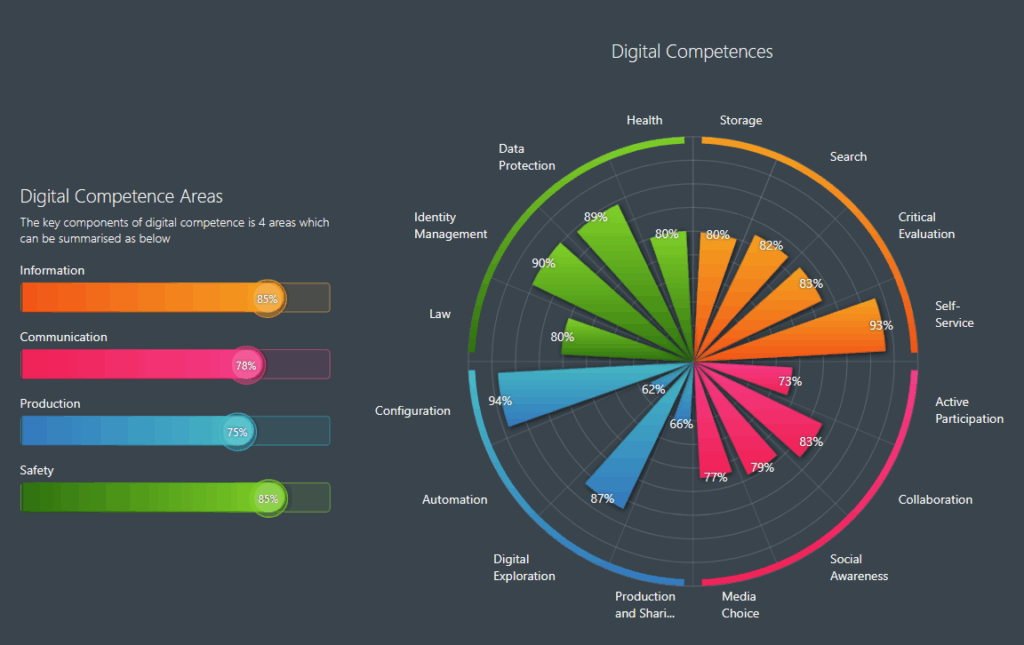
I took the Digital Competence Test online and got a result of 6/8 – Advanced. The result matched my own assessment of my skill level, but it also gave me some ideas about areas where I could improve. My weakest area was Automation, where I scored 62%. The recommendations provided useful tips on how I could improve my skills in this area, for example by interviewing software developers. This would also support the development of my own professional skills.
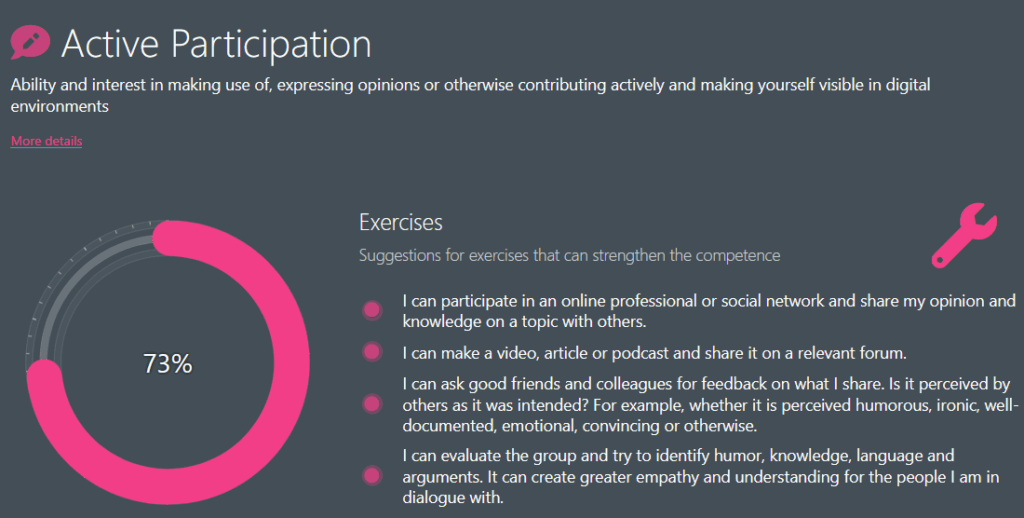
My best area was Active Participating. The result was 73%, which corresponds well with my own view of my digital participation. One good idea for development was to participate more in producing content for our intranet and updating information. This would certainly be useful for others at my workplace as well.
Learnings from assigments
When considering these tasks, I have noticed that even though I have good digital skills and consider myself to be up to date, this is not necessarily the case for everyone. It is particularly important in the digitalization of key public services that attention continues to be paid to teaching and communicating about them. The world of citizens is also more complex than before due to digitalization, but it is also easier when the basics of digital skills are in good shape.
Blogs I have commented:
Hi Jani,
I agree that it can be risky to to hand you personal and classified data and accounts to relatives just to get mandatory things done online. There are many examples of where this has lead to an empty bank account or worse.
Thank you for a clear and well-structured reflection on digital citizenship and public digital services. I found your discussion on KELA and OmaKanta particularly interesting, especially the way you described different authentication methods and how practical issues, such as the lack of a card reader or extra costs for mobile ID, can influence service use. Your perspective on KEVA and military pensions added an important example of how digital systems do not always cover all citizen groups equally. I also appreciated your reflections on digital accommodation services and user loyalty, as they highlight how user experience often shapes digital choices more than price alone. Your discussion on the digital gap and the risks related to relying on relatives for digital assistance raises an important point about data security and social exclusion. You can also visit my blog at: https://blogi.savonia.fi/heidiojala/