Kela
I use the services of Kela (The Social Insurance Institution of Finland) when I get medicines from the pharmacy for myself or my children. Due to chronic illnesses, we receive Kela compensation for our medicines. I use the Kela card when dealing with the pharmacy. We also receive Kela compensation when we take our children to a private medical clinic for a doctor’s appointment. And that’s what I receive too. As a university student, I also pay the annual healthcare fee for university students. I have to pay this even though I don’t use the services of the Finnish Student Health Service (YTHS). I work at a hospital and, as a university student, I get a meal at the student price in the hospital restaurant by showing my student card, thanks to Kela’s meal subsidy.
Back when I was studying for my first degree as a young person, I received Kela’s study grant, housing allowance, and student loan. When the children were born, I received Kela’s maternity package, maternity allowance, which is now parental allowance. I took care of the children at home for their first couple of years, and during that time I received home care allowance. When the children started school, I worked reduced hours for the first year and received partial care allowance. Nowadays, we receive child benefit for our children.
All our family members have a European Health Care Card. I order these after I suddenly fell ill in Spain a couple of years ago, and had to be hospitalized there. With the European Health Care Card, you can receive medically necessary treatment in another EU or EEA country, Switzerland, the United Kingdom, or Northern Ireland. Because of the card, you only have to pay the local co-payment, and the rest of the costs are billed by the treating country to Kela. Although we always have valid travel insurance when traveling, I have still kept the European Health Care Cards with us abroad after the experience in Spain.
OmaKanta
Omakanta is a national online service where you can view your own health care data. You can log in using electronic authentication. I personally use bank codes. I regularly visit the OmaKanta to check laboratory results, healthcare entries, and prescription details.
Keva
I checked my pension estimate on Keva’s website. I can retire at the age of 66 years and 5 months. However, if I work 2 more years, my pension would increase by about 200 euros. If I work until the age of 70, my pension would increase even further
Digital shop
I visited Amazon.com. I have never ordered anything from Amazon.com. However, the website looks clear and visually stylish. Different categories are clearly exposed, and products can be conveniently filtered. While looking at women’s clothing, I found a vast amount of products. The price range was from very affordable to quite expensive items. When I opened the page, it was a little bit confused how many pop-up windows showed up. The privacy notice is available when logging into the service. Amazon.com is known around the world, and I think it’s quite reliable. The thing I don’t like when products comes from different countries, is that the returning is difficult. Usually, if I order clothes from a digital shop, I use Zalando.fi. I have also tried Temu.com once. Temu’s price level is very low compared to local shops. But I wasn’t satisfied with the quality. Also the sizes and materials of products wasn’t good. Trivago and Booking.com are the sites, I have used several times for travelling. From the sites you can sometimes find hotels with cheaper prices and hotels are quite easy to change if needed.
Terveyskylä.fi
Terveyskylä.fi is a familiar digital healthcare service to me, which I use regularly in my work as a nurse. Terveyskylä offers virtual services for citizens, patients, and professionals. The virtual houses are open to all people and they provide information and support related to health, diseases and well-being. The TerveyskyläPRO service offers information and digital tools for healthcare professionals. The Omapolku service includes digital care pathways for healthcare. At our clinic, we have developed a specialized digital care pathway for our patient group. Our digital care pathway offers information, support, and guidance in dealing with their disease.
The challenges of digitalization
Society’s services have largely transitioned to digital formats. Today’s digital world offers virtual services and it requires electronic authentication, which in Finland means that one must have bank codes or a mobile certificate. Electronic authentication is essential for cyber security and data protection, especially for services where identity must be verified. People who don’t have possibility to use electronic authentication may face several challenges. In addition to strong identification, a smartphone or computer is required. And on top of that, one should know how to use smart devices and digital services. While this is not a problem for a large part of the population, it is not the case for everyone. Not everyone has the opportunity or the skills to use digital services. For them, there is a risk of digital exclusion. They may also miss out on, for example, the diverse health services of today, which are increasingly becoming digitalized. This could even lead to the emergence of health disparities among the population. It is important to identify individuals at risk of digital exclusion, for example, in healthcare. They can be offered traditional services. And if they want, they should be offered guidance and instruction in the use of digital health services. If a person does not have the opportunity to own a smart device, libraries offer free use of computers. The most problematic situation is if one doesn’t have the opportunity to get the credentials needed for strong identification or is illiterate (for example, an immigrant). Then, a person can feel very dependent on the help of others and miss so much important knowledge in a digitalized society.
Digital Competence test
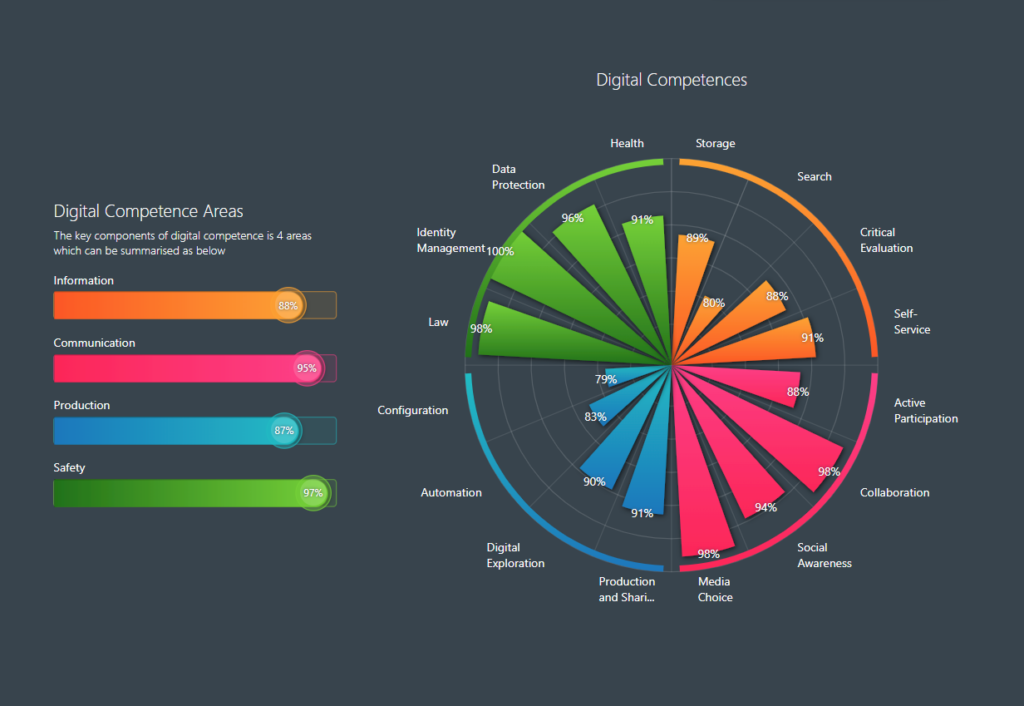
My results:
https://digital-competence.eu/dc/report/?uri=d0e95a670641330a7a9189bc2bc0c609
Self Reflection
This section made me reflect on my own shopping and consumption habits as well as my digital choices. Are the online stores I use reliable, and what about their ethical aspects? The task also made me highlight an important issue: We must always remember in healthcare to consider the services for those patients for whom digital services are not suitable.
Blogs I commented on:
- Sari Lahtoniemi My Digitalised Working Environment -journey (savonia.fi) My comment was intended for the DIGI CITIZEN section. However, since I was unable to post it there, I left it to the DIGI SOCIETY section instead.
- Jenni Heikkinen Jenni´s site (savonia.fi)
- Johanna Rapp Johanna’s site – Digitalized working environment (savonia.fi)
Hello Jenniina,
I was reading your site and noticed we have several familiar digital tools I have also used in family life. I believe that us Finns can relate to the user experience of the many of the services, sometimes I wish there would be a more combined system, as our personal health information is quite widely spread on different databases. Terveyskylä.fi service is new to me and will definitely have a look at it more closely as it seems to be a very useful platform for health related issues. Thanks for the tip!
About the webshops, Amazon and booking.com are familiar to me and I have used their service, but Temu I have not tried, mainly because I have heard of the quality issues in the news and articles, just like you have experienced. Sustainability issues you mentioned are very important and there is still a lot to learn about that for us as consumers. Thanks for your insightful text and all the best in your studies and future!
The risk of digital exclusion has truly increased and at the same time as it sets a risk of not getting services or health care needed, it sets a risk of increased loneliness, when the face to face interactions decrease.
https://blogi.savonia.fi/vaisanensanna/
Thank you for your smooth and interesting blog post. I’ve been thinking about the same things—how can we ensure that everyone has equal opportunities to use digital services? On the other hand, this also means that people are ‘forced’ to use digital services; it is no longer just an alternative. Additionally, I wonder about what other things we will adopt unnoticed as digitalization progresses. For example, the chips being implanted in people sound a bit scary, but will they become everyday things in the future?
Thank you for sharing your experience and thoughts. I really likes your mention of Temu in your blog. It is really a very prominent example showcasing the benefits (price, quantity) along with the drawbacks (quality, mistakes, misinterpretation of products on sale) of digital shopping. It is imperative to perform a thorough investigation and search when shopping this way!
It was really nice to read your text! You had good point about how hard it can sometimes be to return products you have ordered from other countries. Also when price is really low it usually tells, that the quality of the product isn’t that great. Your blog also had nice visual appearance!
It was nice to hear your experiences with the products you ordered from Temu.
I’ve been interested in ordering from them for a long time because you can’t avoid their advertising if you use any social media channel.
I personally also order most of my clothes online and it feels bad because it means the death of physical stores and eventually the city’s attractive street scene will decrease.
I just watched a video on YouTube about London and how London’s street scene has changed because several well-known shops have closed.
I hope we won’t be in a situation where stores have to charge a fee to all incoming customers in order to keep the physical stores like they did in Pieksemäki https://www.mtvuutiset.fi/artikkeli/kasityopuoti-otti-kayttoon-hypistelymaksun-keskustelunavaus-kierolla-savolaisella-tavalla/9076322.
Have a nice springtime