Digital services in Finland
I use OmaKela regularly for checking the messages I receive from state institutions. I also use it for applications of student benefits and payments such as the YHTS student health care service bill each semester. I have also used it once to complain about a decision and managed to get it overturned. You can also print out certificates such as proof of income (student benefits for me) if you need it for a visa. I already have the European health care card since I travel very often. It is only usable for a couple of years but once you order it once, the next ones will be ordered automatically. There are multiple languages to choose from.
My OmaKanta was accessed through strong identification using my bank app. This is very convenient for me but it not accessible to a big part of the population unfortunately since you need to know how to use online banking for it. There is also a text message option for strong identification, which costs money. The database has all my health information like vaccines from the past 10 ish years. I used it during the pandemic to get the European Union certified QR code with proof of my vaccines in order to be able to travel around the world. It is very convenient as even if you go to a private clinic, they can still pull up all of your information. In the past I had to print out papers whenever I went from a public clinic to the private one my workplace’s insurance covers.
My pension so far is only in the hundreds, but to be honest, I doubt that I will ever see any of the money I’m forced to put into this pyramid scheme anyway. My official retirement age is now 68 but will probably be 75 or something similar in reality. I am saving my own pension on the side.
A less talked about downside of all these services going online is the reduced amount of face-to-face interaction between people in the Finnish society. We are already an introverted nation and digitalization and the pandemic really made us even more isolated.
Digital shops and the digital gap
I use sites such as Booking, Hostelworld and Airbnb all the time when travelling to get the best value for money. It’s cheaper 90% of the time compared to booking directly and way more efficient for comparisons. You can’t even book most of these things offline anymore. I have found them reliable even though there is sometimes some botting to get the rating up for a specific hotel or hostel. Centralizing my purchases for flights and accommodation into Booking raises my discount level, and centralization is something we are very used to in Finland. At the same time, people who don’t or can’t use these sites either pay more for the same products or can’t access them at all.
In my industry every carrier and even some couriers have their own apps for tracking the parcels. I find them very reliable, even though they might be off by a day with their early estimates. Sometimes you even need to download the app to get the drop-off box open, which means people without smartphones can’t use them at all. The disadvantage is that you need multiple apps and accounts because the market is so saturated.
The biggest advantages to moving everything online is cutting costs and having everything behind one or a couple of services sites. In the past you would have to go to multiple offices and queue just to be registered as unemployed, but now everything can be done online in minutes. You now also have unlimited options while shopping online, in every category and price range.
The biggest challenge for those without digital literacy skills is that some services are going 100% online, making them inaccessible to a big percentage of the population. Cybersecurity is also another big issue when it comes to online banking and people without the necessary skills to use them safely. Scams on the internet are a massive issue and in this age with AI-made fakes and such, it keeps getting easier and easier to scam people into revealing things like addresses, phone numbers or even bank account information. Another big issue is having to open up the worst social media, LinkedIn, whenever you are applying for jobs.
But at this point we also have to address the elephant in the room. We’ve had the internet in most households for three decades now. I think it’s time for some people to finally just learn how to use it instead of acting like entitled children and outsourcing extremely important and necessary things such as these skill to their relatives or to our society itself. I also think we need to bring back “netiketti”!
Self-reflection and Digital competence
I didn’t realize how much of these services I have actually used during my life. The state of digital state services in incredibly good in Finland in my opinion. The biggest contrast was when I went for a student exchange in Chile. I had to queue for student residency registration at the local police station for over 10 hours, while in Finland you can just do it online. I feel like the only thing we lack in the health sector from digitalization is getting a sick leave certificate online from my local health center. I can have the appointment done by call with my doctor but I still have to go there to pick up the certificate in person.
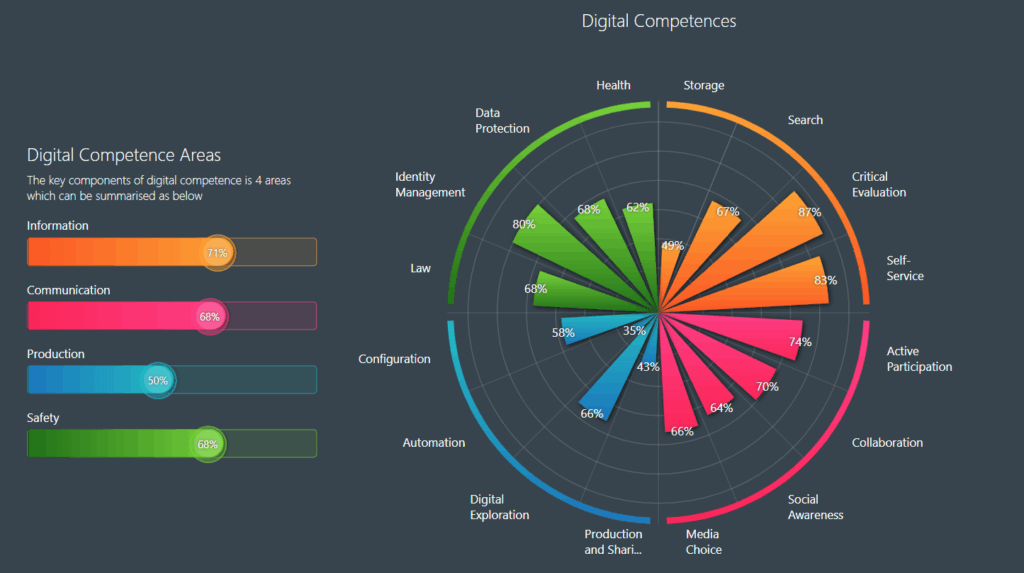
My Digital Competence test result was the following:
Information 71%
Communication 68%
Production 50%
Safety 68%
I think these percentages would be a lot higher if I did this test a decade ago. These days I don’t care enough to be a part of all these social medias and edit pictures and videos for them.
I have commented on Elina’s blog:
https://blogi.savonia.fi/elinavor/digi-citizen/
And on Eino’s blog:
https://blogi.savonia.fi/einojarvinen/esimerkkisivu/
And Jani’s blog:
https://blogi.savonia.fi/janihintikka/digi-citizen/
September 24, 2025 at 4:20 PM
I found your description of using OmaKela and OmaKanta very relatable. I liked how you pointed out both the convenience (like getting the EU vaccine QR code) and the accessibility challenges for people without strong digital skills. The part about reduced face-to-face interaction in Finnish society was also really interesting; it’s a perspective that doesn’t get mentioned often when discussing digitalization.
Your section on digital shops and the digital gap was thought-provoking. I liked how you highlighted the advantages of efficiency and cost savings, but also the risks for people without smartphones or digital literacy. The contrast you made with your exchange in Chile really emphasized how advanced Finland is in digital services. I also agree with your point about scams becoming easier with AI digital competence and “netiketti” are definitely more important than ever.
November 20, 2025 at 7:31 PM
Hi Joel!
Your reflections on Finland’s digital services brought up several things that I’ve also noticed in my own everyday use of systems like OmaKela and OmaKanta. I could relate to your point about how central these platforms have become without us even thinking about it. Like you, I’ve used OmaKela for messages, applications and certificates, and I appreciate how smooth it is compared to many other countries. Your example about appealing a decision successfully also reminded me how empowering it is when these services actually work in your favour.
Your thoughts on OmaKanta were especially interesting, because I’ve experienced the same convenience in being able to access all health information in one place, regardless of whether the appointment was public or private. The strong identification is helpful for security, although I also agree that it excludes some groups who struggle with online banking. During the pandemic I also relied on digital documentation, so reading your story about using the EU QR vaccine certificate felt very familiar.
The part about pensions made me reflect on my own situation as well. I noticed the contrast between your scepticism towards the pension system and my own experience trying to check retirement estimates. In my case, the information didn’t show up in Keva because my contributions are registered through a different pension provider, and only there was I able to make the actual calculation. Your comments reminded me how fragmented and confusing the whole system can feel, especially when retirement still seems far away.
You also made a good point about the social side of digitalization. I’ve noticed this gradual loss of face-to-face interaction too. The convenience is undeniable, but at the same time something human disappears when everything shifts online. Your perspective on how our already introverted culture has become even more isolated because of digital services really made me think.
When you wrote about travel platforms and how much easier they make finding affordable accommodation, I recognized many of my own habits. I also compare multiple sites like Booking, Trivago and sometimes Airbnb. And like you said, people who don’t or can’t use these platforms often end up paying more or missing options entirely. That thought connects strongly to the digital gap you mentioned later.
Your examples from your own field, especially the parcel tracking apps and drop-off boxes requiring a smartphone, highlight exactly how digital dependency affects daily life. In my work I rely on tools like Canva, so I also see how fragmented digital ecosystems can be when every service requires its own account. It’s convenient but also overwhelming at times.
The broader challenges you raised (cybersecurity, online scams, declining digital literacy) among some groups, and even the pressure to maintain a LinkedIn profile, also touched on themes I’ve reflected on myself. In my own background I’ve seen how the digital gap affects older generations, especially with logging into services like OmaKanta or using banking credentials. Reading your more direct take on responsibility and “netiquette” made me smile a little, because I’ve had similar thoughts in softer form.
Your self-reflection was interesting too, especially the comparison with Chile. It reminded me how easy it is to forget how smoothly things often function in Finland until you experience another system. I also liked how honest you were about the changes in your digital competence over time, our relationship with digital tools really does shift as the years go by.
Overall, your post made me think about how differently each of us experiences digital society depending on our work, habits, and personal expectations. Even when we use the same services, our perspectives can vary a lot.
My blog: https://blogi.savonia.fi/sonjamalmstrom/
January 7, 2026 at 2:20 PM
Hi Joel! Thank you for your post! You have written very well at kela, omakanta and keva. When I was watching my retirement age I thought that I have to start make some pension on the side as you are doing. So I’m glad that some has have the allmost the same retirement age than my self. Just kidding.
You have very good points when we are thinking digital gaps.
I like you’re writings. Thank you and have nice winter.