My experience Finnish social and health systems
Kela
The Social Insurance Institution of Finland (Kela) has the responsibility to provide fundamental support to all individuals covered by the Finnish social security system, helping them navigate life’s challenges. Furthermore, Kela is actively engaged in enhancing and developing the social security framework. I have been used KELA’s services when I was pregnant. Kela paid me pregnancy allowance, parental allowance and I was take care my under 3-year old children. So kela paid me child home care allowance. Also I get child benefit of our children. I have also get benefits at kela, when I buy medicines and, when I go to the private doctor.
I have a valid european heath care card. I was traveling in Europe last summer, so I get card because of that.
Omakanta
I have been used omakanta, when I have to check my medical records. Usually I use my mobile certificate when I log in. I haven’t use omakanta for a long time. And my opinion is that the omakanta does not work very well. There are allways something information that is missing. Example laboratory results. But it’s administered by the welfare area, so there is nothing that I can do, when the results are missing.
KEVA
This was the first time check my retirement age. My minimum retirement age is 67 years and 6 months. My target retirement age is 69years and 10 months. That sounds really long time to work at healthcare enviroment. Maybe I have to invest or save some money already so I can stop working earlier.
Online shopping
Personally I only shop on internet. Prices are cheaper online than local shops. I prefer buy at the local shops. But I live very small town and we don’t have any shops here. We only have supermarket and the selection is very minimal. For this task I compared prices nike online shop and zalando who sell nike clothes as well. Zalando have cheaper prices. Why? I don’t know. I haven’t compared these two shop prizes before. Both shops delivers package 2-3 working days. Nike delivers your order directly your home. Zalando delivers to the nearest post office. Maybe that explains price difference.
Social and health applications
Oma Ekhva is a digital service of the South Karelia Wellbeing Area, that helps people manage social and healthcare services easily online or on mobile. It brings different services together so that the user can do things anytime and anywhere, without waiting in line or calling. Example you can discuss your state of health, make a pointment to a doctor or nurse, fill and send forms, check your own laboratory results and so on. My user experience from the app, it’s good in one way. I don’t have to call anywhere, I can ask my health questions at the chat. But that’s all about it. The app direct you multiple different sites. So I don’t quite understand why the app is planned. If you wan’t check you’re appointments you have to identify atleast two times. So with this app there is lots to be improved.
Digitalization and the digital gap
Challenges to people who do not use virtual services is huge! We are now living year 2026. Most of the public utilities have tranfered completely virtual services. For example nearest tax-office is 200km in the distance. Older people don’t know how to use virtual services and older people do not recognize scams. That’s why many older people has lost their money. Also when old people need help virtual services there aren’t necessarily nobody who can help.
Digital competence
My results of the digital competence
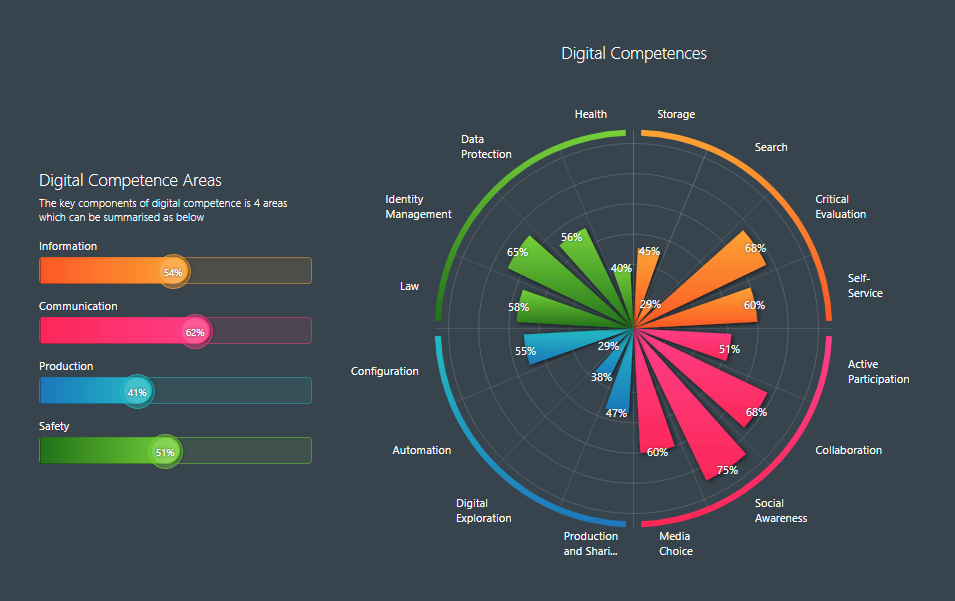
According with the results, I’m strongest at communication and information. I would like to progress at the productions, because that was my lowest prosents.
Self-evaluation
This assignment gave me an opportunity to reflect my personal experiences with the Finnish social and healthcare systems and to evaluate how digitalisation affect my everyday life as a service user. While doing this task, I realised how strongly digital services are embedded in Finnish society and how important they are for accessing social security, healthcare and other public services. At the same time, the assignment helped me recognise the limitations of digital systems and the challanges they can create, especially for people who have weaker digital skills.
Kela, the Social Insurance Institution of Finland, has played an important role in my life, specially during pregnancy and early parenthood. I have received pregnancy allowance, parental allowance, child home care allowance and child benefits, which provided financial security during an important phase of life. I have also use Kela’s reimbursements for medicines and private healthcare visits. Reflecting on these experiences helped me to understand how comprehensive the Finnish social security system is. At the same time, I noticed that I often take these services for granted and do not always think about how complex the system behind them actually are.
Digitalisation is essential when using Kela’s services, because most applications and communication is handled online. Without digital skills or internet access, managing benefits would be very difficult or even impossible. My experience with the European Health Insurance Card also showed how digital services support people beyond national borders. Applying for the card was easy and it gave me a feeling of security while travelling in Europe. This made me realise how digital solutions can support people both nationally and internationlly.
I have also used Omakanta to check my medical records. Logging in with a mobile certificate feels mostly safe and reliable, and having access to my own health information is positive. However, my experiences with Omakanta have been mixed. Sometimes important information, such as laboratory results, is missing or comes very late, which causes frustration. As a patient, there is nothing I can do if the information has not been uploaded. This made me realise that even though digital health records improve transparency, they still depend on healthcare organisations and welfare areas to function propely.
Checking my retirement information through Keva was a new experience for me. Seeing my minimum and target retirement ages made me reflect seriously about my future. Working in healthcare until nearly 70 years of age feels physically and mentally demanding. This realisation encouraged me to think more about saving money and financial planning already now. This part of the assignment showed how digital services can influence long-term life planning, not only everyday matters.
Online shopping is another area where digitalisation strongly affects my daily life. Living in a small town with limited local services means that online shopping is often the most practical option. When comparing prices between the Nike online store and Zalando, I noticed clear price differences. This made me think about competition, delivery methods and logistics. It also highlighted the contradiction between my wish to support local shops and my actual consumer behaviour, which are not always the same.
One of the most important insights from this assignment was related to digitalisation and the digital gap. While digital services improve accessibility for many people, they also create serious challenges for those who do not use or understand virtual services. Older people are especially vulnerable, as they may lack digital skills and can be more exposed to online scams. This is worrying, because many physical service points has been replaced by digital ones and help is not always easily available.
Overall, this assignment helped me to develope a more critical and reflective view of digitalisation. I learned to see both its benefits and disadvantages. Digital services make many aspects of life easier and faster, but they also require continuous development and support for different user groups.
Blogs that I commented:
I enjoyed reading your post. It clearly shows how digital services are embedded in everyday life in Finland. The personal examples make the topic easy to understand and highlight the challenges faced by people with limited digital skills, especially when services are only available online.
I enjoyed reading your Digi Citizen blog! 🎇
Your examples from Kela, OmaKanta, and other public services made the discussion very relatable and grounded in everyday life. I also found your online shopping reflection with Nike and Zalando interesting. Comparing real services like Zalando shows nicely how digitalization affects consumer behavior and choices. Your point about the digital gap and the challenges that older people may face adds an important human dimension to the topic.
The Finnish social and healthcare system and its foundations—Kela, Omakanta, and Keva—were clearly and well explained. You also nicely included your own observations while exploring your personal data. The comparison with online stores was interesting as well. It was pleasant to read about the Oma Ekhva application, but there is clearly room for improvement in the user interface, as constant jumping between views and repeated authentication do not make for a comfortable or agile service. The challenges of the digital divide were also well identified, particularly from the perspective of services moving online. Good work!
Thank you for sharing your experience of being a digital citizen in daily life! I like how you explained using online services like Kela, OmaKanta, and online shopping. It shows how digital skills are a part of everyday life. Your point about the digital gap is important too. because not everyone finds online services easy to use. This makes me think about how we can support people who struggle with digital tools.
Link to my article: https://blogi.savonia.fi/kanchawanat/digi-citizen/
Feel free to browse 🙂
Hi Johanna!
I found your blog very relatable, especially your experiences with Kela and family life. It is clear that you have really used these services in practice, not just written about them in theory. I also smiled a bit at your thoughts about retirement age – working in healthcare until nearly 70 sounds quite ambitious for all of us.
Your comments about Omakanta were interesting as well. I agree that even though the system is useful, it can be frustrating when information is missing and there is nothing you can do about it as a user. That is probably something many people recognize.
I also liked your honest view on online shopping. Living in a small town really explains why online stores are often the only realistic option, even if we would like to support local businesses.
Your point about older people and digital services was important. It is easy to forget how difficult digital systems can be if you are not used to them.
Overall, your blog was practical, honest and easy to read – and very close to real everyday life.
Mira