DIGI CITIZEN
#Swedish Social Insurance System
The Swedish social insurance system is divided among several different agencies, more so than in Finland. For example, student financial aid is paid out by CSN, while Försäkringskassan (the Swedish Social Insurance Agency) handles other types of benefits.
Försäkringskassan offers a wide range of digital services. For instance, you can track sickness benefits (when ill), parental benefits, temporary parental leave (to care for a sick child), housing allowance, and other types of support. You can submit reports and applications online and track the status of these as well as the different payments.
The website is fairly useful, but you are required to fill in a lot of information and be able to navigate between the different types of cases. Almost all applications can be completed digitally, which makes things easier. You can also get assistance from various chatbots — if you ask the right questions. However, you can sometimes get stuck in chatbot conversations while trying to find the right answer to the right question. Customer service often has long waiting times, especially during payment periods or when many cases overlap. At those times, you might have to wait for hours just to speak to a person—which isn’t sustainable for people juggling work, studies, and small children.
Försäkringskassan also has an app, but it is essentially a replica of the website, offering little additional support for the user. I look forward to when they develop a proper app that can be used to resolve cases in a fast and user-friendly way. Many of today’s applications are, in my opinion, based on complicated rules and outdated structures inherited from the paper-based system.
What’s impressive today is that they also offer automated application support. This means that once I submit an application, I often receive a response within minutes. This is helpful for me and also for the caseworkers. However, Försäkringskassan has also faced criticism for its random checks and the basis for these checks and risk profiles. These profiles were introduced over ten years ago, but it’s only in recent years that they’ve faced significant criticism for their AI system, which has been systematically flagging individuals such as women, foreign-born people, and low-income earners without a university degree. The agency has been criticized for the biases the system creates.
In the future, Försäkringskassan will work in a much more AI-driven manner and, for example, increase information exchange and data sharing with other agencies. This has not always been technically or legally possible, which has led to situations where job seekers have fallen between two systems due to slow information exchange. It is also increasingly important to ensure that those applying for support are genuinely entitled to it. Due to the rise in organized crime in Sweden, there are unfortunately actors who exploit the social safety nets and claim money fraudulently.
With digitalization, there are also plans to improve support in various languages and to personalize responses. Accessibility for people with disabilities will also be enhanced. There is already substantial support in this area today, but I assume there is still room for improvement.
#Reliability of digital shops
Temu is one of the stores today that has received much criticism for the quality differences compared to products sold in Europe. Temu is a Chinese store offering various types of consumer goods at low prices. The products are shipped directly from China. The store has been heavily criticized for its reliability and the quality of its goods.
In Europe, stores take responsibility for ensuring product safety – when ordering online from certain stores outside the EU, you don’t have any guarantee that the store has actually conducted such checks. This is especially important to keep in mind if the price is very low. Testing and developing better products is a natural part of a company’s product development process. However, Temu, for example, does not engage in any development itself – its concept is based on copying products that others have already created.
When shopping online, it is also difficult to trace the supply chains and assess the working conditions of the producer. From this perspective, it is always better to buy directly from local vendors who comply with laws and regulations. However, when comparing prices, manufacturing costs are significantly higher due to the high cost of living and wages in the Nordic region. It’s impossible to compete with the prices of goods produced in places like China. Most businesses therefore manufacture their goods outside of the Nordic countries, but try to do so in ways that comply with legal requirements and regulations.
When ordering online, the shipping costs often vary significantly. In many cases, local vendors have transportation and logistics costs for importing large quantities of goods. Platforms like Temu, however, ship one item at a time, which increases carbon emissions.
Ordering from foreign websites can also mean that user instructions are not provided in the local language – which can make it harder to use the product. However, today you can find a lot of information online, and with translation technology, this is often easily solved.
The return process for online purchases can be complicated, and if the product is faulty, it can take a long time to receive a refund or a replacement. In contrast, if you buy the product locally, the process is usually much smoother and you often get personal service.
Amazon, on the other hand, has warehouses in Sweden, which means many items can be delivered quickly and easily. However, the information on the website is not always easy to follow and understand. That said, items are usually shipped very quickly – often from local vendors, though at higher prices. Since Amazon handles its inventory in Sweden, it also has a different level of control over the products and their quality. But some products are much more expensive than local shops– so it’s important to compare prices. They also translate a lot of pages, which sometimes results in inaccurate translations.
#AI Assists in analyses
I chose to take a closer look at an AI service developed by a programmer named Jens Nylander: https://kommun.jensnylander.com/. The service analyses and digitises public procurement data to identify irregularities and deviations from the norm. On this website, there is an option to analyse the public purchases made by municipalities. This is a very important first step toward understanding where errors occur and being able to trace and better comprehend where actors are exploiting the system in inappropriate ways.
I believe that, in the long run, this type of information could also be traced in companies’ own accounting, etc., to ensure that purchases comply with what has, for example, been contractually agreed upon.
#Outside Virtual Services
When we talk about those who are outside digital services, there are of course many elderly people or others who, for various reasons, are unable to use society’s digital structures — for example, due to financial constraints. It costs money to have a mobile phone or computer that is modern enough to support secure identification. Today, for example, libraries do offer access to computers. However, you still need digital identification, and services such as banking are becoming increasingly digital, while physical branches are decreasing.
As a Finn living abroad, I have personally found it quite difficult to access OmaKanta or other sites that require strong identification with Finnish bank credentials. Without a Finnish bank, I was excluded from the system and had to make a personal visit. I now see that development has progressed, and I can use Suomi.fi with Swedish identification services, but this was not the case the last time I checked. There is also a limited number of countries listed, which implies that there are still some Finns abroad being left behind.
#Digital Competence Test
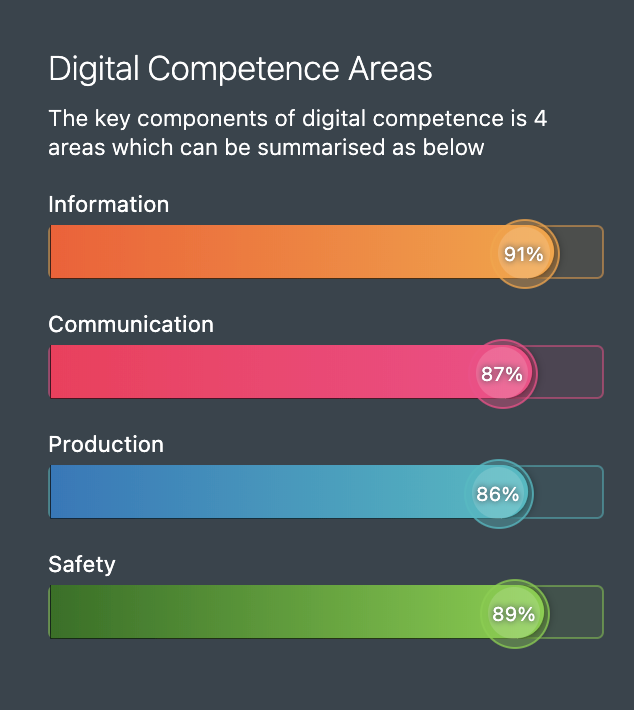
I received fairly high results, in my opinion. The areas where I still have potential for improvement are Law – knowledge about current laws and licenses and Automation – my ability to modify and create digital solutions that can fully or partially automate and perform a task.
I believe it’s difficult to feel confident in understanding all the legal aspects, such as data rights, without actually working with it as a lawyer. Since I only have very basic programming skills, this also affects my results. It would be interesting to learn more about programming in the future to deepen my understanding of digital systems and to be able to approach solutions from different perspectives.
#Self-reflection
I consider myself to be fairly knowledgeable when it comes to digital development, and this is also reflected in the results of the digital competence test. However, I still often feel that there’s so much I don’t fully grasp—I don’t understand the questions in depth; I’m only scratching the surface.
It’s always interesting to look at the tools we use daily through a different lens—if I were 60 years old, something might be much more apparent to me. When my mother-in-law or my own mother asks me certain questions, I wonder why they ask those specific things. What’s their background and level of understanding? Why does the younger generation seem to pick up certain things so much faster and have a completely different attitude—e.g. with sharing information?
I use digital systems effortlessly, but I’ve also experienced the challenges in accessing them. It’s not a given, for example, that you can open a bank account in Finland even if you are a citizen. You need to live in the country for the process to be smooth.
I commented on:
Emma’s blogg here: https://blogi.savonia.fi/kokemma/digi-citizen/
Niina’s blogg here: https://blogi.savonia.fi/niinaaimasmaki/digi-citizen/ and
Davide’s blogg here: https://blogi.savonia.fi/davidegarofalo/digi-citizen/
Leave a Reply