Kela and digital services
Kela is a social insurance institution of Finland. It provides social security benefits, including health insurance reimbursements, student financial aid, unemployment benefits, parental allowances, pensions, and basic social assistance to people living in Finland.
As a parent, one of the benefits I used was paternity leave. The parental allowance is a benefit granted to parents and guardians of children and provides 320 paid days per household that can be distributed equally between both parents, but days can also be transferred from one of the guardians to the other. However, this is the only basic description, and some specific conditions and requirements must be met. This benefit allows parents and guardians to remain at home and take care of their little ones for an extended period of time. So far, I have not needed to use any of the reimbursement services; however, I found the Kela page very useful to pay for the student insurance, since it is already integrated in one place.
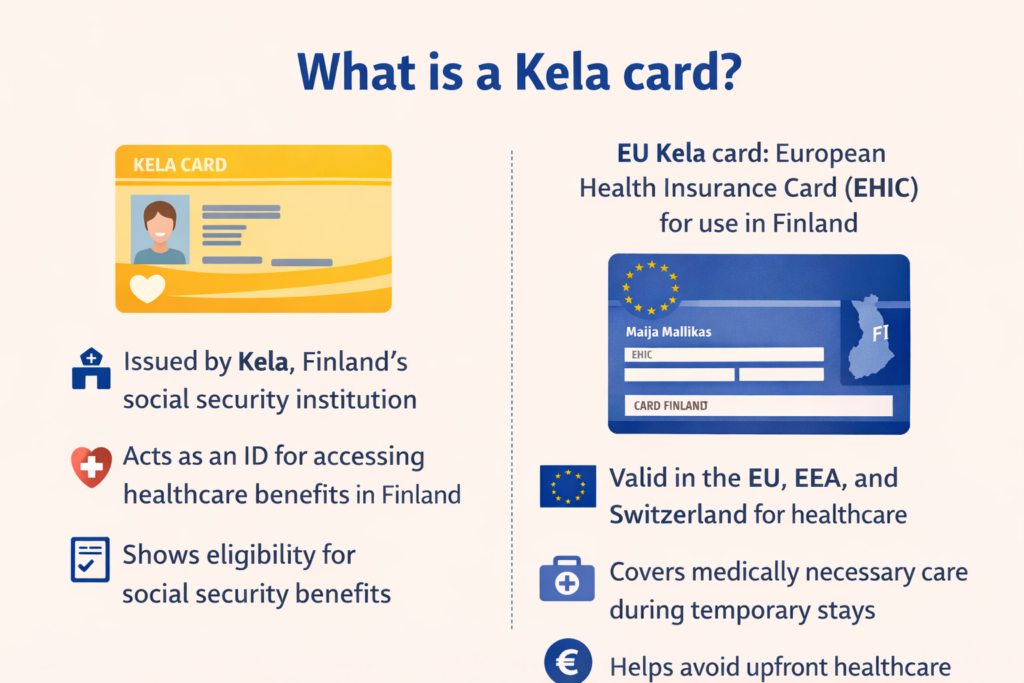
The process of applying for a European Health Insurance Card (EHIC) through Kela was fairly simple. After logging into my Kela account, it was only necessary to complete two more steps, which involved going to the applications section and selecting the card. It is really interesting how digitalized and well integrated everything is. I was not aware that as a foreigner, I was able to get the card as well.
OmaKanta
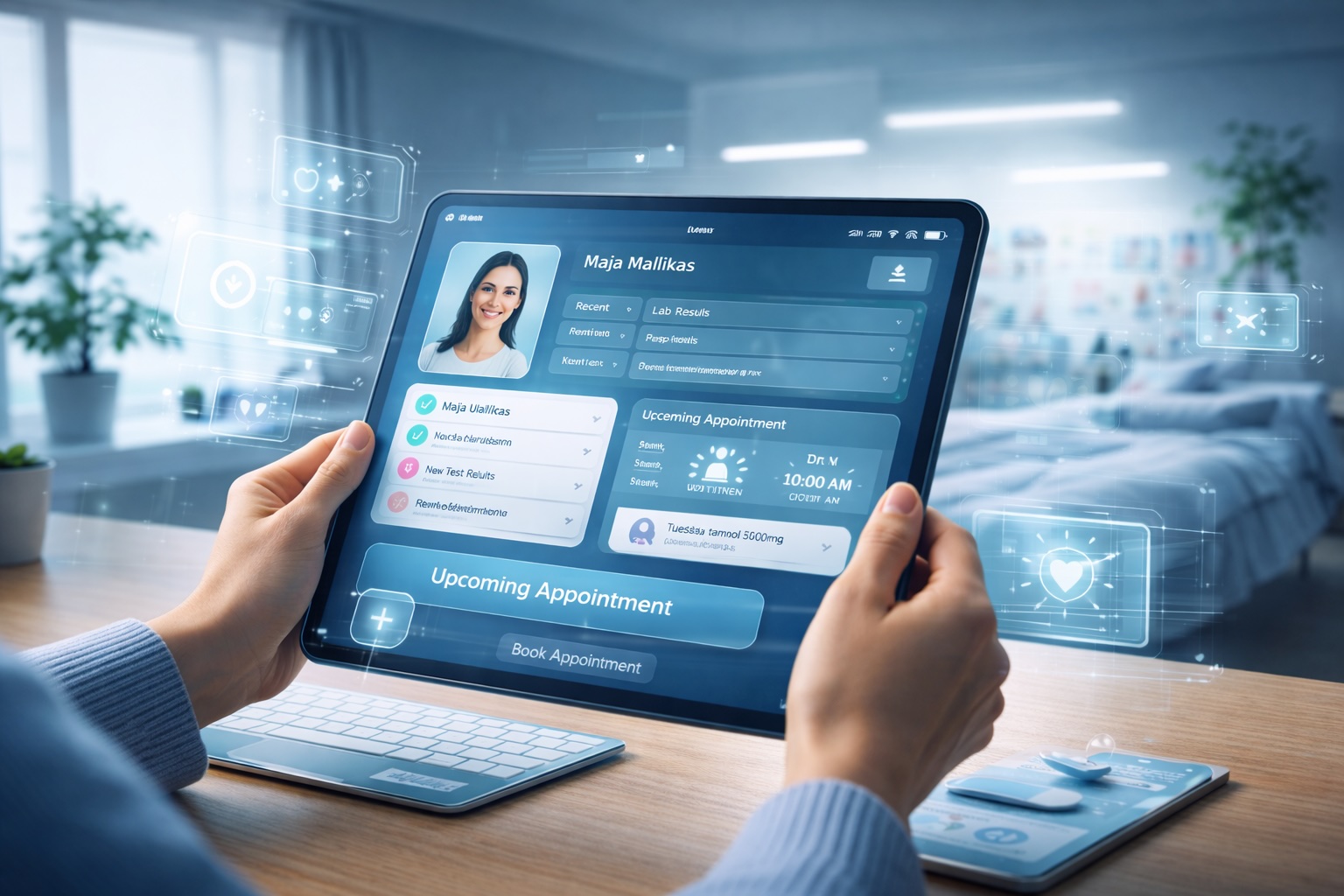
It is an online service where people in Finland can access their personal health records. It allows users to view prescriptions, medical visit records, laboratory results, vaccination data, request prescription renewals, and manage consent for sharing their health information. It is really interesting to see that even medical consultations are visible here. The integration between all healthcare suppliers is a positive feature that allows people to check all their records regarding their insurance company or if they use public or private caregivers. The access, as everything else in Finland, is linked to the strong verification method, in my case, the bank ID.
Keva and pension
As a non-Finnish citizen living in Finland for only a couple of years now, it was a little challenging to understand how the system works. Keva, nonetheless, seems to be the pension holder for public workers only. When logging in, a message indicated that Ilmarinen is the platform to check, depending on whether a person works in the public or private sector. It is the first time that I have access to that kind of information. In my home country, the calculations are different, and it is not possible to see the current pension amount. Though I consider that it can be a motivational factor for people to work hard to earn a well-deserved pension. The difference in the projections for retirement at 63 years old and 68 years old was not too much. But it is worth it to see that it is necessary to study and keep preparing the path for the coming years.
Digital shops
I chose to use Booking.com to compare prices with the local business. Surprisingly, prices did not match. For instance, the online platform offered a special app discount. This particular app is very reliable, as I have used it for many years. I contacted the property and inquired about the price offered by the digital platform, and the company representatives mentioned that the prices at the hotel work with their own system for predicting occupancy. However, it is also possible that they could have special rates or arrangements with the platform, which allows them to have a better price than the property directly. I would have thought that it is always easier to get the best price by contacting the hotel directly; nevertheless, the digital applications also need to use special promotions and benefits to the customers to be able to get a piece of the market.
Digitalization at work
The hospitality industry is probably the slowest innovating and transitioning to the digital field. Whether it is a very traditional one or relies merely on the interaction with people to create a unique experience, the digitalization has not been implemented as fast and deeply as in other industries. However, due to the amount of investment required, some big companies are the only ones working on the implementation while trying to enhance the service experience supported by digital tools. One example of this is Mews, a widely used property management system in the Nordics.
Mews can be accessed by the website browser and also by the App. It is the most common tool used in the hotel, and it helps all the staff, including management, to communicate with each other in the same and different departments to handle all the information of the guests.
A visitor’s profile is created when a booking is made. This information passes from the website to the reception team. In this profile, the person checking in the guest will have all the information available about the guest’s profile, including the preferences, allergies, length of stay, and special events. This information is analyzed and passed to the other departments. The first people in touch with the guest will create tasks for the other departments, so everyone in the company and the hotel chain is aware of the preferences and restrictions of the guest. Most of the time, these tasks will begin before the guest’s arrival, so the room will be prepared according to the requirements. In the same way, the staff can access the customers’ profiles and make notes for further reference according to each experience and feedback.
In my experience, this is a high-level tool that provides the opportunity to access and add information about the guests in each of the touchpoints of the hotel industry. The future of hospitality seems to have tremendous potential for websites that can support the operations and consolidate a fantastic experience by having access to the guest profiles. However, it is to be noticed that some small hotels or businesses may not be in a position to afford a technological investment of this level. This raises a concern about fair competition between the small, local businesses with a limited budget and the transnational hotel companies.
Digital gap
Digitalization is moving rapidly and changing the world as we know it. This transformation is happening globally. I remember, almost 20 years ago, during my first trip to the United States, being shocked by how many digital devices and services were advertised and widely used. In fact, some of those devices never reached my hometown or many parts of Latin America. At that time, those services felt like part of a distant future back home in Ecuador.
Later, more than a decade after that trip, during my first visit to Vietnam, I saw a country moving toward the future despite its many challenges and complex history. I could see how quickly it had to adjust to the needs of its growing population, and only four years later it had transformed into a very modern society, quite different from the one I had first encountered.
In the past, technology was often seen more as a luxury than as an investment. Developing countries used to have significant gaps compared to developed nations. This gap once gave people time to understand the challenges and benefits of new technologies. That period of slow transition is now over. Digitalization moves extremely fast, with startups, platforms, gadgets, and services constantly innovating. Many people can barely keep track of these changes. This creates a new kind of gap, especially for those who struggle even with basic digital services. The risk is not only falling victim to scams or similar online threats, but also experiencing a deeper loss of connection with society.
Digital competence
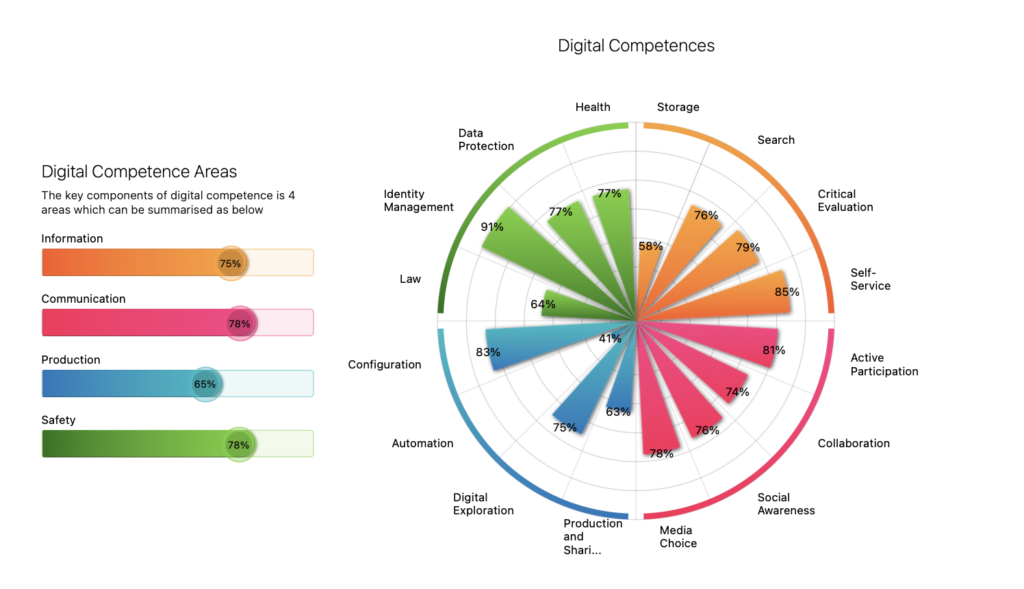
The Digital Competence test has been a very interesting way to understand how aware I am of the tools and systems I use in my daily life. It helped me identify which areas require a deeper understanding and further improvement. As shown in the results below, I clearly need to strengthen my knowledge in all areas, but especially in production, since that is where I received my lowest score.
Self assesment
I have previously mentioned in this blog that technology is moving and evolving faster than ever. Generally speaking, the advantages it brings to our lives should be seen as positive. However, even when it provides many improvements, not everyone is able to benefit from them. After completing the tasks and reading other students’ posts, I realized how important it is to stay up to date. Digital skills are becoming essential in our lives, and our personal interests and self-education should prioritize this area.
At the same time, I hope that the advancement of digital literacy does not reduce our human touch or change who we are as individuals in society.
The posts I commented:
-
—
by