I am currently living in a period of big change, both in my working life and personal life. Moving from Thailand to Finland, and settled here 3 years ago. As a digital citizen, I use the internet daily through a smartphone and computer to interact with individuals, businesses, and public authorities. Digital services play an important role in my everyday life, especially in education, healthcare, commerce, and social security systems.
As a foreign student in Finland and the spouse of a Finnish citizen, I have familiarized myself with the local social insurance system here. mainly through Kela (The Social Insurance Institution of Finland). I have found out that there are various benefits and subsidies you could get depending on your status. In my case, I have got a few benefits from Kela, starting with parental leave/allowance, study grant, study support loan, and child benefit after my child was born until my child turns 17 years old.
Suomi.fi is used for strong electronic identification and official communication in Finland. This system is safe and very convenient for using digital services. After I opened a bank account in Finland, I was able to use my bank’s mobile app to identify myself when logging in to different public services.
MyTax (Vero) is used for tax-related matters and is necessary when starting work in Finland. I need to send my tax card to my employer so that my salary is taxed correctly. In the MyTax service, I can adjust my estimated yearly income, receive decisions and letters, chat with customer service for more information, and make appointments. This makes handling tax issues easier and more efficient.
In Finland, digital public services are already very advanced. The government focuses on making services like social insurance, taxes, and healthcare easy to use online. Digital identity systems such as Suomi.fi allow residents to log in safely using bank apps or mobile ID, which makes official communication fast and secure. Finland is one of the leading countries in digital public services in the EU, and many people already have good digital skills.
Digital services in the field of social and healthcare in Thailand
In Thailand, digital services in social and healthcare are growing and becoming more important. The government and health authorities are using technology to improve how people access care and health information. Many services can be accessed through mobile apps, online platforms, or telemedicine (virtual doctor visits).
The Thai Ministry of Public Health has a digital health platform available through apps (like Mor Prom), and companies/organizations use LINE (chat application) for easier access to services, health advice, and scheduling.
Lately, people can consult doctors online without going to a hospital too often. This helps reduce long lines at clinics and makes healthcare more accessible, especially for minor or follow-up cases. There are popular apps such as MorDee, BeDee, Raksa, Doctor Anywhere, and SkinX that offer home delivery services for medications.
The health ministry and social security systems are working together so that health records and social insurance information can be shared safely online. This means less paperwork and faster service for people who need benefits or medical certificates.
Digital services in social and healthcare in Thailand offer more convenience for many people. Digital health tools help patients access healthcare more easily, even in areas where there are not enough doctors. Telemedicine and online appointments reduce overcrowding in hospitals and clinics and save time for both patients and healthcare staff.
In addition, digital health records and integrated systems between healthcare and social services make it faster to get medical certificates, social benefits, and health advice. This reduces paperwork and makes the system more efficient.
However, there are also challenges. In rural areas, internet access and digital skills are sometimes limited, so not everyone can use online healthcare services easily. Digital health services also require some learning, and older adults or people with less education may find them difficult to use.
Another concern is data privacy and security. When personal health information is stored online, it must be well-protected from unauthorized access. Although Thailand is improving its laws and systems, this is still a concern for many users. Finally, not all hospitals and clinics are fully ready or well-trained to use digital health systems, which can slow down development.
In Thailand, digital services are expanding quickly, but the system is still evolving. The government is building systems so people can use one digital ID for many services, and more services keep becoming available online. But the system is still new, and not everyone uses it yet.
Digital commerce: online and local shops
I visited several digital platforms such as Amazon, eBay, and Booking.com, and compared them with local services. Online platforms often offer lower prices and more options. Amazon usually has lower prices than local shops, but shipping costs and delivery times can be a challenge. These online platforms provide detailed product descriptions, reviews, and ratings. That information is useful for customers to make decisions to buy or not. Services seem reliable, but consumers must be cautious of fake reviews and third-party sellers.
Digital service from my own field
One digital service relevant to my field is Google Forms. I use Google Forms to conduct surveys for my thesis. It is useful for research and data collection because surveys can be shared easily online, and the responses are automatically organized. From my experience, Google Forms saves a lot of time compared to paper surveys and makes data handling easier. However, it depends on respondents having internet access and basic digital skills. This service is especially valuable in academic research and business development.
Digitalization and the digital gap: risks and challenges
As a Thai student in Finland, I can see that digitalization makes life easier in many ways. However, there are also risks and challenges for people who do not use virtual services.
First, people who do not use digital services may have limited access to important services. In Finland, many services such as Kela, tax (Vero), healthcare, and banking are mainly online. If someone does not use the internet, it can be difficult to apply for benefits, book appointments, or receive official information.
Second, People without digital skills may feel left behind in society. They may depend on others to help them with online forms or official communication, which can reduce their independence.
Third, the language barrier can make the digital gap bigger. As an international student studying in English, I sometimes find that some services are mainly in Finnish or Swedish. For people who do not speak the local language well, digital systems can feel even more difficult.
Another challenge is economic inequality that I can see well in my home country. Not everyone can afford a computer, smartphone, or stable internet connection. This can limit their opportunities in education, work, and healthcare.
Finally, older adults or people with low digital literacy may feel stress or anxiety when using online services. If society becomes fully digital, these groups may struggle more.
Digital competence test
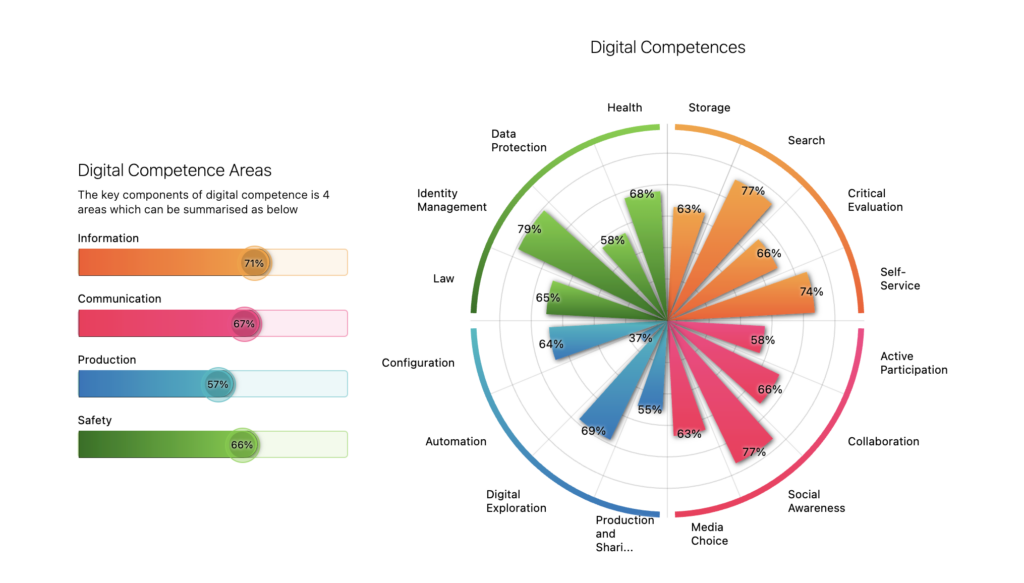
I completed the Digital Competence Test, which evaluates digital skills in 4 main areas: information, communication, production, and safety. My strongest area was information (71%), which shows that I am confident in finding, understanding, and using information online. My result in communication (67%) indicates that I can use digital tools to communicate and interact with others quite well.
My score in safety (66%) shows that I have a good understanding of online safety, privacy, and responsible digital behavior. The lowest score was in production (57%), which means I still have room to improve in creating digital content and using more advanced digital tools. Overall, the results show that I have solid digital skills and understand my strengths and areas that need improvement.
Self-reflection
In this topic, I reflected on my experiences as a digital citizen living in Finland as a Thai student. I was able to clearly describe how I use digital services in my daily life, especially in social security, healthcare, education, and digital commerce. I also compared digital development in Finland and Thailand, which helped me better understand different systems and levels of digitalization.
In this assignment, is using real personal experiences to explain digital services, such as Kela, Suomi.fi, MyTax, and Google Forms. This shows that I understand the topic and can apply it to real life. I also discussed both advantages and challenges of digitalization, including the digital gap.
From my point of view of learning, this assignment helped me better understand digital citizenship and my own digital competence.
I have commented on: