Denmark is one of the most digitally advanced countries in terms of social and health care services that provide a wide range of platforms for effective access to public services. I have been in Denmark for over ten years and I am well familiar with the social security system which is somehow identical to the one in Finland. I am no longer able to use Finnish digital services as I have moved out of the country, but Denmark’s prevailing digital services provide me with the appropriate social and health care coverage to all residents.
In Denmark, the digital services I use are centered around a few key platforms:
Sundhed.dk (Health Portal)
It helps with not only the accessibility of medical services but also the management of personal medical data. I can overview all my medical history through Sundhed.dk that comprises dental visits, hospital treatments, and a list of conducted medications. Besides, I am able to schedule appointments with doctors and hospitals probably via this system. It has become an ultimatum in organising health care via digital means, as all health-related information is gathered under an umbrella.
Borger.dk (Citizen Portal)
This is the hub of what we can call Denmark’s version of KELA, the Finnish social insurance institution. It is the place where you as a citizen can apply for social benefits, keep your track on pensions, etc. and obtain various public services, such as healthcare and social security. I shall furthermore send certificates, that is the documentation of living at an address, and also I have the possibility to deal with my tax issues which include housing taxes. In other words, it is the most frequently visited platform for all official matters in Denmark. However, one difference being the taxes system, whereas Denmark has a wholly separate tax system for handling incometax and other financial issues. Borger.dk simply gives an outline of a communal / city related tax’s (like: property tax and housing rebate) more detailed tax management including income tax filings and deductions is resolved through Skat.dk the official tax authority’s platform.
E-Boks.dk (Electronic Mailbox)
E-Boks is a secure, digital inbox that brings all official documentation from government and private organizations in one common place. This solution is the best fit for me as I don’t have to search for my important documents (such as insurance documents and payslips) among multiple platforms anymore; just a simple login into E-Boks solves all. Besides this, E-Boks is a two way solution for sending official documents to authorities, making it a mandatory tool for any administrative work.
Pension.dk (Pension Information Portal)
On this site, I get information on how my public and private pensions are doing. It is a commendable feeling to know my pension status by just taking a glance at it whether on the internet or in my house. Additionally, Pensions.dk is full of tools that make it easy for me to estimate my future pension payments and thus let me better plan my retirement.
NemID and MitID (Digital Identification Services)
NemID and its new version, MitID, are robust digital systems that are used for secure identification on all public platforms such as healthcare and social benefits where you can log in to example to Borger.dk, E-boks and Pension.dk. Unlike my bank account, they are used for safely logging into government accounts and they are also used for example print signing of documents. In this way, a safe process of online interaction between the public sector and the customer is guaranteed. MitID is similar to bank login (tunnistautuminen) in Finland because it also is a multifunctional service used for secure identification devices in different platforms and both private and public.
Pros and cons of Denmark’s Digital Services
Denmark’s digital services are a great source of benefits that have made the daily administrative activities a lot more comfortable and more efficient.
Definite convenience is the most prominent advantage. Primary services like social benefits, medical care, and pension information are easily found online. All the management should be done solely from a single platform. Thus, it completely excludes face to face visits and greatly reduces the time spent on manual paperwork. Websites such as Borger.dk and E-Boks gather information at one place, thus facilitating easy application for essential documents and their further tracking.
Additionally, a very important issue associated with the subject is the security. MitID serves the purpose of confirming the safety of personal data and internet transactions. The authentication systems are used to prevent unauthorized access, thus becoming a secure way for people to interact with public and private services. This is most crucial when dealing with sensitive information e.g. financial details or medical records.
Further, the efficiency aspect is a major benefit of the digital services of Denmark. Activities such as benefit application, appointment scheduling, and tax matters dealing can be done online with no big problems. As a result, it not only saves the citizen’s time but also makes the administrative costs of both the citizens and the government less.
Nevertheless, there is a downside to the situation. One issue is the digital divide. Denmark is well staffed with digital skills, but some people, especially older ones and those not at all familiar with technology, will likely have a hard time working with these systems. This, in turn, will be a big hindrance for those who are less comfortable with the digital platforms in their attempt to access essential services.
Another disadvantage is the occasional technical issues. Like any digital infrastructure, these services can suffer downtime or system bugs, which prevent important information from being accessed for a short time. These interruptions can be quite frustrating for users who rely on these platforms for urgent and pressing issues.
Overall, Denmark’s digital services provide a highly secure, efficient, and accessible way to manage an array of public services. However, these digital services require not only a level of digital proficiency but also a stable system that functions properly to allow equal accessibility for all.
When it comes to comparing digital services between Finland and Denmark, Denmark’s unfortunate disadvantage is the language barrier. In Finland, most official platforms offer considerable assistance in English, which allows non Finnish speakers to utilize public services easily. By contrast, Denmark lags behind in this area due to the fact that most content found on government websites only exists in Danish, and the translations that do exist are oftentimes limited compared to the original information. This makes it harder for expatriates and international residents to have a full and clear understanding of how to access vital services without outside assistance.
Online Shopping
I frequently use eBay, Amazon, and Booking.com, but my level of trust in each one of them is different from one another.
Out of the three, Booking.com is the platform I trust most. I use it to book hotels within reputed hotel chains, and over the years, I have not experienced any issues with the services I have booked through them. The ability to read some reviews of other guests and top of the line information about each property provides me with informed choices, and the customer service department is usually reliable at least from what I have experienced. All in all, Booking.com is open about what it offers me, and I feel safe that it stands as a trustworthy service. This can easily change overnight if an issue were presented concerning my bookings, for after all, these platforms are deemed reliable or not based on personal experiences.
On the opposite end, I do not entirely trust myself with platforms such as eBay and Amazon. While I do use them, I find it harder to build a rapport with sellers on that platform, particularly because I may be negotiating with a completely mixed bunch of private individuals and businesses. At times, it becomes really hard to tell whether I am dealing with private or business entities, which raises questions in my mind as to how reliable the products I am buying are. Less organized than Booking.com in this regard, both do not make it easy for an individual to discern a reliable source for his or her purchases.
Another major concern with eBay and Amazon is the lack of transparency. When I purchase goods, I do not have the same level of visibility or surety that I would have with a hotel where I can verify the service provider’s reputation. With tangible goods, if something goes wrong, it’s harder to solve issues-the most difficult of which are returns or refunds. I also find that with online purchases, I’m often less active in giving feedback or returning items more so, it just seems like too much effort to go through all that. Unlike a hotel stay, on which feedback can be shared right there, dissatisfaction with a product will require a much greater effort-web-support intervention, or return process, for example. However, I would much prefer to give my feedback directly to the staff when I stay at a hotel, it just feels more natural to express concerns face to face.
Security on eBay and Amazon is another area that I am worried about especially given the extent of their international operations. Considering that both platforms transact with sellers operating outside Europe, I have concerns such as card data security. They do have secured checkout processes and payment protection; but the notion of revealing sensitive information to a marketplace with international sellers remains somewhat risky. Despite protections from both sites against fraud, the fact that I am not dealing with just one company lends some uncertainty.
When comparing prices, sometimes eBay and Amazon have lower prices than local shops, but more often than not, that does not reflect the value I’m expecting. Uncertainty about the seller’s trustworthiness and the product’s quality frequently overshadows the minimal price. In contrast, Booking.com offers competitive rates for hotels, especially considering loyalty programs and discounts, and I feel the extra confidence they give makes the marginally higher price worthwhile.
Application – Trello
Trello is a project management utility that streamlines the workflow, enhances teamwork, and creates organized compartments for marketing research projects. Its interface provides a clear visual way to keep track of tasks, deadlines, and responsibilities, thus allowing keeping track of ongoing activities and running them smoothly.
For me personally, Trello has proved to be very useful for handling complicated marketing research tasks. The drag-and-drop interface is user friendly and easy to navigate, even for a member of the team who might not have prior experience with project management tools. Its adaptability allows me to customize boards, lists, and cards to fit diverse project needs, ensuring that everything remains consistent but is still modifiable as priorities change.
Digitalization and digital gap
Digital divides can affect people’s live and something that happens to run against those who cannot avail themselves of or have no experience with online services. A good practical example is found when someone relocates to another country. In say Denmark, having no MitID means that you cannot access necessary online services or systems, pegging the person to physical visits and finding a paper application to fill out, both tedious and cumbersome.
I have personally gone through such difficulties during some time I spent living abroad from Finland. Without the right digital logins, making any type of contact with Finnish systems is nearly impossible. In accessing information or getting a handle on matters of official duty, it can be annoying. It starts now becoming clear how easy access could just serve to bar people for no reason, restrict them from use of vital services, and clutter very ordinary life.
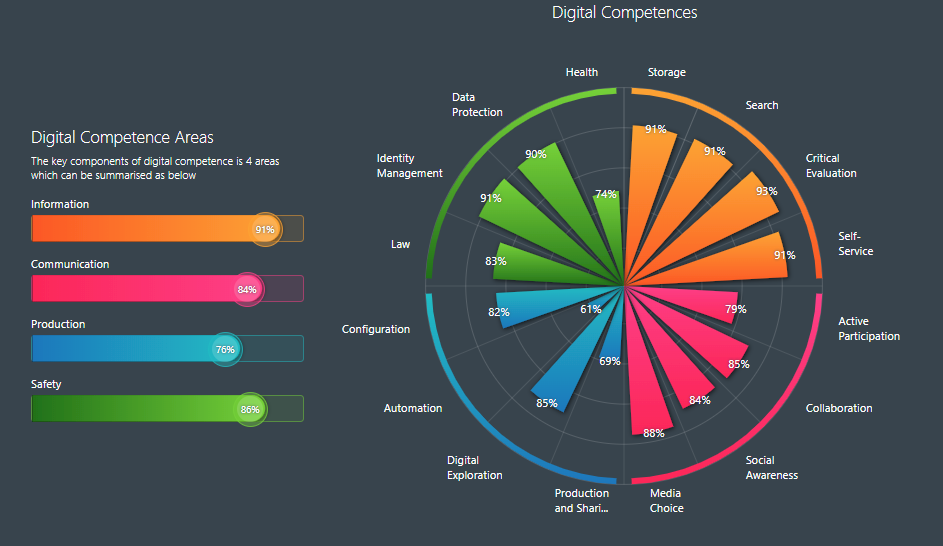
My digital competence test
Reflection
This part of the course allowed me to reconsider digitalization from various angles, especially regarding accessibility and inclusion. I had never engaged with what it meant to be left behind by a digital shift if I could not access services like KELA in Finland. As I theorized on the digital setting in Denmark, I realized that although I benefit from advanced services, such as Sundhed.dk and Borger.dk, there are still people struggling with technology, especially among older generations or those who have not got the necessary digital tools. This made me aware that while digitalization could be extremely efficient for some, it could also build up barriers for others, excluding certain groups from urgent services.