Me, Kela and Omakanta
I have used some of Kela’s services. I currently receive housing benefit and an adult education subsidy from Työllisyysrahasto, so I don’t receive any student allowance from Kela at the moment. In my previous studies, I was eligible for student allowance, and Kela also guaranteed the student loan. Additionally, when I had a long sick leave, I received sickness benefit from Kela, which was really important for me. Without that, it would have been very difficult to survive without pensions. Kela also compensates part of my medicine and therapy costs. Kela is very important, but the government continues to undermine people’s benefits. I have a European Health Insurance Card, even though I haven’t traveled recently.
I access Omakanta with my bank ID. Previously, I had a mobile certificate, which was an easier way to access. My phone connection changed, and I haven’t gotten a new mobile certificate yet. I guess it’s a safer way to access, but it’s still pretty easy to log in.
Keva and Varma
I tried to complete the assignment, but when I accessed Keva, it said: “We are unable to create an employment pension statement for you.” I figured out where I can get my employment pension statement. My employment pension statement comes from “Varma,” and it states that my earliest retirement age is 67 years and 10 months. It’s interesting that if I work for two more years, I could receive 40 euros more per month in retirement pension, which isn’t much. I read other students’ blogs, and they could receive much more in retirement pension than I would if they work two more years.
Digital Stores
I try my best to support local stores, but sometimes I can’t. For example, I have been on study leave recently, so my income isn’t very high. That’s why I’ve done some research on prices and bought from online stores more often. This isn’t ideal. The city center of Oulu has become less vibrant, and there aren’t as many shops anymore. Rent is high, and customers are struggling financially, so more and more people are searching for the cheapest options online. On the other hand, there is much more information available about the sustainability of stores. There have been many news reports on the sustainability of different stores, such as Shein and Temu. If you follow the news, you can’t miss this information. Nevertheless, I understand if some people with lower incomes order from these stores, as it’s much cheaper to shop at Amazon or similar websites than at local stores.
My thoughts on Booking or Trivago are somewhat contradictory. If hotels use these platforms, they lose some money because they have to pay Booking for the service. On the other hand, they could get more customers if their accommodations are listed there. I also often use food delivery services, and I believe restaurants have to pay quite a bit to join them, but I’m not entirely sure. It would probably be better to order directly from the restaurant.
Microsoft 365
In our workplace, we don’t use many apps or services. We have our own information system and laboratory equipment, but we don’t need to use many other tools. However, we use Microsoft 365 a lot. We have our emails here, and we use SharePoint and Excel regularly. We need to log what we’ve done with equipment, and SharePoint is very handy for that. The information stays there, whereas when we used paper records, they could easily get lost. I started wondering what other apps we could use more often. We have workstation instructions that need to be updated at least once a year. I’m considering whether we could use AI for this in the future.
My thoughts on digitalization
I am studying health promotion, so I feel it’s important to advocate for those who cannot use digital services. For example, elderly people often don’t have strong digital skills, so this must always be considered. There should be more education on this and always the option to handle things through traditional methods. Additionally, we must remember that some services are the only form of social interaction for elderly people. If these services are digitalized, they may feel even more isolated and lonely.
I’m also concerned that people may become tired of using different apps and services. Personally, I have six apps on my phone for communication, including Facebook, WhatsApp, Instagram, Signal, etc. On top of these, the communication channels in my workplace and other digital services increase screen time even more. Sometimes, all of this feels exhausting.
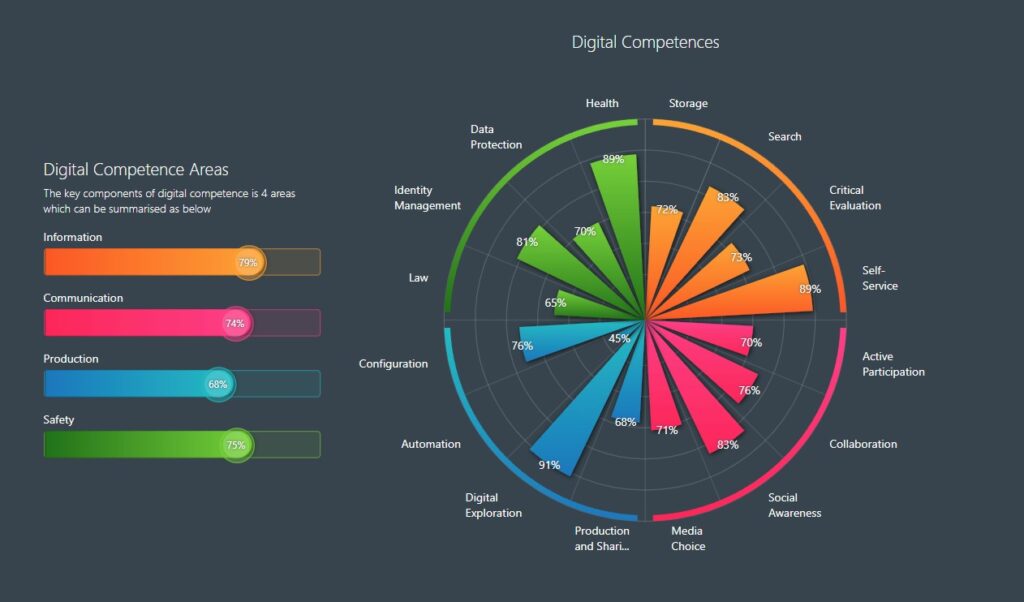
My digital competence is quite good, but I’ve noticed that I don’t know much about databases and programming. I don’t think these are things I’ll need to learn in the near future, but you never know. On the other hand, it could be interesting to learn how everything works behind the scenes.
This learning task included familiar topics, but I approached them from different perspectives than before. I learned to think about things on a broader scale. In everyday life, we don’t often think about how much digitalization is present in our routines. Without it, many things would be nearly impossible. Nowadays, it’s rare to find someone without a smartphone. The texts from other students were also really good, and they provided different perspectives to consider.
Additionally, I started wondering what kind of skills will be needed in the future. The test showed that I don’t know much about programming or databases – will I need them someday? People’s digital skills are being challenged more and more, so it remains to be seen how my own skills will develop.
I commented these posts: