
DIGI SOCIETY
Digitalization and me
Let´s go back to the early 2000s, when our family got our first computer. I was still in elementary school at the time and understandably I didn’t know how to use the computer very well yet. However, I remember that many other families in the neighborhood didn’t have their own computer at that time. In our family, it was mainly my dad and older brothers who used the computer at first and mostly for playing games. We started using computers at school already in the 4th or 5th grade, if I remember correctly. We practiced things like searching for information online. I personally became more interested in computers in 2004, when MSN Messenger was a big thing among young people. It was exciting and new to write messages to friends in real time online.
So, I can say that I have been using computers and digital tools from a young age. I feel that I have the ability to learn new technology quickly. I currently work as a teacher in a preschool group. In our work community, I am often the person others come to for help with things like computers, digital displays, or apps.
Digitalization in early childhood education
Digitalization has also progressed in my work in early childhood education, although the field has lagged behind in development for many years. There are still significant differences between cities in how quickly and widely different digital applications are introduced. I was surprised when I moved to Kuopio in 2018 and noticed that children’s care times were still being reported on paper. Based on these papers returned by parents, staff compiled weekly lists to determine the need for care. In several other cities, applications were already in use allowing families to report care times digitally. If I remember correctly, at the beginning of the 2020s, we finally started using the Edlevo application. It made our work significantly easier especially in compiling care time summaries. Nowadays we can print a ready-made summary directly from the application, which gathers together the care times reported by families. In addition to reporting care times Edlevo also enables reporting absences, sending messages, and sharing announcements easily and quickly. It can be said that digitalization and especially different applications, clearly make communication between home and daycare smoother and improve the flow of everyday routines.
We have been writing and documenting early childhood education plans electronically for quite some time. This has greatly simplified the storage of documents, as paper versions are no longer needed. In addition, families can view the individual plans created together with staff directly through the application. Also, ordering food for daycare centers has been done electronically for many years, which has improved the practical coordination between kitchens and daycare units.
When the COVID-19 pandemic began, multi-professional meetings were held remotely via platforms such as Teams. This practice has remained common even after the pandemic. It has significantly improved time management, as the time previously spent on traveling is no longer needed. Remote meetings also allow for more flexible participation between different actors. Employee training sessions are now mainly held remotely as well, through Teams and Zoom. This allows broader participation in training sessions from different parts of the city or even nationally. In developing employee skills, various digital learning platforms are also used. These platforms provide opportunities to learn regardless of time and place. This way, everyone has the opportunity to improve their skills according to their own schedule, which supports continuous learning.
Digital education
Digital education is part of early childhood education. We introduce children to various digital tools, such as tablets. Tablets in preschool are mostly used to help children learn letters and numbers through different educational games. They are also used for practicing photography and recording sounds. Children are taught how to use devices safely and develop media literacy, which supports their ability to act responsibly and securely in digital environments. As part of digital education, we also practice basic coding skills with children using BeeBot robots. These small programmable robots have become very popular among the kids.
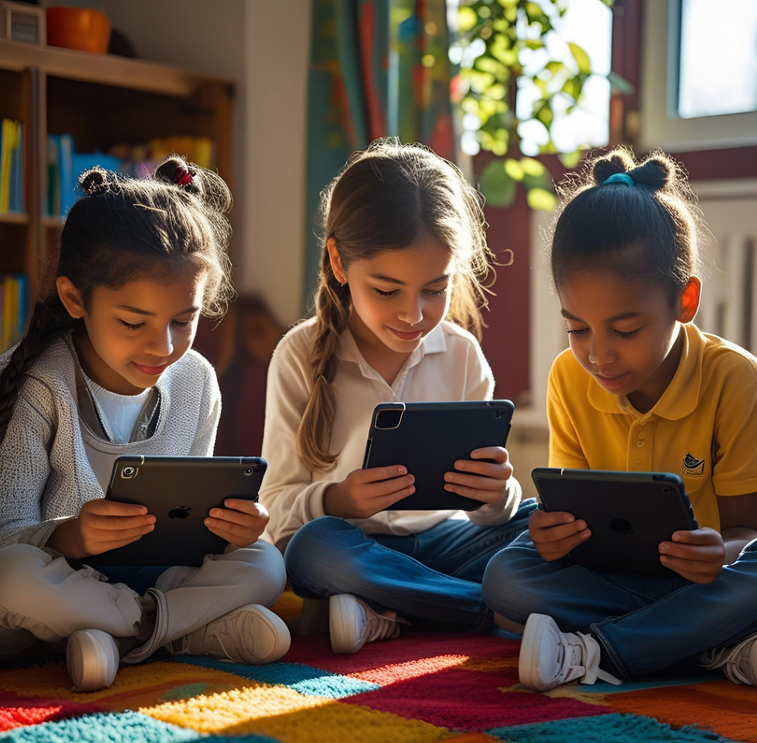
One of the key goals of digital education is to promote equality among children in the area of digital skills and to teach a critical and responsible attitude towards media. However, the implementation of high-quality digital education also requires sufficient understanding and competence from the staff regarding digital tools and their content. I have noticed that employees who are closer to retirement age often prefer to leave digital education responsibilities to younger colleagues.
Future of digitalization in early childhood education
Digitalization has made remote work possible in many sectors, but this idea does not suit early childhood education. I do not believe this will change in the future as work in this field strongly relies on the physical presence of the employee and interaction with the children. Presence is a central part of supporting the child’s growth, development, and safety, and it cannot be replaced by technology. Instead, I believe that in the future digitalization will be utilized more in early childhood education, for example in documenting children’s learning. Currently, everyday documentation is mostly done traditionally by writing either on paper or on a computer and there are no very advanced or suitable digital systems in use for this purpose.
My colleague and I have sometimes discussed how convenient it would be if there was an application for documentation that could be used directly on a phone. Documentation could be made quicker and simpler if, for instance you could take a photo during a learning activity and attach a brief description highlighting what the child found easy and enjoyable, as well as the difficulties encountered. Visual materials, such as photos, often tell much more than just text and help illustrate the child’s learning process. I believe such applications are not yet in use precisely because data protection and practices related to photography in early childhood education are very strictly regulated. Protecting children’s privacy is of utmost importance, which naturally places restrictions on the development and use of technology in this area. Nevertheless, it is important to seek safe and practical ways to develop documentation practices by means of digitalization.
Open digital society
Digitalization has enabled more open and transparent interaction than before. At the same time people are concerned about what too much openness and the transfer of data from one place to another can mean for individuals’ data protection and privacy. Personal data is transferred between various actors such as companies, public services, social media platforms, and the third sector. According to the GDPR, individuals have the right to know who views and processes their data and for what purpose. However, I wonder how many people are truly well aware of who actually processes their data and what possibilities they have to control it? In recent years, there has also been public discussion about data breaches, which practically anyone can become a target of. The GDPR is an important and commendable data protection reform that specifically tries to address these data protection risks and provide the best possible data protection for everyone.
In early childhood education, children’s personal data is also processed, such as names, dates of birth, addresses, health information, guardians’ contact details, special support needs and early childhood education plans related to learning. In our work, access to this data is limited according to necessity. In our work, access to information is restricted based on necessity. For example, children’s birth dates and child-specific early childhood education plans are visible only to the adults working in the group where the children belong. However, parents’ contact information is shared across all groups because children are at times picked up by adults from different groups. Only the information necessary is collected about children and families. Taking photographs of children requires written consent from their guardians, who also retain the right to withdraw or modify their consent at any time. The consent forms include specific sections granting permission for internal use of photos within the group or publication on early childhood education social media platforms, among other uses. The majority of the children’s parents in the group do not want anything published about their child on social media, which is completely understandable. Restrictions on photographing also extend to parents, for example during spring celebrations, when they are not allowed to photograph children’s performances that show other children as well.
Regarding data protection, staff receive annual information security training, which includes exams. The training covers, among other things, data protection in documentation, which involves the entire process from collecting information to storing, using, sharing, and destroying it. Information security training is important so that staff understand how to protect sensitive personal data and prevent data leaks or misuse.
Testing ChatGPT
I tested ChatGPT by asking it various questions related to early childhood education. In my opinion, the answers were mostly good and up-to-date, although in some areas, the answers lacked the depth I had hoped for. I also looked at the sources the answers were based on and I must admit that not all of them were as high-quality or reliable as I would have hoped. However, a positive aspect was that ChatGPT was able to find and use relevant legislation as well as refer to the national early childhood education curriculum.
ChatGPT also reminded me that it can make mistakes. This is important to remember and its answers cannot be trusted blindly. Although most of the information may be correct, there can be factual errors among it. Sometimes ChatGPT gave incorrect information and when I corrected it, it acknowledged its mistake and tried to write a corrected and more truthful answer.
ChatGPT is constantly evolving and gathering new information, which is why I believe it will improve even more in the future. Artificial intelligence enables fast information retrieval and serves as a good tool for brainstorming. Additionally, one can have conversations with it, which can bring new perspectives to almost any topic. However, it is extremely important to remember not to give AI any personal or sensitive information.
Self-assessment
At the beginning of the course, while familiarizing myself with the materials, I realized how little I know about digitalization as a whole, even though I can use some digital devices and applications. During this assignment, I learned a lot of new things about digitalization and understood how significant development has also taken place in my own field regarding digital solutions. Digitalization is a broad and constantly evolving phenomenon, which is why it is important that people not only learn to use technology but also understand its possibilities and the risks associated with it. The course especially made me reflect on safe digital behavior. Using ChatGPT was an interesting experience. I intend to use it in the future to support brainstorming as well as to find different perspectives and new ideas. I want to learn more about digitalization and the development of technology.
I have commented on the following blogs:
July 24, 2025 at 14:52
Hi Maiju!
Thank your post. My history about digitalization is like same than you have. My first touch with computer are from elementary school when we started practis our ATK-skils. We learned use e-mail, search information and Microsoft programes. Communication with MNS and socialmedia came later in teenage when digicamera and image prosessing was new. In our falmily internet came in house when I studied in high school.
I am worked in Early Childhood Education too and in our organization meny planning work was done with pen and paper. Digitalization came step by step.
Best regards, Enni!
July 31, 2025 at 15:56
Hello Maiju!
Thank your post. I also work in Early Childhood Education and share similar thoughts with you about digitalization in this field. When my children were in a municipal daycare, the care times were reported using paper forms, precisely in 2018. It was not secure because the forms were left in the children’s lockers, which anyone could access.
However, soon after, the reporting of care times moved to the Edlevo application. From a customer’s perspective, the app was initially quite limited, as at that time the daycare only used the app for collecting care time information.
Best regards Piia
February 17, 2026 at 12:35
Hi Maiju,
It was really nice to read your post. It brought back memories of when we studied computer science for a few months using only paper, with all the material projected onto a board using acetate sheets.
In the 1990s, computers were just beginning to emerge, and we could not have imagined how quickly they would transform our lives.
It is inspiring to see how technology is now being applied in education in such beneficial ways. What surprised me most is that children are already learning basic coding. To me, this suggests that they hold great potential for the future of society and its ongoing digital transformation. As you mentioned, the transformation will face some challenges and resistance, of course, as it will depend on the digital literacy of the instructors as well. However, it seems that education has a bright future ahead.
Best regards,
Juan