DIGI CITIZEN
Exploring Digital Citizenship
Digitalization has become an essential part of everyday life, influencing how we communicate, work, access public services, and make purchasing decisions. In this blog post, I reflect on my own experiences as a digital citizen by exploring the digital services I use in both my personal life and working life. I will discuss Finnish e-services such as KELA, OmaKanta, the European Health Insurance Card, and the pension calculator, as well as evaluate an online shopping platform and a digital service related to my own professional field. In addition, I will examine the challenges of digitalization, including the digital divide and the importance of digital competence, and reflect on what I learned from completing the Digital Competence Test and interacting with other students’ blog posts. Through these experiences, I hope to highlight both the opportunities and the responsibilities that come with living in an increasingly digital society. These topics also reflect several key dimensions of digital citizenship, including digital access, communication, commerce, digital literacy, health, security and responsible participation in digital society.
KELA – From Paper Forms to Digital Services
KELA, the Social Insurance Institution of Finland, is a public organization responsible for administering social security benefits and financial support for people living in Finland. Its digital services allow citizens to apply for benefits, access personal information, and manage many everyday matters conveniently online.
For a long time, KELA’s digital services were not a significant part of my everyday life because I was working full-time and did not need to apply for many benefits. In my professional role, I have also never needed to use or become familiar with KELA’s employer services, as they are not related to my work responsibilities. KELA became much more relevant to me after I started my studies and when our family began to grow. At different stages of life, I have searched for information about student benefits, pregnancy, parental leave, and various family benefits. I have also applied for the European Health Insurance Card for our whole family through KELA’s online service. While reading other students’ blog posts, I noticed that several of them had similar experiences. Many described how digital public services become particularly important during different life situations, such as starting studies, starting a family, becoming unemployed, or facing health-related challenges.
Compared to the past, KELA’s online services have made the whole application process much easier. Applications can be completed electronically at any time, required documents can be attached directly to the application, and decisions are available online without waiting for paper mail. I still remember how different the process was years ago. Back then, applications had to be completed on paper forms, which were collected from the local KELA office, filled in by hand, placed in KELA’s own envelopes, and mailed back. Looking back, it is remarkable how much digitalization has simplified these everyday tasks.
Our whole family has also applied for the European Health Insurance Card through KELA’s online service, making it easy to access healthcare when travelling within Europe. Overall, I find KELA’s website clear and user-friendly, and the electronic services work reliably. However, understanding the content is sometimes more challenging than using the service itself. Because the instructions and decisions are based on legislation, the terminology can occasionally be difficult to understand, especially for someone who is unfamiliar with legal language.
Source
KELA – Social Insurance Institution of Finland: https://www.kela.fi/henkiloasiakkaat
OmaKanta – Easy Access to Personal Health Information
OmaKanta is Finland’s national digital health service, where citizens can securely access their personal health information online. The service brings together essential healthcare information, including electronic prescriptions, medical records, laboratory test results, and vaccination records, making it easier to manage personal health and healthcare-related matters.
In our family, OmaKanta has become a service that we use regularly, especially for checking valid prescriptions and requesting prescription renewals. Instead of contacting our local health centre, we can easily check which prescriptions are still valid and submit renewal requests directly through the service. While reading other students’ blog posts, I noticed that many of them also highlighted prescription renewals as one of the most useful everyday features of OmaKanta. This suggests that the service has become an important part of managing healthcare for many people.
I access OmaKanta using strong electronic identification, which makes logging in both secure and reliable. From a citizen’s perspective, I find the service clear and fairly easy to use, and the information is presented in a logical and easy-to-find format. Having all health-related information available in one place makes everyday life easier and saves time. At the same time, strong authentication increases confidence that personal health information is well protected. As I do not work in the healthcare sector, I cannot evaluate how easy the system is for healthcare professionals who enter and manage patient information. My experience is therefore based solely on using OmaKanta as a citizen and patient.
Source
OmaKanta – Finnish National Health Data Service: https://www.kanta.fi
Keva – Preparing for Retirement
Keva is responsible for managing the earnings-related pensions of employees in Finland’s public sector. The website offers services for both individual customers and employers. For individual customers, it provides information about different pension options, vocational rehabilitation, applying for pensions, and pension calculators that help estimate future retirement benefits. For employers, the website includes information on pension insurance, pension contributions, supporting employees’ work ability, and managing pension-related matters.
Personally, Keva’s services have not been very familiar to me because my employer’s pension insurance is managed by another pension insurance company. My employer provides comprehensive information about retirement, and when more detailed information is needed, employees are directed to their own pension insurance provider as well as to Työeläke.fi, a national online service maintained by the Finnish Centre for Pensions. For this reason, I have had very little need to use Keva’s services.
For this assignment, however, I explored both the Keva website and Työeläke.fi, the online pension information service maintained by the Finnish Centre for Pensions. I also used the pension calculator to estimate my earliest retirement age. It was interesting to see the estimate, although I have to admit that retirement still seems a very long way off. According to the calculation, I still have more than twenty years left in my working career. Although retirement is not yet something I need to think about on a daily basis, using the pension calculator encouraged me to reflect on my future career and retirement planning. Overall, I found the Keva website, my own pension insurance provider’s online services, and Työeläke.fi to be clear, informative, and easy to use, even for someone who had not previously been familiar with these services.
Sources
Keva – Public Sector Pensions: https://www.keva.fi
Työeläke.fi – Finnish Centre for Pensions: https://www.tyoelake.fi
Comparing Digital Stores and Consumer Information
As part of this assignment, I explored digital stores and evaluated how easy it is for consumers to compare prices and whether the information provided is sufficient for making purchasing decisions. Instead of focusing on international online marketplaces, I chose to compare Finnish online pharmacies because they are digital services that I use regularly in my everyday life.
Comparing prices between different online pharmacies is generally straightforward, and many of the same products are regularly available with discounts or special offers. For this reason, I usually compare several pharmacies before making a purchase. However, calculating the final cost of an order is not always as simple as comparing product prices. Different loyalty programmes, member benefits, and delivery charges all affect the total price, making it surprisingly difficult to determine which option is actually the most affordable. While reading other students’ blog posts, I noticed that several of them had made similar observations. Although comparing individual product prices is easy, determining the final purchase price can be much more challenging because of additional costs and different pricing practices.
Overall, I have found Finnish online pharmacies to be reliable and trustworthy. They provide comprehensive product information, clearly display prices, and make the ordering process secure and easy. The websites also clearly indicate which products are medicines that require a prescription. In addition, many online pharmacies publish interesting articles written by pharmacists on topics related to health and well-being, and I occasionally use these articles to help me choose suitable products.
One aspect that I find slightly frustrating, however, is that after almost every purchase I am asked to review the products I have bought, and during the ordering process I am often automatically subscribed to the online pharmacy’s newsletter. I understand that companies want to collect customer feedback and promote seasonal campaigns and special offers, such as sunscreen products during the summer or information about tick prevention. However, the frequent requests for product reviews and newsletter subscriptions can sometimes feel excessive.
An Internal HR Application Used in My Work
As part of this assignment, I chose to examine an internal HR application used by my employer, as it represents a digital service commonly used in my field. I selected this application because it is one of the digital tools that I use regularly in my work and it supports many everyday HR processes. The application is used for submitting annual leave requests and other absences. It also stores personal information required by the employer, such as contact details and employment information. In addition, the system contains records of employee training, internal career history, development discussions, performance reviews, and annual goals.
Although the application contains a great deal of useful information, my overall user experience has been mixed. Reading information is easy, but entering and updating information is often unnecessarily complicated. This is particularly noticeable during the annual development and performance review process. Every year, the discussion templates, goals, and performance indicators are updated, meaning that the system changes regularly. As a result, every time I need to use the application, I have to spend time finding the correct sections, making sure that every field has been completed correctly, and ensuring that all the information is submitted properly.
In my opinion, the application feels rather cumbersome and does not provide a particularly smooth user experience. It fulfils the employer’s need to collect and store employee information effectively, but from the user’s perspective, the interface could be much clearer and more intuitive. This would make the application more efficient and significantly more pleasant to use.
Digitalisation and Digital Exclusion
Digitalisation has transformed society by making many everyday services faster, more accessible, and more efficient. At the same time, it has increased the risk of digital exclusion. In her column Digitaalisen alaluokan syrjäytyminen uhkaa vain syventyä, Niina Rantamäki (2024) explains that digital exclusion is not simply about lacking technology or digital devices. It also refers to the risk of being excluded from information, essential services, and participation in society. It concerns people who are unable, do not have the opportunity, or choose not to use digital services. The reasons vary and may include limited digital skills, a lack of suitable devices or reliable internet connections, or uncertainty about using digital services.
While reading other students’ blog posts, I noticed that many of them raised similar concerns. A common observation was that limited digital skills can make it difficult to use public services, manage banking and healthcare matters, and find reliable information online. Many also pointed out that although digital services make everyday life easier for most people, those who are unable to use them face an increased risk of inequality and social exclusion.
The Ombudsman for Older People, Päivi Topo (2026), has highlighted that an estimated 500,000–600,000 people over the age of 65 in Finland do not have sufficient digital skills to use online services independently. In her recommendations for the next government term, Topo emphasises that alongside digitalisation, alternative service channels must remain available, digital support should be strengthened, and everyone should have an equal opportunity to manage their affairs regardless of their level of digital competence. She also calls for concrete actions by public authorities, municipalities, and wellbeing services counties to promote digital equality. Rantamäki (2024) further argues that digital inequality may continue to deepen if some people are left behind without adequate support to develop their digital skills. The goal of digitalisation should be to increase equality, not widen the gap between those who are able to benefit from digital services and those who find them difficult or impossible to use.
Working on this assignment made me realise how much of my own everyday life depends on digital services. I use them almost every day at work, when dealing with public authorities, managing healthcare matters, and shopping online. At the same time, this assignment reminded me that digitalisation is not equally easy for everyone. For example, my parents belong to a generation that first became familiar with computers during their working lives. Their digital skills have gradually developed through practice and by having the confidence to try new things. They are particularly concerned about digital security, as the news frequently reports online scams that often target older people. They also find it challenging when applications are updated and changes to the user interface require them to learn new ways of using familiar services. Age-related changes in learning and memory can further increase uncertainty and reduce confidence when using digital services.
Looking ahead, it is important that digital services are designed with users’ needs in mind, that sufficient support is available for developing digital skills, and that alternative service channels remain available for those who need them. It is equally important that public authorities continue to communicate actively about digital security and how to recognise online scams. These themes are also strongly emphasised in the recommendations published by the Ombudsman for Older People for the next government term. In my opinion, these are important considerations for everyone involved in designing and developing digital services, applications, and information systems.
Sources
Rantanen, N. 2024. Digitaalisen alaluokan syrjäytyminen uhkaa vain syventyä. Kokkolan yliopistokeskus Chydenius. Published 16.10.2024. https://www.chydenius.fi/fi/blogikirjoitus/niina-rantamaen-kolumni-digitaalisen-alaluokan-syrjaytyminen-uhkaa-vain-syventya. Accessed 24.7.2026.
Topo, P. 2026. Vanhusasiavaltuutettu: Seuraavan hallituksen on ratkaistava digitalisoinnin iäkkäille aiheuttamat ongelmat. Vanhusasiavaltuutettu. Published 9.4.2026. https://vanhusasia.fi/-/vanhusasiavaltuutettu-seuraavan-hallituksen-on-ratkaistava-digitalisoinnin-iakkaille-aiheuttamat-ongelmat. Accessed 24.7.2026.
Vanhusasiavaltuutettu 2026. Iäkkäiden ihmisarvoa sekä perus- ja ihmisoikeuksia on kunnioitettava päätöksenteossa – Vanhusasiavaltuutetun suositukset seuraavalle hallituskaudelle. Published 8.4.2026. https://vanhusasia.fi/-/vanhusasiavaltuutetun-suositukset-seuraavalle-hallituskaudelle. Accessed 24.7.2026.
Digital Competence Test
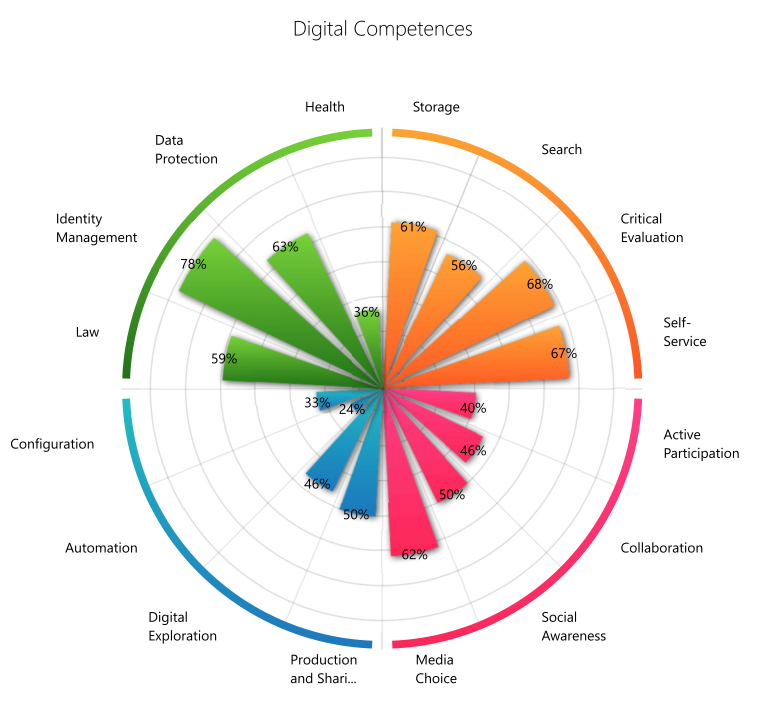
As part of this assignment, I completed the Digital Competence Test (https://digital-competence.eu/), which is based on the Digital Competence Wheel framework. The test evaluates digital competence across four main areas: information, communication, production, and safety. Rather than measuring only technical skills, it also assesses competencies such as searching for and critically evaluating information, communicating online, protecting personal data, and using digital services responsibly. After completing the test, users receive a personalised report that identifies both their strengths and areas for further development.
My test results showed that my strongest competence areas were Identity Management (78%), Critical Evaluation (68%), and Self-Service (67%). These results reflect my everyday life well, as I use digital services daily in both my work and personal life. My work requires me to evaluate information critically, make extensive use of digital services, and work safely in digital environments. The test also identified several areas for improvement, with the lowest scores in Automation (24%), Configuration (33%), and Health (36%). These results did not surprise me because my work does not require programming, automation, or advanced configuration of technical systems, and I have not studied these topics either. As a result, these are not my strongest areas of expertise. However, I think the test serves as a good reminder that digital competence is a broad concept and that there are always opportunities to continue developing one’s skills.
Self-Assessment
Writing this blog has been an interesting learning experience. It encouraged me to think more deeply about what it means to be a digital citizen and how strongly digital services are integrated into everyday life. I also enjoyed reading the blog posts written by other students. It was interesting to notice that many of us had similar experiences and opinions, even though we approached the topics from different perspectives. Reading and commenting on other students’ blogs also reminded me of the importance of respectful online communication and good digital etiquette.
While completing these tasks, I learned a great deal. In particular, I realised how well-designed and user-friendly many Finnish public digital services are. Services such as KELA, OmaKanta, and the Finnish Centre for Pensions provide clear, reliable, and accessible online services that allow people to manage important matters independently, regardless of time or place. At the same time, this assignment made me realise how concerning the issue of digital exclusion is. The topic feels particularly relevant because I can already see these challenges affecting my own parents. They first learned to use computers and digital services as adults, and changes to applications, concerns about digital security, and online scams often make them feel uncertain.
However, digital exclusion does not only affect older people. It can also affect children and young people. Although they usually learn to use digital devices very quickly, they do not always know how to evaluate whether information is reliable, how to use digital services safely, or where to find trustworthy information about topics such as public services and social benefits. Digital competence is therefore much more than knowing how to use technology—it also includes critical thinking, online safety, and the ability to use digital services responsibly.
Looking ahead, digitalisation will continue to shape our everyday lives. Artificial intelligence, automation, and increasingly advanced digital services will create many new opportunities, but they will also bring new challenges. How can we ensure that everyone is able to keep up with these changes? How can digital services remain accessible, secure, and easy to use for people of all ages and backgrounds?
In my opinion, the responsibility does not lie only with the users of digital services. It also lies with the people who design, develop, and make decisions about digital services in both the private and the public sectors. Digital solutions should be designed with users’ needs in mind, be clear and secure, and take into account the diverse needs and abilities of different users. Technology will continue to develop rapidly, but at the same time we must ensure that no one is left behind. Are we building a digital society that is truly accessible to everyone, or only for those who are able to keep up with technological change?
My thoughts on other blogs
The comments below have been submitted to the respective blogs and are also included here for assessment purposes. At the time my own blog was completed and submitted, some of the comments were still awaiting moderation and approval by the blog owners.
- Blog: DIGI CITIZEN | Bluestream Blog / Sini Ahonen
- Comment: “Thank you, Sini, for sharing your blog. I enjoyed reading how you connected the course topics to your own professional experience. The section about Työmarkkinatori was particularly interesting, as it provided a practical example of how AI can be used to match job seekers with suitable vacancies based on their skills and experience. It was fascinating to see how digitalisation is supporting both professionals and job seekers through these kinds of services. Your reflections on the digital divide also gave me new ideas when revisiting my own blog. I especially appreciated your point that the digital divide is not only about access to technology but also about equality, participation, and opportunities in today’s society. It reminded me how important it is to ensure that digital services remain accessible and that people have the skills needed to use them confidently and safely. Overall, your blog was well structured, informative, and easy to follow. Your professional experience added authenticity to the discussion and made the topics relevant and engaging. Thank you for sharing your insights.”
- Blog: DIGI CITIZEN – Johanna’s site / Johanna Myllys
- Comment: “Johanna, thank you for sharing your reflections. What I appreciated most about your blog was how your self-evaluation went beyond simply summarising the assignment. It was interesting to read how completing the different tasks made you stop and think about services that had become such a natural part of everyday life that you no longer really questioned them. I think many of us use digital services every day without reflecting on how much they actually support our daily lives. I also agree with several of the earlier comments about the challenges of digital healthcare services. Your experiences with OmaKanta show that even good digital solutions still require continuous development to provide a smooth user experience. As users, we often only notice the technology when something does not work as expected. Another point that caught my attention was your reflection on future planning after checking your retirement information in Keva. Rather than focusing only on the retirement age itself, I liked how you connected it to thinking about your own future and financial planning. It shows that digital services can also encourage us to reflect on long-term life decisions. Your blog gave a realistic picture of how digitalisation influences everyday life through both small daily routines and bigger life events. It was interesting to read your personal reflections and see how your own experiences shaped your perspective on digital citizenship.”
- Blog: Digi Citizen – Miranda von Ré Goes Digital / Mira Repo
- Comment: “Thank you, Miranda, for your well-structured and informative blog post. I liked how you combined your own experiences with digital services and explained clearly how digitalization has become part of everyday life in Finland. Your examples made the topic easy to understand and relatable. I especially agreed with your discussion about the digital divide. Aino also pointed out in her comment that limited digital skills can make it more difficult for people to compare prices, find the best deals and access important services, and I fully agree with both of you. People who already face financial or social challenges may be affected the most if they lack the skills or confidence to use digital services. This reminds us that improving digital competence is not only about learning new technology but also about promoting equality and inclusion in society.”
Leave a Reply