ePLATFORMS
Digital Tools in My Working Environment
I work in the grocery retail sector, where I collaborate with customers who use digital solutions and participate in their continuous development. My work combines business development, planning, communication, and collaboration with a wide range of stakeholders. As a result, digital tools are an essential part of my daily work and enable efficient cooperation across different teams, departments, and locations.
At the same time, my work gives me a broad perspective on how rapidly digital working environments are evolving. Although our organisation already uses a wide range of digital solutions, there is still considerable potential to improve the efficiency of everyday work. Not every business area has progressed at the same pace. Some teams still rely on older ways of working because the business environment has changed faster than digital systems have been able to adapt, or because development resources have needed to be prioritised elsewhere. In a large organisation with many different business functions and professional roles, it is simply not possible to digitalise everything at once. Continuous prioritisation is necessary to ensure that limited resources are invested where they create the greatest value.
Our organisation makes extensive use of the Microsoft ecosystem as the foundation for daily work. Microsoft Teams is the primary platform for communication, online meetings, collaboration, and virtual training sessions. Outlook is used for email and calendar management, while Excel, PowerPoint, and OneNote support data analysis, documentation, presentations, and the creation of training materials. Documents are shared and collaboratively edited through SharePoint and the company’s internal intranet, where employees can also access news, guidelines, and other essential information. In addition, Microsoft Copilot has become part of our everyday work, supporting tasks such as creating meeting summaries, drafting calendar invitations, and improving written communication. These AI-supported features help reduce routine work and make daily tasks more efficient.
Alongside Microsoft applications, I use several internal business systems that support areas such as business operations, project management, finance, human resources, and occupational healthcare. Some of these systems have been developed specifically for our organisation, while others are commercial solutions that have been customised to meet our company’s processes and business needs. Separate digital tools are also used to plan development work, monitor project progress, and manage enhancement requests and system-related issues. Together, these systems support collaboration between business experts, IT specialists, and other stakeholders throughout the development process.
One of the biggest changes I have witnessed during my career is how the role of digital technology has evolved. The first major step in digitalisation was replacing paper-based processes with electronic documents and digital systems. This significantly reduced the need for paper and made information easier to store, access, and share. Today, the focus has shifted to the next stage of digital transformation. Instead of simply replacing paper with digital documents, organisations are increasingly moving away from using numerous separate systems and towards integrated digital platforms.
The long-term goal is to create an environment where information only needs to be entered once and is then automatically transferred to all the systems that require it. As integration between systems continues to improve, duplicate work decreases, data quality improves, and employees can focus more on value-creating tasks instead of manually transferring information from one system to another. In my opinion, this is one of the most significant developments in today’s digital working environment. The future is no longer about using an increasing number of separate applications but about creating connected digital platforms where information flows seamlessly between systems. This also supports flexible, location-independent work. Our workplace is already almost entirely paperless, and employees work both remotely and on-site from different parts of Finland while collaborating with international partners around the world. Without digital platforms and integrated systems, this kind of modern working environment would not be possible.
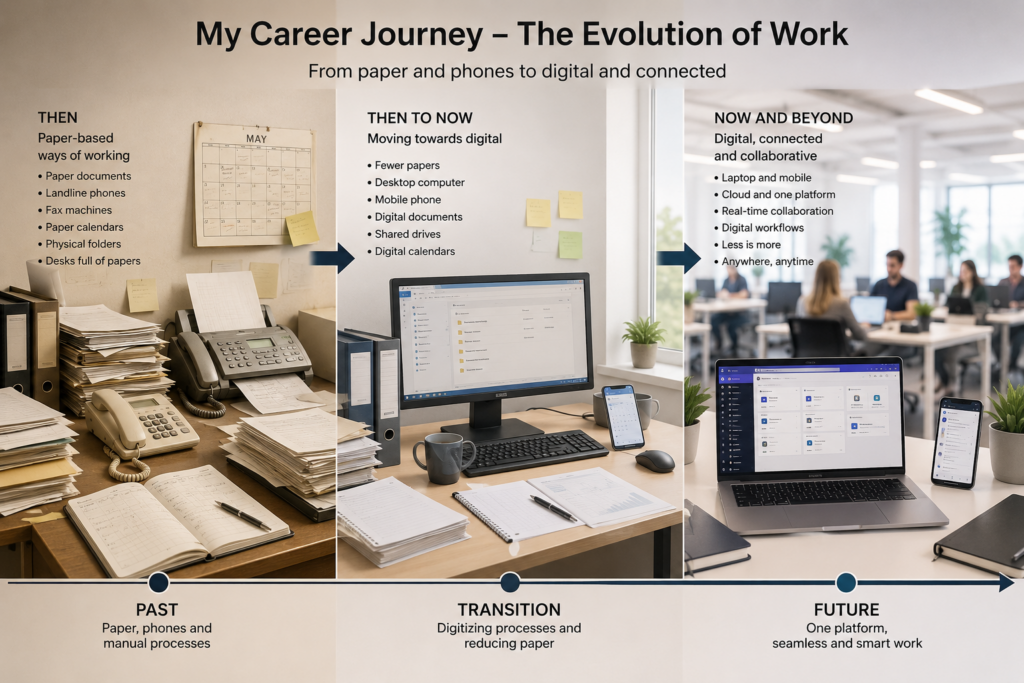
This image was created by providing a prompt to the open version of ChatGPT, illustrating the digital transformation I have personally experienced during my career. When I entered working life, paper documents, landline phones, fax machines, and paper calendars were still part of everyday work. Today, work is almost entirely digital, based on integrated platforms, cloud services, and AI-assisted tools.
Digital Tools Supporting My Work
For this assignment, I selected five digital tools that are either completely new to me or that I have not yet actively used in my daily work. I explored their features and evaluated how they could support my work in the future. I chose these tools because they represent different purposes, including content creation, collaboration, professional networking, communication, and video sharing.
DALL·E
DALL·E is an AI-powered image generation tool developed by OpenAI. It enables users to create images simply by describing them with text. The tool can be used for marketing materials, presentations, training content, and various types of visual communication. DALL·E is a new tool for me, and I became familiar with it during this course. I have used it to create the illustrations for this blog and have been impressed by how easily it can produce visual content without requiring graphic design skills. In my work, I could use DALL·E to create illustrations for training materials, presentations, and internal communications. Well-designed visuals often help explain complex ideas more effectively than text alone. However, creating high-quality images requires carefully written prompts, and AI-generated images should always be reviewed to ensure they are accurate and appropriate for professional use.
OpenAI DALL·E: https://openai.com/fi-FI/index/dall-e-3
Miro
Miro is an online collaboration platform that functions as a digital whiteboard. It allows users to brainstorm ideas, map processes, facilitate workshops, and collaborate visually in real time, regardless of where participants are located. Although I do not currently use Miro myself, I know that some of our company’s IT teams use it for project planning, workshops, and collaborative brainstorming. I have seen examples of how Miro is used to visualize processes and support teamwork between people working in different locations. I believe that this kind of visual collaboration could also support my own work, especially in development projects involving participants from different business units. One of Miro’s greatest strengths is that everyone can contribute to the same workspace simultaneously. On the other hand, introducing a new tool always requires training and shared ways of working before its full benefits can be achieved.
Miro: https://miro.com
LinkedIn is a professional social networking platform where users can build their professional profiles, connect with colleagues, follow organizations, and share knowledge. It is widely used for professional networking, recruitment, expert communication, and staying up to date with developments in working life. At the moment, I use LinkedIn only occasionally, but I believe it offers far more opportunities than I currently take advantage of. Many experts in our organization regularly share insights about the future of work, digitalization, and retail while also participating in professional discussions. LinkedIn provides an excellent opportunity to follow industry trends, learn from other professionals, and expand my professional network. In the future, I would like to use the platform more actively for professional development and to stay informed about current topics in my field. The challenge, however, is finding enough time to participate actively and identifying the most relevant content among the large amount of information available.
LinkedIn: https://www.linkedin.com
Slack
Slack is a collaboration and communication platform designed for teams. It enables users to communicate through organized channels, share files, and collaborate on projects, helping reduce the need for email and making information easier to find. Slack is another tool that is already used within my organization, although I have not yet used it actively myself. I know it is particularly popular among IT development teams and project groups where fast communication and information sharing are essential. Slack allows discussions to be organized into different channels, making project communication more structured and reducing reliance on email. I see considerable potential for using Slack in multidisciplinary development projects involving several teams or organizations. However, introducing another communication platform can also increase the number of messages and spread information across multiple systems unless there are clear organizational guidelines for its use.
Slack: https://slack.com
Vimeo
Vimeo is an online video hosting and sharing platform designed especially for businesses, organizations, and content creators. It offers advanced privacy settings and video management features, making it suitable for sharing professional video content securely. Before this assignment, Vimeo was relatively unfamiliar to me. After exploring the platform, I realized that it could be a useful solution for sharing training videos, online learning materials, and instructional videos with selected audiences. Compared with general video-sharing platforms, Vimeo appears to offer better control over video management, privacy, and presentation quality. I can see potential for using it in employee training and internal communication. However, implementing a new platform requires investment, user training, and careful evaluation of whether it provides sufficient added value compared to the video solutions already available within the organization.
Vimeo: https://vimeo.com
Social Media – Opportunities, Risks and Responsible Use
Social media has changed dramatically during the years I have been using it. When the first platforms, such as Facebook, became popular in Finland in the mid-2000s, their primary purpose was to help people stay in touch with friends and share everyday moments. I still remember when news feeds were filled with holiday photos, funny videos, chain messages and stories from daily life. People shared content quite freely without giving much thought to privacy, digital footprints or how something published online might affect them years later. At that time, social media had very little connection to working life, and job opportunities were not found through social media platforms. I also remember the discussions about what to do if your manager sent you a friend request on Facebook. For many people, it was the first time they started thinking about limiting the visibility of their posts or considering how much of their personal life they wanted to share online. Today these questions seem almost obvious, but back then social media was mainly seen as a place for leisure rather than something that could influence a person’s professional life.
Today, social media has become one of the most important channels for digital communication. It is used to share news, build company brands, market products and services, recruit new employees and distribute professional knowledge. At the same time, the boundary between personal and professional social media has become increasingly blurred. More and more professionals use social media to build their personal brand, while organisations actively engage with customers and other stakeholders through different platforms.
In my own work, social media is primarily a tool for following professional discussions and industry developments. For example, many experts within my organisation share their thoughts on digitalisation, the future of retail and changes in working life through LinkedIn. These posts provide an opportunity to follow developments in the industry, learn about solutions implemented by other organisations, discover new perspectives and participate in current discussions. However, I have also noticed that the nature of social media has changed considerably. In its early years, content was often spontaneous and focused on sharing everyday life, whereas today many posts are carefully planned and form part of a personal or corporate branding strategy. Social media rarely presents the complete picture—it usually highlights only the best moments. On the other hand, this also means that new trends, news and phenomena spread across the world almost instantly. Public visibility can create significant opportunities, but it can also become a major risk, as both positive and negative publicity can spread within minutes.
Although social media offers many opportunities, it also presents significant challenges. One of the most important is evaluating the reliability of information. As artificial intelligence continues to develop, increasing amounts of online content are generated that can be difficult to verify. A study published by Traficom in 2026 found that Finns still have strong trust in domestic news media, even though they increasingly encounter misleading content online. According to the study, a large proportion of Finns have seen AI-generated or manipulated images and videos, as well as other forms of false information. Encouragingly, most Finns are still able to distinguish between traditional news media and social media in terms of reliability.
Nevertheless, the rapid development of artificial intelligence is making this increasingly difficult. The more realistic AI-generated images, videos and audio recordings become, the harder it is to determine whether they are authentic. An interesting example was reported by Yle in 2026. Graphic designer Chris Bolton initially assumed that a video showing the coffin of Iran’s Supreme Leader, Ali Khamenei, being carried in a vehicle displaying K Group logos had been created using AI. In reality, the video was authentic. This example illustrates that in the future, the challenge will not only be recognising AI-generated content but also trusting genuine material when it appears too unrealistic to be true.
Another widely discussed issue concerns the impact of social media on well-being and mental health. Public debate often focuses on its negative effects, but research shows that the reality is much more complex. According to the University of Helsinki in 2022, social media can improve well-being when it is used for active interaction, building communities and sharing knowledge. Participating in discussions, receiving peer support and staying connected with others can strengthen a sense of belonging and improve well-being.
I recognise these benefits in my own life as well. Through social media I have found valuable information, particularly about health and well-being. It has been reassuring to discover that other people have experienced similar situations and to benefit from their practical advice and peer support. At the same time, I have become much more critical of the information I encounter. Not every recommendation is based on genuine personal experience; some are paid collaborations or forms of hidden advertising. Learning to distinguish authentic experiences from commercial content has become an important digital skill.
Mielenterveystalo.fi also describes the effects of social media as two-sided. On one hand, it can provide peer support, strengthen a sense of community and make it easier to stay in touch with others. On the other hand, constant comparison with other people’s lives, excessive screen time and algorithm-driven content consumption may increase stress, feelings of inadequacy, sleep problems and difficulties concentrating. I recognise this phenomenon in my own everyday life as well. Seeing friends’ holidays, achievements or restaurant experiences can sometimes make me wonder why I do not have the same opportunities at that particular moment. Even though I understand that social media usually shows only a carefully selected part of people’s lives, it is still easy to compare oneself with others. For this reason, social media cannot simply be described as either good or bad. Its effects depend largely on how it is used and how consciously people manage their own digital habits.
Concerns about the well-being of children and young people have also become an important topic in public policy. An interim report published by a working group appointed by the Ministry of Social Affairs and Health (2026) highlights that social media provides young people with opportunities for learning, communication, peer support and self-expression. At the same time, it identifies significant risks, including addictive algorithms, harmful content, cyberbullying and disinformation. Similar findings were presented in a study discussed in Tehy magazine (2025), which found that approximately one in seven young adults belongs to the high-risk group for problematic social media use.
The discussion is also becoming increasingly international. According to Helsingin Sanomat (2026), France approved legislation in July 2026 that prohibits social media use by children under the age of 15. The purpose of the law is to protect children’s health and safety while reducing the harmful effects of social media. At the same time, the European Commission is preparing common European measures to strengthen the protection of minors in digital services. This demonstrates that the impact of social media is no longer viewed solely as an individual’s responsibility but has become an important social, political and legislative issue.
From my perspective, social media is at its best when it is used consciously and with a clear purpose. It is an excellent source of information and a valuable professional tool that supports continuous learning, professional networking and keeping up to date with developments in my field. At the same time, users carry increasing responsibility for how they use these platforms. In the future, the most important digital skills will not simply involve learning to use new technologies. They will also include media literacy, the ability to evaluate the reliability of information, recognising misleading content and maintaining one’s own digital well-being. Managing screen time is also an essential part of responsible social media use. Most people have probably experienced intending to watch just one video or check social media for a few minutes, only to realise that an hour has passed while scrolling through TikTok or other endless content feeds. For this reason, using social media today requires increasing levels of self-management—a skill that has become just as important in working life as it is in everyday life.
Sources
Helsingin Sanomat 2026. Ranska kieltää somen alle 15-vuotiailta. Written by Koivunen, T. Published 22.7.2026. https://www.hs.fi/maailma/art-2000012156513.html. Accessed 26.7.2026.
Helsingin yliopisto 2022. Sosiaalinen media voi lisätä hyvinvointia. Published 3.2.2022. https://www.helsinki.fi/fi/uutiset/yhteiskunta-ja-oppiminen/sosiaalinen-media-voi-lisata-hyvinvointia. Accessed 26.7.2026.
Mielenteryveystalo.fi. Sosiaalinen media ja mielenterveys. https://www.mielenterveystalo.fi/fi/digihaitat/sosiaalinen-media-ja-mielenterveys. Accessed 26.7.2026.
Ministry of Social Affairs and Health 2026. Työryhmä julkaisi väliraportin lasten ja nuorten suojelusta sosiaalisen median haitoilta. Published 10.6.2026. https://valtioneuvosto.fi/-/1271139/tyoryhman-valiraportti-lasten-ja-nuorten-suojelusta-sosiaalisen-median-haitoilta. Accessed 26.7.2026.
Traficom 2026. Kuluttajat luottavat uutismediaan, vaikka kohtaavat verkossa myös harhaanjohtavaa sisältöä. Published 24.4.2026. https://www.traficom.fi/fi/uutiset/kuluttajat-luottavat-uutismediaan-vaikka-kohtaavat-verkossa-myos-harhaanjohtavaa-sisaltoa. Accessed 26.7.2026.
Tehy magazine 2025. Sosiaalinen media voi kolhia nuorten aikuisten hyvinvointia – noin joka seitsemäs kuuluu korkean riskin käyttäjiin. Written by Velhovaara, V. Published 26.8.2025. https://www.tehylehti.fi/fi/uutinen/sosiaalinen-media-voi-kolhia-nuorten-aikuisten-hyvinvointia-noin-joka-seitsemas-kuuluu-korkean-riskin-kayttajiin. Accessed 26.7.2026.
Yle 2026. Chris Boltonin vanha asiakastyö päätyi keskelle Ali Khamenein hautajaisia. Written by Malmberg, R. Published 10.7.2026. https://yle.fi/a/74-20235882. Accessed 26.7.2026.
Elements of Successful Use of Digital Applications
Throughout this blog, I have discussed both the digital applications I use in my work and various social media platforms. One important observation connects them all: the success of a digital application does not depend solely on its technical features. Even if an application is technically advanced and offers a wide range of functions, it provides little value if users do not find it useful or if it is difficult to use. In my opinion, a successful digital solution is created when technology, user needs and organisational practices support one another.
One of the most important success factors is ease of use. A digital application should have a clear, logical and intuitive user interface that allows users to find the functions they need without relying on lengthy user manuals. In reality, very few people read instructions before using a new application. Instead, the application itself should guide users through its interface by using clear icons, colours, symbols and other visual cues. The faster users learn how to use an application, the more likely it is to become part of their everyday routine.
However, ease of use alone is not enough. A digital application must provide genuine value to its users. It should solve a problem, simplify a task or save time. If a new application only adds extra steps to existing processes or feels like just another system among many others, users are likely to return to their old ways of working. In working life, the first question users often ask is very practical: How does this make my work easier? The same principle applies in everyday life—digital applications should simplify daily activities rather than make them more complicated.
Today, users also expect different applications to work seamlessly together. Information should transfer automatically between systems without the need to enter the same data multiple times. This expectation applies to both working life and personal life. For example, when purchasing a new smartphone, people expect their contacts, photos and settings to transfer automatically to the new device. Similarly, a new smartwatch is expected to synchronise effortlessly with a smartphone and other health or fitness applications. If systems cannot communicate with one another, the user experience quickly deteriorates, regardless of how well the individual application functions. Seamless integration is therefore no longer an additional feature but a basic expectation.
Successful digital applications also require trust. Users need confidence that the application works reliably and that their personal data is handled securely. Information security and data protection have become fundamental requirements for all digital services, and their importance is even greater in applications that utilise artificial intelligence. Users should be able to understand how an application works and on what basis it generates recommendations or responses. Trust is built through both reliable technology and transparency.
From my perspective, the best digital applications are those that become a natural part of everyday life. At their best, users do not pay attention to the technology itself—they simply focus on completing their work or everyday tasks easily and efficiently. At the same time, digital applications must continue to evolve alongside changing user needs, as technology, working life and user expectations are constantly developing. A successful digital application is therefore never truly finished but requires continuous improvement to remain useful and relevant in the future.
Self-Assessment
This assignment gave me the opportunity to explore digital applications and platforms from several different perspectives. I started by reflecting on the digital tools I use in my own work and then explored new applications that could potentially support my work in the future. It was particularly interesting to compare different solutions and consider how they could improve collaboration, communication, creativity and everyday work processes.
The section on social media encouraged me to examine the topic from a broader perspective than before. While social media offers valuable opportunities for networking, professional learning and information sharing, it also raises several concerns. Exploring recent studies and news articles highlighted issues such as the rapid development of artificial intelligence, the spread of misinformation, the effects of social media on mental health and well-being, screen time management, and the protection of children and young people in the digital environment. Reflecting on these topics reinforced my understanding that responsible use of digital services requires not only technical skills but also critical thinking, media literacy and responsible digital behaviour.
The final section on the elements of successful digital applications brought together the main themes discussed throughout the blog. Writing it strengthened my belief that technology alone does not create value. A successful digital application must be easy to use, provide genuine benefits to its users, integrate seamlessly with other systems and inspire trust. At its best, technology becomes such a natural part of everyday life that users hardly notice it—they simply focus on completing their work or daily tasks efficiently.
Overall, I really enjoyed this assignment. It was interesting to explore different digital applications and platforms while reflecting on their role in both working life and everyday life. I completed all the tasks required in the assignment, and I feel that they have broadened my understanding of how digitalisation influences not only organisations but also people’s daily lives, communication and well-being. I believe that artificial intelligence, automation and increasingly integrated digital platforms will become an even more natural part of both work and everyday life. Rather than simply learning how to use individual applications, people will increasingly need the ability to adapt to new technologies, evaluate information critically and make responsible choices in continuously evolving digital environments. I believe these are skills that will become increasingly important both in my professional role and in my personal life.
Leave a Reply