DIGI CITIZEN
Digi Citizen – my everyday digital life at home and at work
Digitalization is almost everywhere in my life. At home it is mostly about convenience, for example I can manage everyday tasks, shop, and communicate without leaving the sofa. At work it is also about responsibility, safety, and fairness. I work in oral health care as a dental hygienist, and I also do coordination and development tasks related to services for older adults/elderly. That combination has made me pay attention not only to the benefits of digital services, but also to the situations where digitalization creates new barriers. Because I work in healthcare and also do development work, I notice digital services both as a citizen and from the side of someone who sees how they work for other people.
Digital access and communication
Digital access depends on skills, devices, language, and confidence. For me, participation in a digital society is mostly easy. I can use online banking, manage appointments, shop online, and handle practical matters digitally. In working life these skills are also expected almost automatically, and digital systems are part of daily routines.
In oral health care I see the other side of access. Many services assume that citizens can book online, read messages, and authenticate themselves. For many older adults/elderly that works well, but for some it does not. The barrier might be practical, like not owning a smartphone, or it might be cognitive, such as memory issues. Sometimes it is simply anxiety about doing something wrong or fear of being scammed. When digital becomes the default, the risk is that the people who need the most support get the least access. That is why I think a functioning digital society still needs alternative channels, human guidance, and clear instructions. Digitalization should improve access, not reduce it.
Digital communication is another everyday part of being a digi citizen. At home it is messaging, apps, and notifications. At work it is coordination, internal messages and information sharing. In development work I often notice that communication is where things either become smoother or more confusing. A message can save time and reduce unnecessary phone calls, but only if it is clear, respectful, and sent through the right channel. This is also where digital etiquette matters. It is easy to forget tone online, and misunderstandings happen faster than face-to-face. In healthcare, respectful communication is part of safety and trust. Even small things like using plain language and avoiding unclear instructions can make a big difference.
Digital literacy, rights and responsibilities
Digital literacy is not something you learn once and then you are done. Tools change constantly, and so do services. I feel quite confident with everyday digital tasks, but I still notice how much my confidence is based on routines. When a service changes its interface, I can get annoyed sometimes. A small change can make a familiar service suddenly feel less straightforward.
Digital rights and responsibilities are closely connected to literacy. In a digital society, I expect services to be usable and safe, and I expect clear information about what data is collected and why. At the same time, I also have responsibilities to use strong authentication, be careful with links and messages, and pay attention to what I share and where.
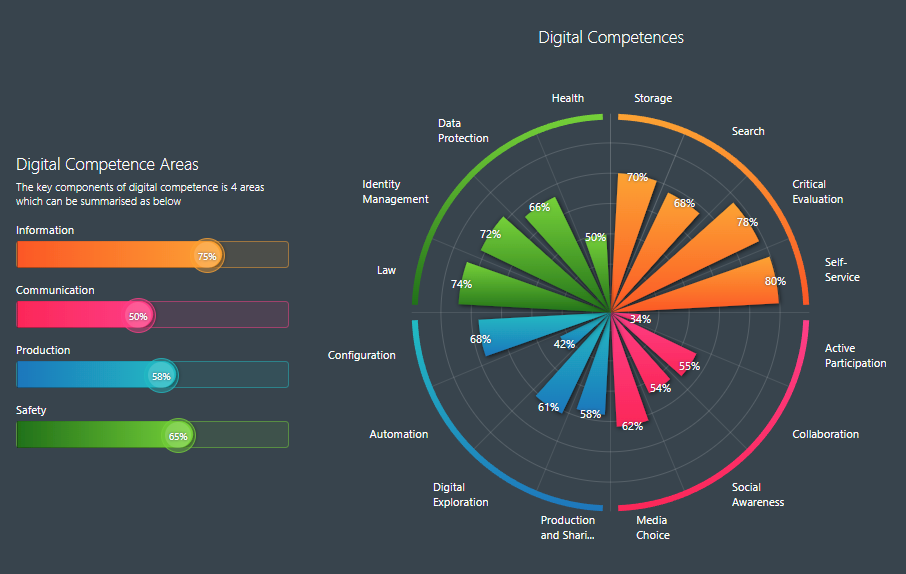
I also completed the Digital Competence Test for this assignment. The results did not feel right, and my first reaction was that the score looked lower than how I see myself. Then I realized that I may judge myself quite strictly. The test was still useful because it reminded me that digital competence is broader than technical skills. It includes communication habits, participation, and the ability to make safe choices in different contexts.
Finnish e-services in everyday life
I accessed Finnish public e-services using strong electronic identification. In my case, I logged in with mobile authentication, which feels convenient because it works without separate devices or apps.
In Kela, I use the online service for normal everyday matters related to personal and family life. What matters most to me is that I can handle things without paper forms and without having to call somewhere first.
I also applied for the European Health Insurance Card through the digital service. The process was straightforward and quick, which shows how public e-services can genuinely save time when authentication is smooth and the steps are simple.
In OmaKanta, I viewed my own health-related information. Citizens can access records and prescriptions in one place. The content can be very clinical and not always easy to interpret without background knowledge. Even though I understand healthcare documentation better than many users because of my work, the records can still feel quite technical from the citizen’s side.
In Keva, I checked a pension estimate using the online calculator. I will not share exact figures here, but the result made me reflect on how strongly pension estimates depend on work history and future income assumptions. I also noticed that the calculator did not allow comparisons for ages that are below a person’s own minimum retirement age.
Digital commerce
Zalando is the online shop I use most often. The biggest benefit is convenience: browsing clothes for myself and my child from the sofa is much easier than going to multiple stores, especially with a child. The selection is wider than in local shops, and Zalando offers brands that are not available locally. From a consumer perspective, product information is usually sufficient, such as size guides, materials, multiple photos and reviews support decision-making. Pricewise, it is not always cheaper than local stores, but discounts and campaigns can make it competitive. In terms of reliability, I consider Zalando safe because delivery and returns are predictable and customer processes are clear.
Amazon is something I use occasionally. I’ve ordered some household appliances because, even with shipping included, the total price has sometimes been lower than buying the same product in Finland. At the same time, this is not true for everything: delivery costs, warranty issues and seller differences matter a lot. Information is often extensive, but I have learned to check seller ratings and return policies carefully, because the experience can vary depending on who is selling the product.
Earlier, I used AliExpress for small craft materials (beads, satin ribbons, cords, buckles, clips, pins, etc.). The price difference compared to Finland was huge—often only a fraction of local prices. The trade-off was variability: delivery could take a long time and product quality was not always consistent. I also remember ordering Fiskars tailor’s shears from eBay UK cheaper than in Finland.
Digital services in my field
In my work, the most central digital service is the electronic health record system. It shapes how we document, how we share information, and how smoothly care is coordinated. When the system supports the workflow, it makes daily work safer and faster. When it does not, it creates extra steps and frustration, and that can also affect patient safety.
From a development perspective, I am also interested in digital care pathways and guidance materials. In services for older adults, clear pathways and understandable guidance can support daily routines, follow-up, and cooperation between professionals and caregivers. Digital formats can make guidance easier to access and update, but only if the pathway is truly simple and the content is understandable for different users.
In healthcare the digital gap can mean missed appointments, misunderstood instructions, or people not knowing where to get help. Some older adults/elderly are very capable digitally, but some are not, and the reasons vary. That is why services need accessible design, simple language, and real support and not only a technical solution that assumes everyone can use it.
Digital health, wellbeing and security
Digital tools can support wellbeing in many ways. They may provide access to information, services, and self-care support. In healthcare, reminders, clear guidance, and easy access to records can help people manage their own health.
However, I’ve noticed digital life has downsides too. Constant notifications, screen time, and information overload can increase stress. In working life, digital systems can also blur the line between work and free time. For me, digital wellbeing is partly about boundaries such as choosing when I am available and when I am not. Digital security is one of the most important parts of digital citizenship, especially in healthcare. As a professional, I’m especially aware of how important it is to protect personal data. For citizens, safety means strong authentication, secure payments, careful sharing and awareness of scams.
Self reflection
I did not have huge “wow moments” during this assignment, because many of these themes are already familiar to me through work, studies and personal life also. I have been thinking about digital inequality, privacy, and trust for quite a long time, especially in the context of healthcare services.
The Digital Competence Test made me realize how broad digital competence actually is. It includes participation and communication habits, not just technical tasks. Another useful outcome was putting familiar things into a clearer structure. It made me notice how the same questions come up again and again, whether the topic is public services, online shopping, or healthcare. In the end, it is often about the same basic things such as clarity, trust, usability and support.
Blogs that I commented:
25.2.2026 at 18:00
Hi,
It is interesting how you highlight different aspects of digitalization in everyday life, work, and healthcare. The text shows clearly how digital services can make communication and daily tasks easier, while also creating challenges for people with varying skills or limited experience with technology. Overall, the reflection provides a broad view of what it means to live in a digital society where services, security, accessibility, and wellbeing are increasingly interconnected.
BR, Liina
4.3.2026 at 15:34
Hi,
I liked reading your post. I liked especially how you describe digital life at home and at work and make it feel very realistic. You use good examples of Kela, OmaKanta, and internet shopping and show where digital life is easy and where it is stressful.
You mentioned digital gaps, and I think it is very important, especially for older people who might not know how to use digital technology. This is very important for digital citizens because it shows you are aware of it and feel for people who might need it.
Your post shows how digital tools help, support, clear instructions, and human guidance are still needed. It’s very thoughtful and practical!
4.3.2026 at 15:34
Thank you for your article about being a digital citizen! I like how you explained using digital services, especially how oral health care services can be booked and used online. However, it might be challenging for some older adults who face memory issues. The point about the digital gap is important too, because not everyone finds online services easy to use. I also agree that people who struggle with digital tools shouldn’t be left out, and we need to think about how to support everyone in using digital services.
Link to my article: https://blogi.savonia.fi/kanchawanat/digi-citizen/
Feel free to browse 🙂