DIGI SOCIETY
Digi Society – reflections from oral health care, senior services and digital change
Digitalization is something I notice at work and at home. Many everyday things happen through digital systems nowadays. We book appointments online, receive messages through apps, use electronic identification, and rely on digital platforms for information. In health and social care, digitalization is not only about new tools. It changes routines, responsibilities, access to services, and sometimes also the feeling of safety for the patient.
My own perspective comes from oral health care. I work as a dental hygienist and I have also been involved in coordination and development tasks, especially related to services for older adults/elderly. My work includes developing cooperation models between oral healthcare and elderly services, shaping care pathways, and supporting staff training. Studying service design and digitalization in health and social care has pushed me to look beyond whether a system works technically.
What digitalization looks like in my work
In oral health care, digital tools are already part of normal daily practice. We use electronic health records, digital imaging and national e-services. When systems are usable and well integrated, information is easier to find and care becomes more continuous. When systems are fragmented or unclear, digital work easily turns into extra steps and workarounds, which can increase stress and take time away from patient interaction.
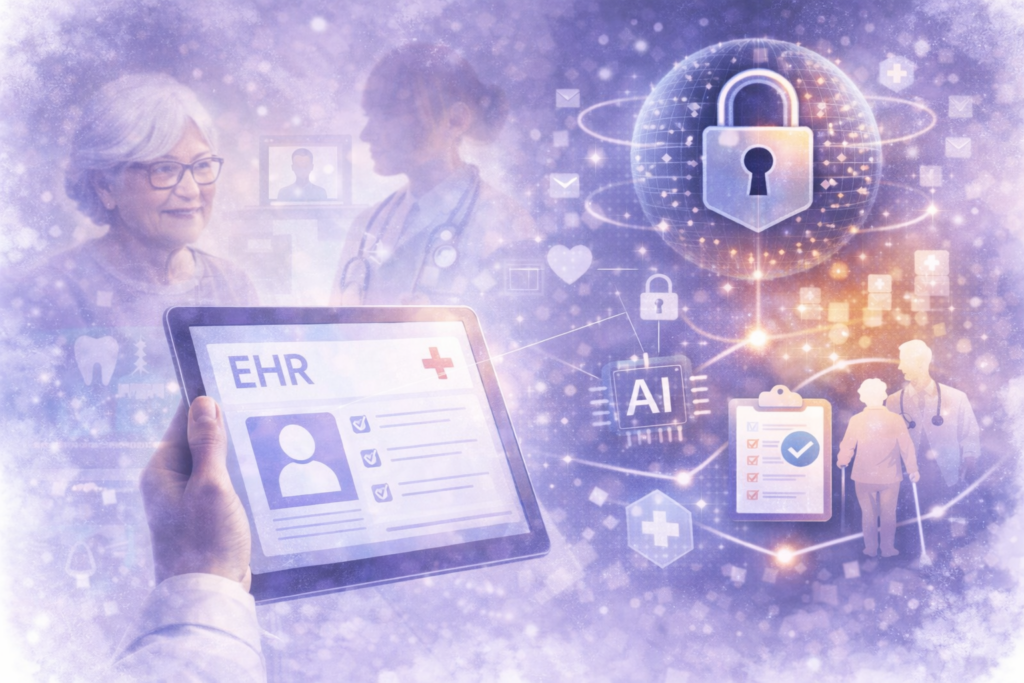
In elderly services, digitalization is often less about impressive technology and more about shared routines and clear pathways. A concrete example from my own development work is building an operating model for oral health care in elderly services. The goal is that older adults receive oral health services more equally whether they live at home, in assisted living, or in institutional care. Clear pathways support early recognition of problems, smoother communication and more systematic follow-up.
I have learned that the most useful digital improvements are usually the simplest ones. They support clear roles and make everyday work more consistent. When staff knows what to observe, where to record it, and how to move forward, the process becomes safer for the patient. This is especially important with elderly, because small oral health problems can escalate quickly when functional ability declines or when there are multiple medications and chronic conditions.
I have also worked with practical guidance materials for staff and family members, especially in situations where a person has memory disorders or reduced functional ability. Clear instructions and easy-to-find guidance can make daily care much easier. Digital formats can support this by making materials accessible whenever they are needed, but the content still needs to be simple, concrete and usable in real situations.
I also see that digital services don’t work equally well for everyone. Older adults/elderly may have limited digital skills, sensory limitations, cognitive challenges, or no access to suitable devices. This is why digital services must be supported by alternative channels and human guidance. For me, it is important to remember how to improve services without leaving behind the people who need them most.
Benefits and challenges in everyday reality
Digitalization can improve care when it supports the real workflow. It can strengthen continuity of care because information is easier to access. It can support preventive work because follow-up becomes more systematic. It can also support multi-professional collaboration when responsibilities and communication are clear.
In elderly services, staff are often the first to notice daily changes in oral health. When communication channels and pathways are clear, concerns are more likely to reach the right professional quickly. That affects patient safety in a very practical way.
Digitalization also brings challenges that are easy to underestimate. Digital inequality is one of them. It affects patients, relatives and even professionals. Not everyone has equal confidence, time or resources to adapt to new systems. If services become digital by default, the people with the greatest needs could end up with the weakest access.
Usability and system integration are another major issue. If systems do not work well together, information is duplicated or lost between platforms, and professionals spend time navigating instead of focusing on patient interaction. In health care, this is not just annoying, it can also create safety risks and increase stress.
Trust and human contact remain central. Health care is relational work. Digital tools can support care, but they should not replace human support when human support is needed. In my view, successful digitalization is not measured only by speed or efficiency but also by whether care becomes safer, smoother and more equal.
Open digital society, GDPR
An open digital society brings opportunities for participation, innovation and communication. It also brings risks, including misuse of personal data, cybercrime, profiling and misinformation. In healthcare these risks are particularly serious because health information is sensitive.
I also think it is important to acknowledge that not all risks are purely technical. Human factors matter. Unclear processes, rushed documentation, or overreliance on systems can lead to errors. Digital systems can reduce mistakes by supporting structured work, but they can also create new ones when interfaces are confusing or when staff are not supported properly.
In my work, GDPR is visible in practical routines such as collecting only necessary data, using secure channels, and paying attention to access rights. It supports trust, which is essential in healthcare.
I see GDPR as mostly positive, because it strengthens patient rights and pushes organizations to improve data security practices. At the same time, it can increase administrative workload and create uncertainty if guidelines are unclear. Good implementation requires clear processes and continuous training so that staff feel confident about what is allowed and what is required.
ChatGPT, future trends
As part of this assignment, I tested ChatGPT with a couple of questions related to my field.
- How digital tools could support oral care routines for older adults?
- What the main risks are when using AI tools in healthcare communication?
The answers were structured and easy to read. They offered practical suggestions such as reminders, checklists and guidance materials. The answers were mostly reasonable on a general level, but I would not consider them ‘correct’ without checking details against clinical guidelines and local practices.
AI tools can support thinking and drafting, but they should not be treated as an authority. In healthcare, professional judgement remains essential, and sensitive patient information should never be entered into open AI tools.
Looking ahead, I expect hybrid service models to become more common. Face-to-face visits will remain essential for treatment, but digital services can support guidance, follow-up and monitoring. In the best case, this improves accessibility and reduces unnecessary visits. In the worst case, it creates extra steps or increases inequality if the digital parts are not designed for different users.
Self reflection
Many of the themes in this assignment were already familiar to me through my work and studies. In oral health care development, I’ve been thinking about digital risks, data protection and inclusion for quite a while. Issues like usability, digital inequality and trust are not theoretical topics for me, because they show up in everyday practice, especially when services involve older adults and their support networks.
Even so, the course materials helped me put my existing thoughts into a clearer structure. It also pushed me to look at digital society a bit more broadly than my own workplace context. One thing that felt genuinely useful was noticing how often the same pattern appears across different topics.
This assignment made me think more about communication and guidance as part of patient safety. In senior services, much of the work is about turning information into something staff and relatives can actually use in everyday situations. Working through these tasks made me think more about how easily small misunderstandings spread in digital settings. If a pathway, instruction or digital service is even slightly unclear, it can quickly cause confusion when it reaches users in different environments.
AI tools can sound confident even when the content is generic or missing context. In my opinion AI can support drafting and idea generation, but professional judgement and responsibility must stay central, and sensitive information should never be shared in open tools.
Overall, I didn’t “discover digital risks” for the first time here, but I did strengthen my ability to describe them clearly and connect them to practical service development.
Blogs that I commented:
10.2.2026 at 21:42
It was nice to read a professional’s thoughts about healthcare and its digitalization in relation to elderly people and the accessibility of services. I had to help my own grandparents with digital services, they would not have managed, for example, booking appointments on their own anymore. I have noticed the same with my own parents. Using new applications and services is difficult, and there is not necessarily the confidence to use them.
I work in the ICT sector, and our clientele also includes senior customers. Their challenges are quite different from those of other customer segments. Enter Ry provides seniors free support in using computers, mobile phones, and tablets, as well as other technology-related matters. They visited my workplace to demonstrate, using the so-called ‘elderly suit,’ how difficult it can be to use a mobile phone, for example. The suit allowed you to wear glasses simulating various eye diseases, gloves that made your hands tremble and feel dry (like in Parkinson’s disease), as well as weighted clothing and other means to create the sensation of what it feels like to be elderly. This was very enlightening but also caused anxiety. In my opinion, everyone who designs digital services for the elderly should try their own products before publishing them while wearing this suit.