



KELA, KEVA and OmaKanta
I belong to a generation that has experienced adulthood both without and with public digital services. In my opinion, life has become significantly easier since we gained access to these services via Internet. When you have digital access to public services like Kela, Keva, Maistraatti and Suomi.fi you save a lot of time.
I live in the countryside, where public services are constantly being reduced. If I had to handle matters in person every time I needed help from Kela or the tax office, I would have to take time off work, drive 45 minutes each way, and wait in line before even getting service. Thanks to digital services, I can take care of these things quickly and efficiently whenever it suits me best.
I became familiar with Kela’s services through my studies and having children. I was also already familiar with Keva’s website. I work in the healthcare field and regularly make entries into the OmaKanta system, so using it is second nature to me. I also check my own and my children’s health records through OmaKanta. I log in using strong identification via a mobiilivarmenne.
DIGITAL SHOPPING
I visited Amazon.de and Amazon.it with the intention of comparing food prices with Finnish grocery stores, but unfortunately, this comparison didn’t work out as planned. However, I noticed that pet food, such as Royal Canin for dogs and cats, was about 10–20% cheaper in Germany and Italy. Shipping costs raise the overall price, but I started thinking that if one is traveling to Europe by car, it could actually make sense to buy a large bag—assuming there’s space in the car.
I find it interesting to compare prices across Europe. I consider Amazon’s websites to be reliable, as they are part of a global platform.
VARHA APPLICATION
I chose to review the Varha mobile application. I work at Varha, the wellbeing services county of Southwest Finland, and I hadn’t downloaded Varha’s own app before this assignment. I personally use an occupational health doctor, and my children are covered by private health insurance, so we usually go to a private clinic.
Varha’s app appears to be clear and user-friendly. It provides direct links to other digital services such as Omaolo, OmaKanta, self-care instructions, Lab and X-ray appointment booking, official treatment guidelines (Käypä hoito), and Omahelpper. By downloading just one app, you get easy access to many useful portals. Logging in requires strong authentication, such as online banking credentials.
I work in oral healthcare at Varha, and through the app, people can chat with a dental nurse. I think this is an excellent service that allows people to get in touch with oral healthcare quickly and easily. I haven’t used the service myself, so I can’t say how fast the chat works or whether people have received help through it.
In my opinion, we employees at Varha should be trained on how to use the app so that we can better guide patients to it. It frustrates me that new, high-quality digital platforms are created and maintained, but not enough is invested in instructions or training for employees. I truly hope to see a change in this.
Digital Competence Test
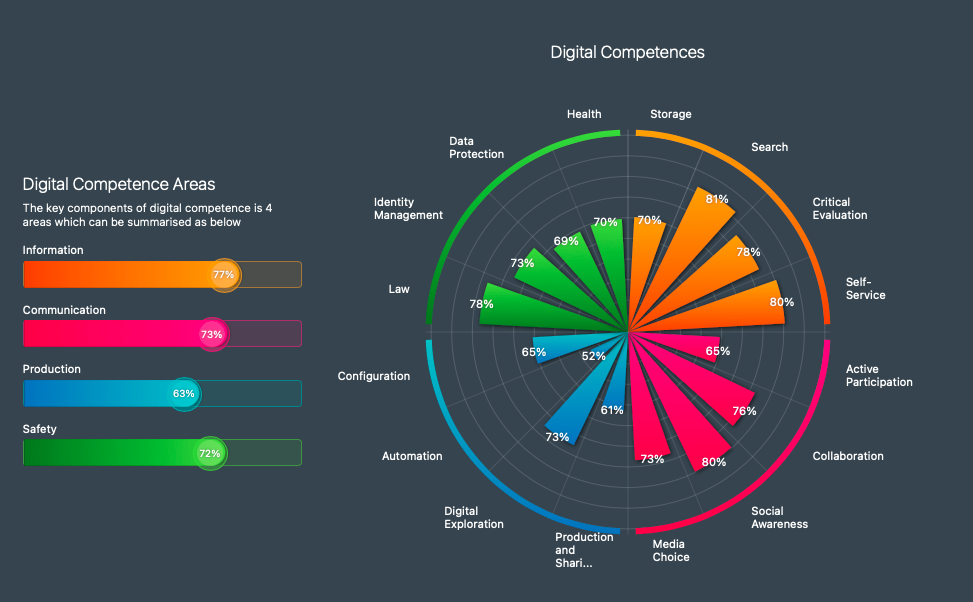
I found this test very interesting to complete, and it gave me a comprehensive picture of my own digital skills. My strongest areas were searching for information from reliable sources and reading information critically. These skills have improved significantly during my studies.
I graduated as a dental hygienist in 2019, and during those studies, my digital competence grew considerably. In 2021, I began studying in the Master’s program at Savonia University of Applied Sciences, and the studies are entirely online, which has further developed my digital skills.
While working on my thesis, it was crucial to search for reliable information, and I received valuable support from the school library’s “Tärppi” service. I share very little about myself on social media and I am quite a passive user—I mainly read others’ posts but don’t share much from my own life. I’ve been thinking that I should join LinkedIn, as it could open up new job opportunities.
I still need to learn more about the technical side of digital content. I’m interested in understanding how algorithms work, how automation is used, and how data is collected and stored globally.
DIGITALIZATION AND THE DIGITAL GAP
According to data from Statistics Finland (stat.fi), nearly 100% of people aged 16–64 in Finland used the internet during a three-month period in 2024, and almost 90% used it several times a day. Among those aged 65–74, 81% used the internet daily, and about half of people over 75 did the same.
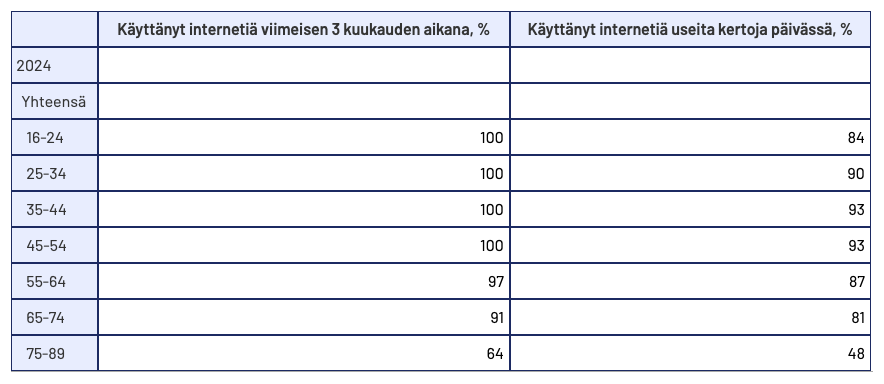
Looking at these statistics, I’m not particularly worried about whether Finnish people have internet access or the ability to use it. However, there is undoubtedly inequality in terms of finding information and knowing how to manage affairs via digital services. Young people, for example, are facing many mental health issues, which can affect their ability to manage personal responsibilities.
In the future, I believe that differences in digital skills won’t necessarily stem from a lack of access to the internet, but rather from people not being motivated to handle their affairs at all. Since everything happens digitally, human contact may disappear, and people may become isolated from normal interaction and the skills needed to connect with others.
For some, handling matters online is a relief—it can be done without face-to-face contact. For others, the lack of contact may lead to forgetting or neglecting their responsibilities altogether. So how do we ensure that people don’t fall out of society?
Additionally, the overwhelming amount of information and tasks to manage online can lead to mental exhaustion, making it hard to get anything done—even when the systems are designed to be “easy and convenient.” For some people, even simple digital interactions can feel mentally challenging.
I believe that promoting mental wellbeing and ensuring that people feel a sense of belonging in a community should be a top priority in society. Finland has an excellent education system, and we should not only teach concrete subjects at school but also focus on how to live a good life—how to care for mental wellbeing, develop emotional intelligence, and build stress tolerance. These are the skills that will carry our society forward amid future uncertainty.
We need to learn how to work together, so that the bright flames of life shine for everyone.
SELF REFLECTION
This assignment made me reflect on how remarkably well digital public services function in Finland. You can contact authorities 24/7, and official, reliable information is easily accessible online. I had never applied for the European Health Insurance Card from Kela before, as I have comprehensive travel insurance, but I think it’s great that the EU offers shared health insurance services for its citizens.
In my view, the internet has brought many benefits to society. It has increased transparency, made prices easier to compare globally, and at the same time, brought different values to the forefront. Do you buy the cheapest option—or the one that aligns with your values? In physical stores, you’re often buying products that reflect the store’s values. But when shopping online, you can choose items that reflect your personal values. I think that’s a powerful thing for humanity.
It was fascinating to read the texts and thoughts shared by other students while working on this task. I believe that in the future, people will need to continuously maintain and develop their digital skills. Artificial intelligence will transform the world in ways we cannot yet fully understand.
But as digitalization progresses and services become more electronic, we must remember to care for people, too. To be human to one another, to connect with each other, to show compassion—and to recognize that life without a community can be very lonely. That’s why we must ensure that neither the elderly nor the youth fall into isolation.
Digitalization will never replace the importance of genuine human contact.
I commented these blogposts:
Hi! Thank you for your thoughtful and insightful text! I am from the same generation as you, and I completely agree that life has become significantly easier with the advancement of digitalization. I believe our generation holds a valuable position, as we had the opportunity to experience childhood without the internet, mobile phones, or social media, while also growing up alongside digital technology and learning to use various digital services wisely and critically.