
Social insurance system and accompanying digital services in Vietnam
In Vietnam, the country where I was born and raised, the Social Insurance (SI) system has made significant progress in applying technology to improve management efficiency and serve the people. The Vietnam Social Insurance Agency is currently deploying many digital platforms to optimize processes, simplify procedures and ensure transparency.
One of the most popular tools today is the VssID application – Digital Social Insurance, which allows users to look up information about their participation in social insurance and health insurance, use QR codes to replace paper health insurance cards when going to see a doctor, as well as receive notifications about insurance benefits. In addition, people can also use the National Public Service Portal (https://dichvucong.gov.vn) to carry out procedures related to social insurance without having to go directly to administrative agencies.
In addition, businesses and organizations that use labor are also familiar with electronic social insurance declaration through service providers such as EFY, VNPT, TS24, etc. This helps to significantly reduce time, effort and costs for both employers and social insurance agencies.
The future development trend of the social insurance sector in Vietnam focuses on three main focuses: Comprehensive digital transformation: All social insurance records, processes and data will be digitized and integrated synchronously in a centralized management system. National data connection: Social insurance data will be connected with other databases such as population, health, tax, etc. to simplify procedures and support quick decision making. Application of artificial intelligence (AI) and Big Data: Big data analysis will help social insurance forecast trends, detect fraud and personalize services effectively.
Digital services in the social and healthcare sector in Vietnam
Along with social insurance, the healthcare sector is also undergoing a strong transformation thanks to the application of technological solutions. Many digital services have been deployed at both central and local levels, serving the increasing and diverse needs of the people.
Some typical services include:
Electronic health book: A mobile application deployed by the Ministry of Health, helping people manage personal health records, vaccination history, test results and medical examination and treatment.
Electronic medical records (EMR): Applied in many large hospitals such as Bach Mai, Cho Ray, helping to replace paper medical records, while improving the quality of patient management and treatment.
Online medical examination and treatment registration: Many hospitals and private clinics have allowed patients to make appointments via website/phone or applications such as eHospital, helping to reduce waiting time and overload.
Telehealth: Particularly promoted during and after the COVID-19 pandemic, this model allows people in remote areas to access high-quality medical services through online connections with central doctors.
The advantages of applying digital technology in the healthcare sector include: People can access medical services and personal information quickly, conveniently, anytime, anywhere and save time. Data is stored synchronously and accurately, helping doctors have a comprehensive view of the patient’s condition, helping to improve management and treatment efficiency. Thanks to the telehealth system, people in difficult areas can be examined and consulted by highly qualified doctors.
However, there are still some disadvantages that need to be overcome: While large cities such as Hanoi, Ho Chi Minh City, and Da Nang can easily deploy these technologies, many remote areas still lack equipment and stable internet connections, hindering access to digital services. The storage and processing of personal health data do not have comprehensive protection mechanisms, raising concerns about privacy and leading to risks of patient information leakage. Finally, the operation and management of digital systems requires highly skilled technical human resources, which many medical facilities still lack.
Digital stores like eBay, Amazon, Booking.com, Trivago
I have used eBay, Amazon, Booking.com and Trivago a lot and I find them much cheaper than local stores. They have the advantage of price because many sellers source their goods from factories and have warehouses in many different countries which greatly shortens the shipping time. They also have a wider selection of storage and items than local stores. I have never been scammed or had any problems with these services so I find them very trustworthy.
A service/app in my field
I chose the S-Pankki service because I used to work in a bank before so I am familiar with that field. I opened a S-Pankki account when I came to Finland to study. I found their service quite good to use. They have a website and a mobile app for customers. I have used their app for strong identification for some state services for example. I have not used their website much because it is not really necessary, their app has everything you need for banking services. The app works almost perfectly most of the time so I am very satisfied with it.
Digitalization and the digital divide; risks and challenges for those who do not use virtual services
In my opinion, digitalization in Finland is very advanced and has been implemented in many areas, so those who do not use digital services may be missing out on a lot. For example, job searches in many places are only done through online applications, so a lot of potential jobs are missed because of that. Many state and city services require online banking credentials, so without them you can’t log in anymore. Many companies also don’t accept cash anymore, so many services or goods can’t be purchased anymore because of that. Therefore life is much more difficult today if you need services that are only available in digital form.
Digital Competency Test
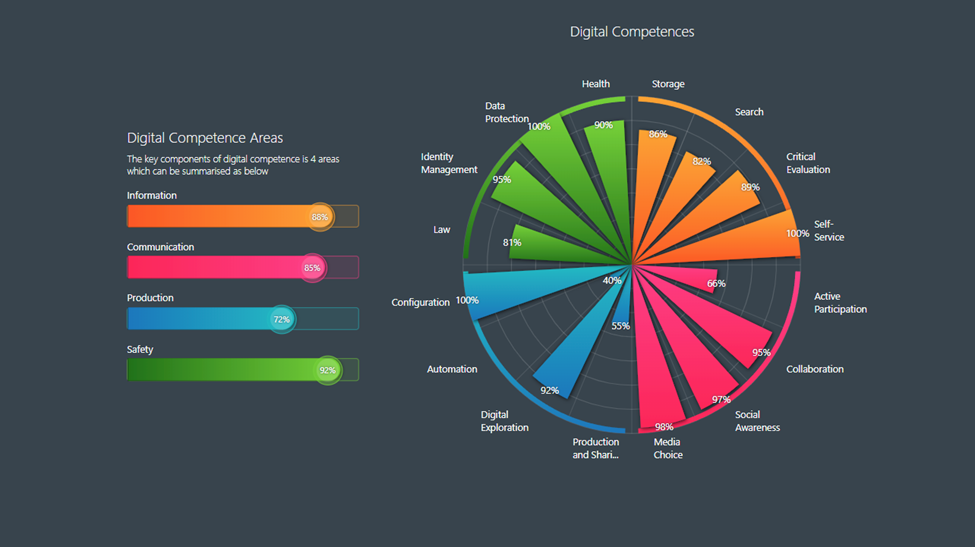
My thoughts and experiences
When I came to Finland, I was surprised at how efficient digital services are here compared to Vietnam. In Vietnam, many things are still done the old-fashioned way, on paper. For example, banks still use a lot of paper documents for filing applications and storing customer information. Electronic registers are not used as much as in Finland.
I was also surprised at how efficient these services are in Finland. I think digital services are very seamless and easy to use, from taxes to education. I have used many different services from the state, the city and my school while in Finland and I am very satisfied with them.
Many things are becoming digital and in addition, artificial intelligence will replace many things in this area. I think there are many good things in this regard, but we also have to be careful about this. For example, I personally do not like the artificial intelligence customer service agents that we see in many places now. To me, it feels like the company is trying to distance itself from its customers. I experienced this when I had to request a refund for an order, but only an AI bot answered my questions. This was frustrating because I felt like I was not getting the proper help from the bot. I believe this issue will grow in the future, but there is still a lot of development to be able to do better than a real person in customer service.
Overall, digitalization in Finland has been very successful and I believe this development will only increase. Those who do not use or cannot use digital services will suffer in this development, but the state and municipalities should come up with solutions to this problem, for example by providing the right devices, systems and people to help them use them in public places.
I learned the lessons of the struggles of those who cannot use these services in these exercises. I am fortunate to not have any problems with the current digitalization process but now I know how difficult daily life can be without these services.
I have commented on the blogs below: