The Finnish Social Insurance Institution (KELA), is the agency that helps people in Finland access the support they need in everyday life. It provides financial assistance for things like medical care, sickness, unemployment, raising children, disability, and housing. By offering these benefits, Kela helps ensure that people can get the help they need when life becomes challenging, whether due to illness, work loss, or simply growing older, so they can maintain a sense of security and wellbeing.

I and my family rely on several important services from Kela that greatly support our daily lives. As a single parent of two children, one of whom turned 17 last year, I receive child benefits for my younger child and state child maintenance support (elatustuki) for both, as child benefits are provided only until the age of 17, while child maintenance support continues until 18. I also receive the single parent allowance, which, together with these benefits, helps cover living expenses and ensures my children’s needs are met.
In addition, I have previously received study grants when I was a student and maternity leave benefits when I had my two children, which provided crucial support during those life stages. I also hold a European Health Insurance Card (EHIC), which provides access to public healthcare in the EU, EEA countries, Switzerland, and the UK, giving us security and peace of mind when traveling. These services are essential for our family’s wellbeing, stability, and health, allowing me to focus on raising my children in a safe and supportive environment.
Omakanta
Omakanta is Finland’s national online service that allows residents to view and manage their personal health information. I access Omakanta by logging in securely through the Finnish electronic identification system using my bank mobile apps. Omakanta is Finland’s national online service, available round the clock, that allows residents to view and manage their personal health information.
Through Omakanta, I can check my medical records, prescriptions, and lab results, as well as see the medications I or my children have been prescribed. It also enables me to renew prescriptions and track my healthcare history, giving me more control over my own and my family’s health. This service is extremely valuable because it provides convenient, up-to-date access to medical information, ensures continuity of care, and allows me to make informed decisions about our health in collaboration with healthcare professionals.
Estimating Future Pension Income with Keva
Keva, governed by the Act on Keva and the Public Sector Pensions Act, manages statutory earnings-related pensions for Finland’s public-sector employees, including those in municipalities, wellbeing services counties, the government, the Evangelical Lutheran Church, and Kela. Keva’s responsibilities include paying old-age, disability, and survivor’s pensions, overseeing pension accrual, providing retirement planning and estimates, supporting work ability, and managing pension-related investments. Within Finland’s earnings-related pension system, coverage depends on the employer, with Keva handling public-sector pensions while private-sector employment is covered by other providers. Pension accrues automatically from reported salaries, with estimates calculated from national income data. I accessed my own pension information by signing in securely to Keva’s online service using my bank ID, which I authenticated through my bank’s mobile app on my phone.
My Keva profile states that my retirement age has not yet been confirmed, but it provides an estimated range from 66 years and 10 months up to 70 years. based on the system’s calculation using registered income of €6,595.95 per month, the earliest pension would begin on 1 April 2049, when the personal retirement age of 66 years and 10 months is reached, with an estimated pension of €3,433.72 per month. If retirement is postponed to the target age of 68 years and 9 months on 1 March 2051, the pension would increase to approximately €3,939.29 per month. Continuing work until the maximum accrual age of 70 years on 1 June 2052 would further raise the pension to around €4,286.25 per month.
However, using the personal estimate of €3,500 per month, which is likely more realistic since it reflects regular income without me working extra hours, the pension projections are lower. With this income, the earliest pension would start on 1 April 2049 at the personal retirement age of 66 years and 10 months, with an estimated amount of €2,444.70 per month. Retiring at the target age of 68 years and 9 months on 1 March 2051 would increase the pension to about €2,770.26 per month, and continuing work until the maximum accrual age of 70 years on 1 June 2052 would raise it further to approximately €2,991.73 per month.
Comparing Prices and Reliability of Health Monitoring Devices: Online vs. Local Finnish Shops
For my assignment, I compared the prices and product information of two health monitoring devices: the Omron blood pressure monitor and the Contour Next blood glucose monitoring system. I checked their availability and prices across Amazon, eBay, and local Finnish shops.
Regarding the Omron blood pressure monitor, Amazon listings were unclear, as most prompted “see more options,” and “no featured offers available”. On eBay, prices for brand new devices ranged widely from €31.74 to €264, depending on the model and seller. Local Finnish shops offered more consistent pricing: Yliopiston Apteekki had prices between €114.90 and €259.90, Tockman ranged from €49.99 to €259, and Prisma listed them for €34.95 to €179.
For the Contour Next blood glucose monitor, Amazon had only one listing with a price of €133.36, while other listings either displayed “see more options” and “no featured offers”. On eBay, brand new monitors ranged from €7.72 to €48.93, showing a wide price variation. Local Finnish shops provided more stable pricing: diabeteskauppa.fi sold it for €22.90, yliopistonverkkoapteekki.fi for €27.90, and Suojaintukku.fi for €59.16. Suojaintukku.fi also included instructions for proper usage, which can help ensure accurate blood glucose readings.
Comparing the product information, I found that eBay and local Finnish shops generally provided more accurate and detailed information than Amazon. Individual customer reviews on eBay were particularly helpful for understanding the products, while Amazon mostly relied on general ratings. Personally, I would choose to buy from Finnish shops first because I trust the quality and reliability of the products. My second option would be eBay, as the site is user-friendly and the reviews help in making an informed decision.
In conclusion, while online marketplaces like eBay and Amazon offer convenience and a wide range of prices, local Finnish shops provide more consistent pricing, reliable product information, and additional support such as usage instructions. This makes local shops my preferred choice for purchasing medical devices.
My App of Choice: Omakanta – A Valuable Tool for Both Professional and Personal Use
As a registered nurse, I use Omakanta regularly in both my professional and personal life, and it has become one of the most valuable digital health services I rely on. Professionally, Omakanta allows me to access essential patient information quickly and securely, which supports safe, efficient, and high-quality patient care. Having access to medical histories, laboratory results, and healthcare professionals’ notes helps me make informed decisions and ensures continuity of care across different healthcare settings.
From a personal perspective, I use Omakanta to manage my own health as well as my children’s. I often check blood test results, review upcoming hospital appointments, and read healthcare professionals’ notes or treatment decisions. One feature I especially appreciate is the ability to request prescription renewals online. This saves me time and reduces stress, as it eliminates the need to wait on hold when contacting the healthcare center. The 24/7 availability of the service also means I can access important health information whenever it suits my schedule.
From a professional standpoint, Omakanta enhances patient care by promoting transparency and empowering patients to take an active role in managing their health. It improves communication between patients and healthcare providers and supports accurate documentation. As a nurse, I value how the service contributes to patient safety, efficiency, and trust within the healthcare system.
Digitalization and the Digital Gap
Digitalization has transformed healthcare in Finland, a trend that has drastically accelerated since COVID-19. Many services, including Hus laboratories, now require online appointment booking, which creates challenges for elderly patients who do not know how to use smartphones or are uninterested in learning. Many rely on basic phones, such as Doro phones, which lack internet capabilities. This means elderly patients may queue for extended periods if they visit the lab without an appointment, or must rely on a nurse or family member to book appointments on their behalf. While some elderly individuals are intrigued by online healthcare services and eager to use them, the majority face barriers in accessing these digital resources. Rehabilitative services could also benefit from telehealth, allowing nurses to provide guidance, assessments, and follow-up care remotely, but many elderly patients cannot take advantage of these opportunities.
The digital gap is even more pronounced in developing countries. Factors such as poverty, limited access to smartphones, computers, or tablets, unstable or costly internet, and inconsistent electricity prevent people from fully participating in digital services. My family in Cameroon faces these challenges daily. These barriers hinder access to education, telehealth, and online economic opportunities, preventing many from earning a living online despite the potentials of digital technologies. Digitalization also brings new risks, including identity theft and online fraud. For example, Nigeria’s e-visa website was quickly exploited by scammers, prompting an official warning within three months. Elderly and digitally inexperienced individuals are particularly vulnerable to such risks.
Bridging this gap requires support such as digital literacy programs, alternative access options, and protection against online risks to ensure that everyone can benefit from the digital era.
My Digital Competence Evaluation
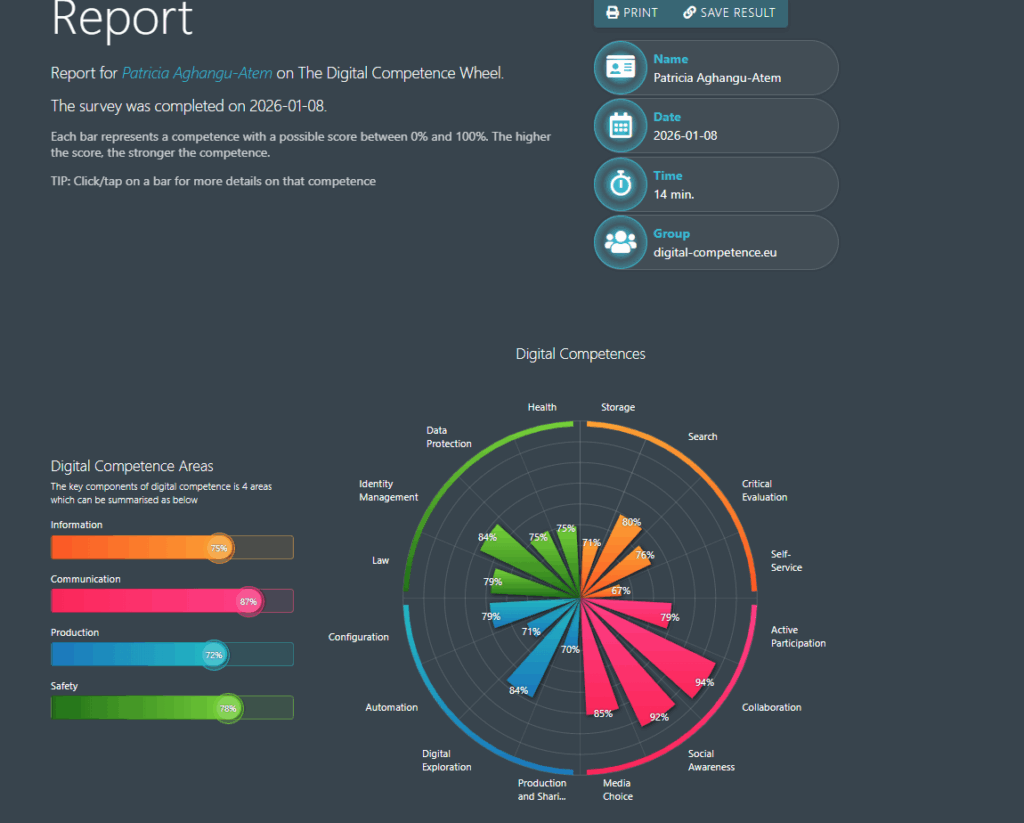
https://digital-competence.eu/dc/en/report/?uri=e568dd86a3e962175edc1913e675d0f6
Completing the digital competence test provided a clear overview of my strengths and areas for growth in working with digital tools and environments. My results show strong capabilities in identity management (84%), collaboration (94%), social awareness (92%), media choice (85%), and digital exploration (84%), demonstrating that I can navigate complex digital contexts, protect personal information, communicate effectively, and adapt to new technologies. Areas such as self-service (67%) and production/sharing of content (70%) indicate opportunities for improvement, particularly in independently creating and using online solutions. Overall, the results reflect that I have advanced to highly specialized or advanced levels in most key areas, which aligns with my professional experience in healthcare, where critical evaluation, data protection, collaboration, and digital literacy are essential. The test also highlighted the importance of continuously developing digital skills to keep up with evolving technologies and maintain effective, safe, and professional digital practices.
Self-Reflection
Working on this digital citizen assignment has helped me reflect on my personal and professional experiences with digitalization and its impact on daily life and healthcare. I have seen firsthand how services like Kela, Omakanta, and Keva provide essential support and access to health and financial information, improving wellbeing, efficiency, and security for my family and me.
Comparing online marketplaces and health monitoring devices highlighted the importance of reliable information and trusted sources, while my experience with digital healthcare platforms reinforced the value of transparency, patient empowerment, and continuity of care. At the same time, I became more aware of the digital gap, particularly for elderly patients in Finland and people in developing countries, and the risks associated with identity theft and online fraud.
Completing the digital competence test showed that I am highly capable in areas like collaboration, social awareness, digital exploration, and identity management, but that I can further develop skills in self-service and content production. Overall, this assignment emphasized the importance of digital literacy, critical thinking, and ethical use of technology in both personal and professional life, and it motivated me to continue learning and adapting in an increasingly digital society.
Links to blogs i commented on
REFERENCES
Kela. Web page. Available at: Henkilöasiakkaat | Kela [Accessed 11 January 2026]
Kanta. Omakanta. Web page. Available at: OmaKanta – Kanta.fi [Accessed 11 January 2026]
Keva. About Keva. Web page. Available at: About Keva – Keva [Accessed 11 January 2026]
Factsheet. Nigeria Immigration Service Warns Public Against Fake e-Visa Websites. Web page. Available at: Nigeria Immigration Service Warns Public Against Fake e-Visa Websites – Factsheet [Accessed 11 January 2026]
Techstock2. 2025. Internet Access in Cameroon: The Race to Connect a Nation. Web page. Available at: Internet Access in Cameroon: The Race to Connect a Nation [Accessed 15 January 2026]