
KELA
Unfortunately, this link did not work, but it did redirect me to Kela’s website.
I have dealt with Kela quite a bit, especially when I was on parental leave and applied for parental allowances. Through Kela, I have also ordered a European Health Insurance Card for both myself and my child.
I also interact with Kela as part of my job when submitting sickness allowance applications for client companies. Additionally, I use Kela’s services to pay the student healthcare fee.
OmaKanta
Recently I have visited the OmaKanta service quite often. I log in to the service with my bank credentials. I think it has been easy and it has worked well.
Keva
I logged into Keva’s website, but unfortunately, I couldn’t find my information there. However, I received a notification stating that my data could be found elsewhere. I then logged into Työeläke.fi, where the system directed me to Ilmarinen’s website.
On Ilmarinen’s site, I couldn’t find information on whether my retirement age is 63 or 68, but I was able to conveniently view all the details on how much pension I have accumulated with each employer over the years. Additionally, I found a calculator that estimated my pension amount. This estimate was based on an assumed salary generated by the service.
I was shocked at how small the estimated sums were. Fortunately, the service allowed me to adjust the assumed salary, which made the estimated pension amount look less discouraging. The system also provided my earliest possible retirement age, which was 67 years and 5 months. Pension accumulation ends at the age of 70. The service also displayed my target retirement age, which was 69 years and 7 months.
Digital shopping
eBay and Amazon are not familiar to me, but I decided to take a quick look at what they offer. It seems that both platforms sell both new and used items.
In my opinion, the websites appeared cluttered, and as a first-time user, I found it difficult to navigate and quickly determine how to find specific items. It was also not immediately clear whether a product was being sold by a store or a private seller. Additionally, I would have liked more clarity on which items were new and which were used. Because of this, I found price comparison quite challenging.
After exploring further, I concluded that for the products I usually purchase, the prices were not significantly cheaper. I also started wondering about warranty and complaint processes—would these services handle them smoothly? Another concern that came to mind was product safety, especially regarding toys. Are they safe, or do they contain harmful substances? Is anyone overseeing this?
Since I had many doubts and unanswered questions, I don’t think I will personally use these services.
I also visited Booking.com and Trivago. Both are already familiar to me. I think the prices on Booking.com and Trivago are almost the same as they would be somewhere else, but of course, there are also good deals from time to time. I believe that competition in the travel industry has intensified as new services and providers have emerged, which is why prices remain relatively similar across different platforms and apps.
Although I believe that prices are often quite similar to what they would be otherwise, flight prices, in particular, can be influenced by adjusting departure and arrival dates based on the cheapest options.
Therefore, I think that comparing prices across different services is at least easier, and I have more control over the final cost, unlike when purchasing a package holiday.
Overall, I can say that I like these services and will continue using them in the future.
Digital application from my own field
I am currently working in payroll and human resources. I use numerous applications in my work, but I chose to highlight Netvisor because I use it frequently.
Netvisor is a cloud-based software that integrates accounting, payroll, and HR functions. With Netvisor, I can manage time tracking, calculate salaries, and submit necessary reports to authorities, such as the income register.
Logging into Netvisor is possible with online banking credentials or a mobile certificate. In my opinion, Netvisor is a clear and user-friendly system that includes all the essential features.
Digital gap
I think that people may find themselves in an unequal position because for some, using digital services is easy, while for others, using these services becomes increasingly difficult as digitalization progresses.
I believe that digitalization carries also a risk of social exclusion. A person who does not use or know how to use digital services may face difficulties. A close relative of mine does not know how to use the internet or online banking at all. He does not own any smart devices or even a computer. If we, his family, did not help him manage the essential tasks that must be handled digitally, I don’t know how he would cope.
I am aware that some services offer assistance with using the internet, but they may not be sufficient for everyone or provide enough support to complete necessary tasks. For example, banking services and cashier services in banks are now available in only a few branches, making in-person banking more difficult. The same applies to services provided by Kela – the number of customer service offices has been significantly reduced, making it harder to handle matters face-to-face with a service representative.
Additionally, I believe that if a person does not stay up to date with digital advancements, they may struggle in the workplace. Many jobs require the ability to use various digital services and applications, and new technologies are constantly being introduced. To succeed in the working world, one must be adaptable and quick to learn new digital skills.
Self evaluation
This task made me reflect on the importance of digitalization and, in particular, keeping up with its advancements.
By reading other texts, I also learned how social security systems are organized in different countries. I realized that nowadays, it is likely possible to handle matters related to social security and other essential public services entirely digitally in most parts of the world. If this is not yet the case everywhere, it soon will be. This also made me think about how digitalization might deepen inequality. If some people lack access to digital services—whether due to financial constraints preventing them from owning necessary devices or the lack of access to loaned equipment—they may face increasing disadvantages. These are aspects I had never really considered before, but they became quite thought-provoking after reading about them.
As part of this task, I also explored eBay and Amazon.com, albeit only briefly. Additionally, I came to realize just how much digitalization and digital services simplify my life. For instance, platforms like Booking.com and Trivago make it easier for me to compare options and find the most suitable flight or accommodation for my needs.
From the videos, what stood out the most was the significance of big data and its potential applications now and in the future.
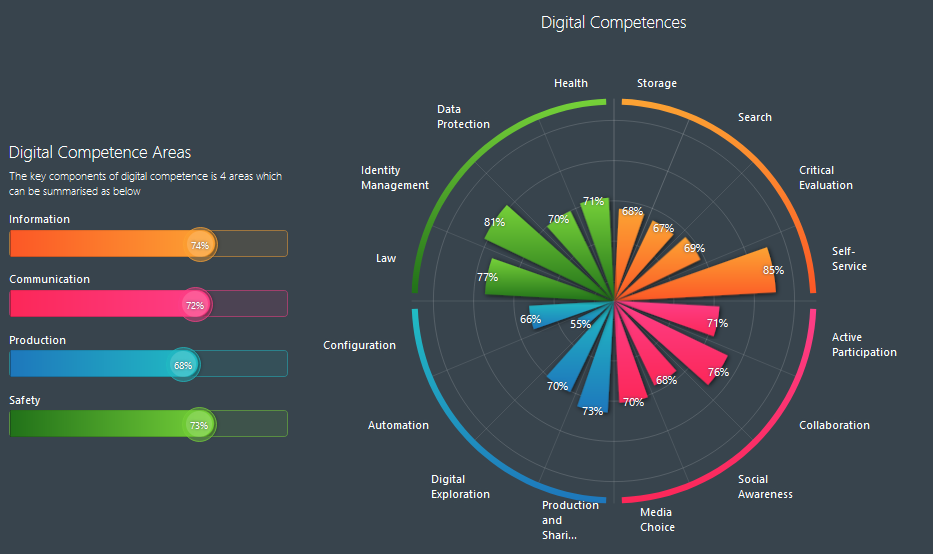
I also took the Digital Competence Test as part of this task, and its results actually surprised me a bit. I expected to score better, but my results turned out to be quite average I quess.
Blog comments
Sandi
Mazi
Theo