-
My Experiences with Digital Services
Digitalisation is now visible in almost every part of everyday life. Government services, healthcare, banking services, online stores, grocery stores, and many other services have moved more and more online. This has made many everyday tasks much easier and faster. At the same time, digital services require users to learn new skills while providing opportunities to use different electronic services.
Kela
I have often used Kela’s online services to check my benefit information, read decisions, and submit different applications. Over the years, I have used several different services. During my studies, I used student financial aid, housing supplement, and paid the YTHS healthcare fee through Kela’s website. I have also used the student meal subsidy, although it does not need to be applied for separately. After having children, I have used different benefits for parents, such as the maternity grant, child benefit, parental leave benefits, and in the newer system also pregnancy leave and home care allowance. When someone in our family has been ill, we have also used Kelas’s services for reimbursements for private healthcare visits, medicine reimbursements, and travel expense reimbursements.
I have had the European Health Insurance Card for many years. Once it has been ordered, Kela automatically sends a new card when the old one is about to expire. Because of this, I did not order a new card during this assignment, although it could easily have been done through the website.
OmaKanta
OmaKanta is a familiar service for me. I use it whenever I need to check my health information or review and renew prescriptions for myself or my children. It is easy to use. Users can log in through the OmaKanta website (www.kanta.fi/omakanta) using strong authentication.
I think it is important that people can easily see their own health information. This increases transparency and supports people in taking care of their own health. The service is easy to use, but I believe it will continue to develop in the coming years. For example, it is not yet possible to print all certificates that have been created.
Pension Services – Keva
I have checked my Keva information several times before out of curiosity. For this assignment, I also used Keva’s pension calculator and looked at my pension estimate for different retirement ages. It was interesting to see how working longer increases the future pension. Although retirement is still far away, calculators like this help with planning personal finances for the future. However, I do not want to publish my personal pension information.
Online Shopping
When comparing online stores, I looked at Amazon, eBay, Booking.com, and Trivago. International online stores often had lower prices and a wider selection than Finnish stores. On the other hand, Finnish companies usually offer faster delivery, customer service in Finnish, and easier handling of complaints.
When comparing accommodation services, Booking.com and Trivago provide a lot of useful information for making decisions. Users can easily see prices, customer reviews, pictures, locations, and cancellation policies in one place. In my opinion, these well-known websites are generally trustworthy, but users should always compare prices carefully and read customer reviews critically. Sometimes the prices are even lower than when booking directly with the accommodation provider.
Social and Healthcare Applications
I chose the OmaHyvaks application because it is related to my field. After downloading the application and completing strong authentication, it works on a mobile phone. Logging in can also be made faster by using a fingerprint or PIN code. The application allows users to check booked appointments, add them to their calendar, start digital communication with healthcare professionals, and book appointments. It is also easy to view laboratory results, referrals, and patient records through the application.
The difference compared to OmaKanta is that OmaHyvaks only shows visits within the OmaHyvaks wellbeing services area, while OmaKanta includes information from different healthcare providers. The application makes digital healthcare services and checking information faster because logging in is quick. It is also possible to manage another person’s healthcare matters through the application. The application is still quite new, so it will probably continue to develop in the coming years.
Digitalisation and the Digital Divide
Digitalisation also brings challenges. Not everyone has sufficient digital skills, the necessary devices, or an internet connection. Older people may especially experience difficulties using digital services, but challenges may also affect immigrants, people with disabilities, or people whose financial situation makes it difficult to buy suitable devices. In addition, not everyone wants to learn how to use digital services, even if they would be able to.
If a person cannot use digital services, they may not be able to access certain services, or using them becomes more difficult. This can increase inequality. For example, some grocery store applications offer discounts only to users of the application. If the application is not installed on a mobile phone, the customer cannot receive the discount. In addition, many companies publish the latest information first on their websites. It is important that alternatives to digital services remain available, especially for urgent or important matters. Digital services should be as accessible and easy to use as possible for all user groups. Limited digital skills may also increase the risk of scams if people do not understand or know how to use digital services correctly.
Digital Skills
I completed the digital skills test, and the result is shown below. The result did not surprise me. I know that my digital skills are strong, but there is always something new to learn and opportunities to improve.
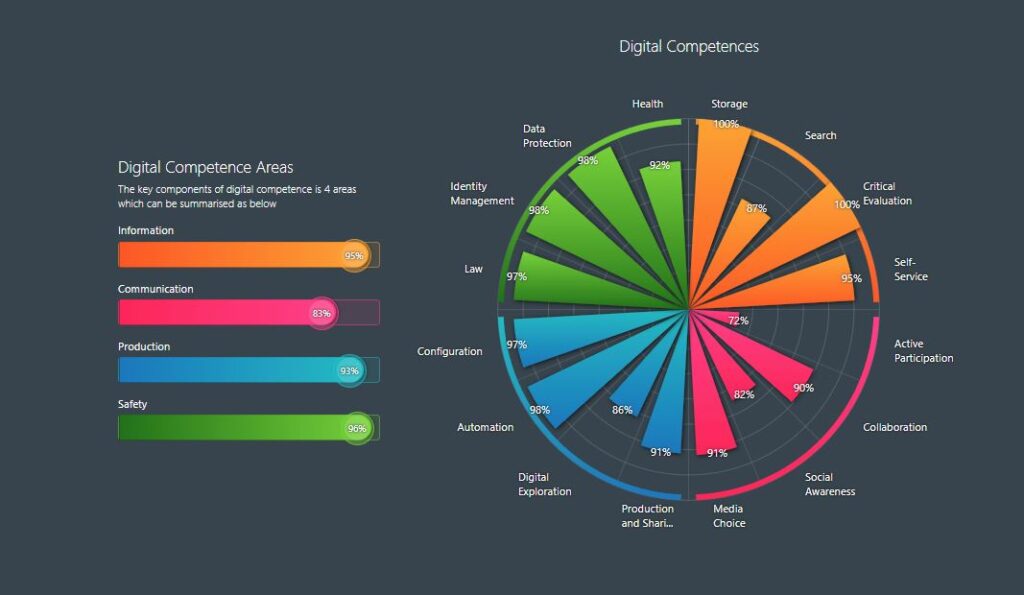
Self-Assessment
Completing this assignment reminded me how important digital services are in everyday life. Many services have become such a normal part of daily life that we often do not even think about their importance. During this assignment, I also thought about people for whom using digital services is not as easy. Sometimes it is easy to forget how challenging digital services can be for others. I would be happy to continue working to make digital services easier for everyone.
Well-designed digital services can make everyday life much easier, as long as they are secure and people know how to use them correctly. Digital services also reduce queues at service points and on the phone because many tasks can be completed independently online. However, this may also lead to fewer traditional service hours, making life even more difficult for people who cannot manage in the digital world. I enjoy looking at digital applications from the perspectives of customers, employees, and developers, and thinking about what works well and what could be improved.
Comments
One response to “My Experiences with Digital Services”
-
Your point about the digital divide and different user groups is so spot on. Making things smoother online shouldn’t leave behind people who struggle with smart devices.
It got me wondering about what’s coming next, too: How will AI and automation change these services in the near future? Hopefully, digital tools will get better at adapting to what each person needs, which could actually help bridge that gap.
Here is my blog: https://blogi.savonia.fi/sinisalonen/ if you would like to have a look and leave a comment.
Leave a Reply
-
