Digitalization has changed our everyday lives significantly, and in this blog post, I reflect on the reliability and effectiveness of various services in our everyday lives. I will get to know the digital services of Finnish social welfare and health care and also open up my experiences of the services and the things I learned in the course related to digitalization in our everyday lives.
Kela
At the moment, Kela’s services are not used much in our family, the only thing that comes to my mind now is the higher education student’s health care fee, which comes to Kela this is how the student pays. I didn’t think it was very natural to take care of that payment through Kela’s website and the service path was perhaps a bit difficult through that site. Payment management on the site was therefore not easy and unambiguous. The European Health Insurance Card was very easy to obtain through the website and its home delivery was also very fast. In my opinion, this very important and practical card has been talked about quite little and it could really be useful for many travelers if they had remembered to get one before the trip.
Previously, when the children were small, I used Kela’s services, to some extent in the form of parental leave and other errands, but back then, digitalization was not quite as advanced. As a whole, I think Kela’s digital services could use some harmonization and clear structures, the website perhaps showed that the different sections were built at different times, and there has been no harmonization between the sites.
Omakanta
I logged in to the Omakanta data through the website and performed strong authentication with my own online banking credentials. Omakanta Pages made it easy to browse one’s own health data, visits, diagnoses and written prescriptions. The use felt easy and clear, and the user interface was unambiguous enough to make it easy to find things there. Kanta Pages is a good example of a good digital service, it makes it quick and convenient, for example, to renew prescriptions, and at the same time it eases the work of professionals and congestion in physical services.
Keva
I went to Keva’s website to check my own information and how much pension I would receive at the age of 63 or correspondingly at the age of 68. There was a fairly large difference in pension accrual between the lowest pension and the target pension. However, the biggest attention was certainly paid to how long you still have to work in order to be able to retire at all, as the retirement age is already quite high. The service is good and I think it brings transparency to the entire Finnish pension system, of course it also raises thoughts about how income can possibly decrease after working life.
Omaolo
Omaolo is a national digital social welfare and health care service used in Finland that helps you assess your own need for care and service. In the Omaolo service, citizens can make various symptom assessments and receive current care instructions or guidance on health care services. Omaolo is a very convenient digital service channel for citizens who are concerned about their own health issues. The service is available 24/7 and guides citizens through various surveys based on scientific research and national criteria. The Omaolo service is a CE-marked medical device that meets EU regulations and requirements. The service can be used by anyone over the age of 15 who has the opportunity to use electronic services independently with strong identification.
The digital omaolo service was easy to use and the operation of the site was logical and guiding, so I could say that the user interface design considers users of all levels. Various surveys are convenient and the results are available immediately after answering, and the information can also be sent directly to a healthcare professional if desired.
With the Omaolo digital service, it has been possible to reduce unnecessary appointments and speed up people’s referral to treatment. It has helped to improve the quality and equality of services and reduce the overlapping of services. Through the service, citizens can receive various coaching related to well-being, and the service can also be used to assess the need for social services.
E-commerce
In this assignment, I compared the product and price of an online store and a local store. For the product, I chose wireless headphones, which I was considering getting anyway. On Amazon, the price of the headphones in question was €88, while in the local store, the price for the headphones was €99. The price difference wasn’t big, but ordering from an international online store can result in different customs fees and the delivery time can also be long, so I ended up getting the headphones from a local store this time. I also made comparisons of accommodation prices on two different websites and services. I looked at accommodation options through Trivago and Booking.com sites and compared the prices and services offered by the sites. Both sites offered clear information, but there was a lot of variation in prices depending on the offers and different promotions. The sites I researched seemed trustworthy because they were well-known brands in their respective fields. There was enough information available, but it is worth checking the payment methods and return terms before ordering or buying, as there may be differences.
Digitalization and digital gap
Digitalization has brought many benefits, but it has also brought various challenges, for example, to those who do not use digital services. These challenges can be seen, for example, as social inequality, and when services move online, many people may be left behind if they do not have the skills or ability to use digital services. Accessibility is also one of the challenges of the digital divide, as digital services require devices and functional connections to be able to use them, and this is not always the case everywhere. Information security is one of the most significant issues related to these services and their use. If there is no competence and understanding of digital services and their information security, the risk of misuse increases, which is likely to increase distrust in digital services.
In my opinion, not all services can be produced digitally alone, and it is a national obligation to enable physical services, for example, for older and more privileged population groups. The assumption that everyone can only take care of their affairs digitally has perhaps already gained too much ground in many everyday matters and thus increases the digital divide between people. Digitalization is not or creates this problem, but the problem arises if the options around services disappear. Education plays a major role in the competence of digital services and more should be invested in it.
Test
I took the Digital Competence Test, which assesses skills in various areas, such as information security, information retrieval and digital communication. My results were quite mediocre, but I noticed that I could develop my skills in all areas. Perhaps the test should have assessed one’s own skills even more critically, so that there would have been more dispersion into the areas of the test.
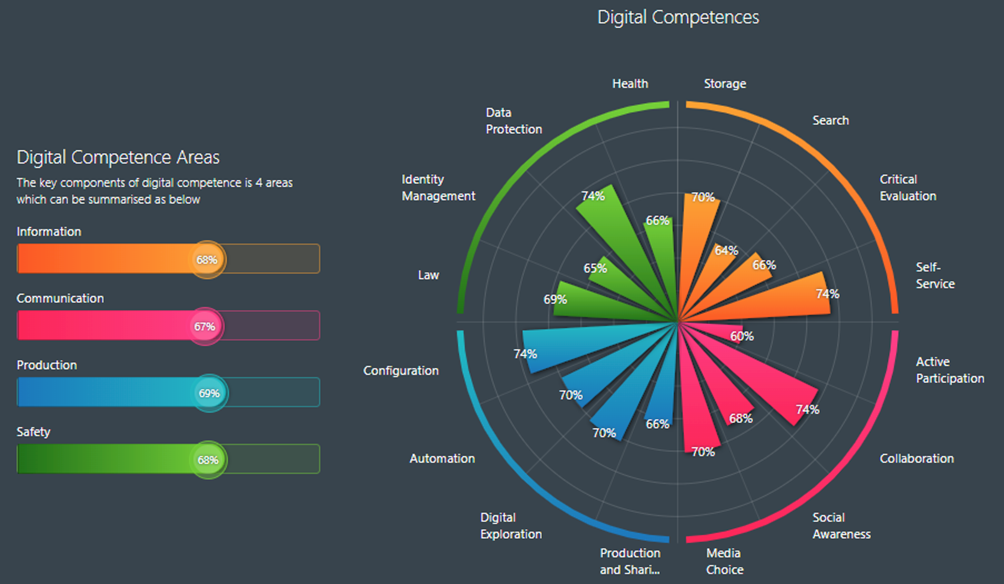
My digital competence test
SELF EVALUATION
This part of the course offered an interesting way to look at how digitalization has become a very large and visible part of our everyday lives, even a little unnoticed. During the assignments, I also understood how extensive digitalization affects everyday life and, for example, social relationships, not only in a visible form, but also in the ways of communicating. Reflecting on the issues, it also became clear that the digital divide is a real challenge in many areas, and this requires solutions at the national level so that the gap is not deepened further. Writing this blog post helped me to structure my thoughts and see the effects of digitalization around us.
It can therefore be said that digital skills must be part of the basic skills of citizens now and in the future. However, we are still living in a kind of transition period, which causes a so-called digital divide, as the older population is not as digital native as the younger generation, and therefore the change should not be forced through, but both digital and physical services must still be available. However, more people are moving completely towards digital, and physical services are significantly reduced even further. In this case, we must also consider citizens in a weaker position, who may not be able to use digital services.
COMMENTS OF THESE THREE ARTICLES
I read the following three articles by my fellow students, which were very interesting. The articles did a great job of highlighting different views and experiences on digitalization and how it is visible in our daily lives. It was also useful to see how other students had considered the same things from a slightly different perspective.