DIGI CITIZEN
My experience with Kela services
Kela has been part of my life in different ways. I have received student financial aid and housing support from Kela in the past. Currently, I use their services mainly for reimbursements related to private doctor and dentist visits. Since I study in a university of applied sciences, I also pay the student healthcare fee via Kela. I think the services are easy to use. The website is clear, and filling in the forms online is simple. Recently, I ordered the European Health Insurance Card through their online service. It was easy and quick. I’m thankful that many Kela services can be handled easily online. That suits me very well.
Accessing my health data via OmaKanta
OmaKanta is a national online service where I can view my personal health records. I log in using my bank app, which makes the process safe and simple. Logging in to OmaKanta is quick: I just scan the QR code with the app. Through OmaKanta, I’ve checked prescriptions, lab results and doctor visits. I think it’s great that all the information is available in one place. It helps me feel more in control of my health, and I can check when something happened or when a symptom started. This makes it easier to explain things to a new doctor, because I don’t think they always have time to go through the patient’s OmaKanta records in detail.
Checking my pension via Keva
I visited Keva’s website to estimate my future pension. According to Keva, my minimum retirement age is 66 years and 5 months. If I continue working until I’m 68, my monthly pension would be about 80 euros more. I have worked most of my life as a small entrepreneur and always paid the minimum YEL pension insurance. Because of this, my future pension is very low. I have even lost sleep thinking about it. The system has been especially unfair to small business owners. The difference in pension contributions between entrepreneurs and salaried workers is huge. To prepare for the future, I have chosen to invest in funds to gain some extra financial security for when I’m old.
Comparing digital shopping services
I compared different online stores, such as Temu, Amazon, Verkkokauppa.com, Prisma, Tokmanni and Jysk. I noticed that digital stores like Temu and Amazon often have lots of product images, but sometimes the photos look poorly photoshopped or misleading. In some cases, the images show different products altogether. Product descriptions are not always clear, which can happen in both Chinese stores and local ones. Prices vary a lot. I found many items much cheaper in Temu or Amazon than in Finnish online stores, but I also found items that had almost the same price in both. Because of unclear images and stories I’ve heard about poor quality items from China, I trust local stores more. I feel more confident shopping at Prisma or Verkkokauppa.com, even if the price is higher. I’ve ordered from Amazon before, and while it feels more reliable than Temu, I’ve also received incorrect products or had my order missing. I’m not a big shopper, so when I do buy something, I prefer to get it from local stores or Finnish online shops.
A digital tool I use: Canva
I work in telemarketing and don’t use many digital tools in my daily job, so I chose to write about Canva. I used Canva for a school assignment where I had to create images of customer personas. I wrote prompts and Canva’s AI tool generated images. I tried to improve the prompts to get better results. The tool was easy to use, and I managed to create useful images pretty quickly. However, I noticed that to use Canva more effectively, I would need to learn more about it. It seems like a great tool not only for school but possibly for future work projects too.
Digital gap: risks and challenges
Digital services are everywhere, but not everyone knows how to use them. Older people, people with low digital skills, or those without access to smart devices are at risk of being excluded. Many services like Kela, banks, and even healthcare are now mostly digital. If someone can’t use these platforms, they might miss out on benefits or help they are entitled to. Not all cities have physical service points anymore. If there is no one to help, a person may be left alone. This can cause stress and make people feel like they don’t belong in today’s society. I remember an elderly man who started crying when he told me that bank services were being removed from his hometown. It felt really sad. It is important that services are made easier to use, but it is equally important that help is available for those who need it. Society must remember that digital solutions are not suitable for everyone.
Digital Competence Test and reflection
I took the Digital Competence Test and found it useful. It made me think about my own digital skills and how I use different tools.
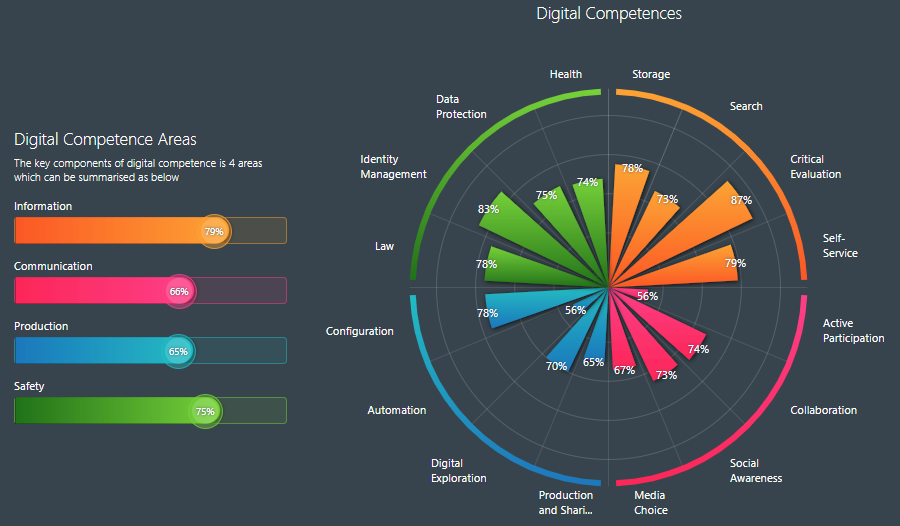
The results showed that I am good with finding information and digital safety. However, there is always something new to learn. I realized that I could improve in some areas, especially by getting to know and learning to use different content creation tools.
Self-evaluation
This assignment made me reflect on my digital life. I learned how dependent we are on digital services, both in daily life and at work. I realized how useful services like OmaKanta, Kela, and Keva have become, and how easy things are when they work well. But I also saw how difficult it can be for people who don’t have access to or skills in using these tools. The task encouraged me to think more about online shopping, my future pension, and what digital citizenship really means. It also reminded me how important it is to keep learning and stay up to date with digital changes. Now I understand more deeply how wide the digital world is. At the same time, I’ve started to wonder what would happen if the whole digital system failed.
Comments
I left comments on the following articles:
Leave a Reply