DIGI CITIZEN
Digitalization has invaded the services that we use daily, and our information has moved from paper to a digitalized form. It is essential to consider the fact that not everyone has the skillset or hardware to use these services. How do we make sure that everyone gets the services they need? Online services have displaced face-to-face services, which can put people in an unequal position.
Kela
The Social Insurance Institution of Finland, Kela, provides basic economic security for Finnish residents. Kela offers social benefits, for example, family, sickness, and unemployment benefits.
Kela’s services work brilliantly for me. I can make all the applications that my family and I need online and track the progress of the application handling and check the complete decision. I can also see future payments and subsidies from the service. In case of problems, you can get help by telephone or chat.
However, Kela’s services and forms can be quite complex to fill out. Sometimes I wonder how the most vulnerable people manage to complete these forms and get the benefits they need. OmaKela requires strong identification, which might be a problem for some people. Kela’s online services could be made easier to use by simplifying and making all the forms work in the same logic.
OmaKanta
OmaKanta is a brilliant service that gives people access to their personal health care records online. You can check your own and your children’s medical information and prescriptions on OmaKanta. Like OmaKela, OmaKanta also requires strong identification.
Not all healthcare providers have access to OmaKanta, so the information isn’t always available when needed. Hopefully, the use of OmaKanta will expand so that healthcare professionals can access records whenever necessary. OmaKanta is quite easy to use, but I wonder if it is used by elderly people who would benefit from it most. Developing services like OmaKanta the usability should be the one of the main focuses.
Keva
Keva is a pension provider in Finland. I found Keva’s services easy to use, and I was able to find the information I needed. I must admit that I hadn’t visited Keva’s site before this task, but I believe I will visit it again.
There are lot of digital services, but I wonder how do you find or know that they all exist? It would be easier for the user if all the data were connected to one service in which you navigate depending on what you need to do.
Digital Shops
I use digital shops carefully and usually compare prices from different stores before deciding to order. I don’t use Chinese digital shops like Temu, even though their prices are very low. The low prices of these products are often due to low quality. I’m also concerned about data privacy policies in digital shops outside of Europe.
On eBay, there are individual sellers, so prices can vary. You need to compare prices before buying and check sellers’ feedback from previous buyers. Since sellers can vary, their data policies may also differ. The information provided depends on the seller, so it can be inconsistent.
Amazon uses competitive pricing, so prices can be low. When ordering online, you need to consider the shipping costs, which increase the total price of the product. Amazon provides a lot of information, such as customer feedback and product details, so you need to study the information carefully.
There is a wide selection of digital shops to choose from. We should be aware of the risks they bring. How and where are the products made? Are they produced sustainably? Are they copies of the original version? Also, shipping costs and return policies need to be taken into consideration, as they can increase the total price and cause issues. Data privacy is a huge risk that you should be aware of before ordering and providing your information. Who knows where your data will end up?
Oma Pihlajalinna
Oma Pihlajalinna is an app that contains all your occupational health data and enables chat, remote consultations, and appointment booking. The app is easy to use and provides all the information you might need. Laboratory results are presented in a visual and very clear way.
Chat and remote consultations save time for both the patient and the physician. This can help alleviate the healthcare worker shortage. For the patient, it makes it easier and faster to get the treatment they need. Apps improve access to medical data, allowing users to check their information anytime, anywhere.
OmaKanta should take inspiration from the apps provided by private healthcare companies. These apps are designed to cater to user needs and make life easier. This is how every digital service should be designed.
Digital Gap
People who won’t or can’t use virtual services are at great risk of losing the ability to access essential services. Virtual platforms have taken over almost all services, so if you don’t own a mobile phone or have internet access, handling everyday matters can be extremely difficult. While virtual services are an excellent improvement, they cannot be the only solution.
For example, healthcare, banks, and Kela must offer services to not just digitally literate people. Otherwise, these services will not be accessible to everyone.
We still need services that are provided by humans for humans. How do we make sure that this happens?
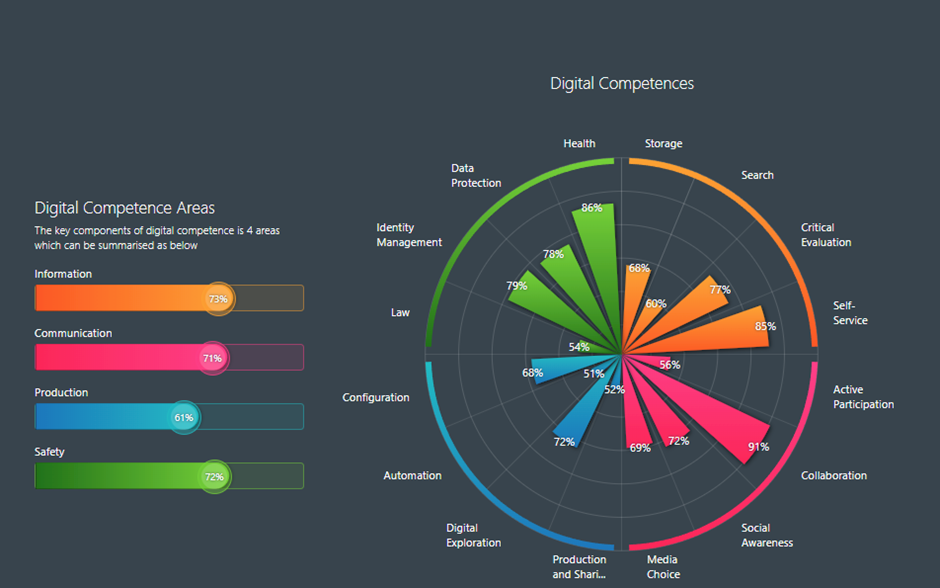
Digital Competence Test
The Digital Competence Test was an interesting tool to assess my digital skills in different areas. I found out that my skills are quite okay, but there are areas where I should improve.
Self-Reflection
Digitalization is changing the world, and we all must adapt to it. However, we must ensure that no one is left behind in the process. Changes should be made in a way that includes everyone.
This task was a good summary of what digitalization is today and the challenges it may cause. It is clear that digitalization brings many positive developments, and we should all be able to benefit from them. Through this course, I was able to deepen my understanding of digitalization.
Commented articles:
Leave a Reply