
Living as a digital citizen today means navigating a world shaped by digital tools, both in professional life and at home. Technology has become so interwoven with everyday routines that many tasks are carried out almost automatically, from handling official matters to communicating across different platforms. Reflecting on my digital habits made me realize how many different systems I rely on without consciously noticing it. These services strongly influence how I participate in society and manage responsibilities.
Digital citizenship covers areas such as communication, access, literacy, etiquette, rights, wellbeing and security. All of these appear in my daily life in different ways. Strong identification methods protect personal information, digital communication enables efficient interaction, and various online services allow me to complete complex tasks quickly. Understanding how these elements connect has helped me recognize my own role as an active user in a digital environment, not just someone who occasionally logs in to complete a task.
Using Kela services
Kela has supported me at several stages of life and in many different situations. During my studies, I used Kela’s digital services extensively to manage student financial aid. The online system made it easy to check decisions, update information and ensure that everything was handled on time. Later, when I had my child, I used Kela for family leave applications, parental allowances and other child-related matters. Each of these processes was handled online, and the clear structure of the platform made it easy to follow what was happening and what documentation was required.
Kela has also played a role in handling sick leave situations and in managing administrative matters concerning my child. Logging in with bank credentials provides secure access, and the service stores all messages and decisions, which makes it easy to return and check details later. Even though I do not handle Kela matters as frequently now, I still appreciate how reliable and simple the digital services are. Being able to manage everything from home saves time and reduces stress in already busy moments.
My personal health security is supported by several layers of coverage. I have my own private health insurance, which covers part of the costs of private healthcare services. In addition, my employer provides health expense insurance that broadens the range of available services and often shortens waiting times. These private insurances complement public healthcare by giving more flexibility and quicker access when needed. Together they create a balanced structure that makes healthcare more predictable and manageable.
When travelling, I rely on travel insurance to handle unexpected medical expenses outside Finland. I also have the European Health Insurance Card, which provides access to necessary healthcare in EU and EEA countries under the same conditions as residents. Ordering the card was straightforward, and the validity period is long enough that it does not need constant renewal. Having both travel insurance and the European card ensures that different types of medical situations are covered when travelling abroad.
Accessing personal health information in OmaKanta
OmaKanta has been particularly valuable during moments when I needed official health documentation. The COVID certificate is one example, as I was able to access it quickly and easily when travelling. Having vaccine records and test results in one place made the process smooth, especially during a time when requirements were constantly changing. I also use OmaKanta to check prescription information and to read doctor’s notes after appointments. It is reassuring to know that all information is stored safely and can be accessed whenever necessary.
The clarity of the platform also supports communication with healthcare professionals. After medical visits, I can review what was discussed without relying solely on memory. This helps me follow instructions accurately and understand the purpose of treatments or tests. In the past, this type of information would have depended on printed papers or phone calls, but now it is collected centrally. Even if I do not visit the service regularly, the availability of information gives a sense of control and keeps me informed about my own health.
Pension information and understanding the system
Exploring my pension information was an interesting experience that revealed how fragmented the system can initially seem. When I first logged into Keva, I expected to see a pension projection, but my account showed no information. Only later did I realize that my pension contributions are managed by another provider, which explained why Keva did not display any details. Once I accessed the correct service, the pension forecast became clear and easy to understand.
According to the pension calculator, my statutory earliest retirement age is in late 2052, when I will be slightly over 67 years old. This age forms the reference point for assessing how postponing retirement influences my pension. The projections show that working even one additional year beyond the earliest retirement date leads to a noticeable improvement in the final benefit. From the baseline estimate at 67 years and one month, retiring at 68 increases the projected pension by approximately 7%. The effect becomes even more pronounced with a longer career extension: continuing to work for nearly three additional years raises the projected pension by roughly 22% compared to the earliest possible retirement.
Comparing the projections for different retirement ages helped me see how strongly timing affects the final pension amount. This made the system feel more real, even though retirement is still far away. It also reminded me of the importance of checking these details early and understanding which provider stores my information. Once the correct channel is identified, the digital pension services are straightforward and informative.

Comparing digital shops and local stores
Digital marketplaces have become a natural part of my shopping behavior. Platforms such as Amazon, eBay, Booking and Trivago offer easy access to prices, reviews, photos and product descriptions. This helps me compare options more effectively than I could by visiting multiple physical stores. The reliability of these platforms has generally been good, especially when paying attention to seller ratings and cancellation policies. The amount of information available makes decision making systematic and provides transparency about what I am buying.
Local stores still hold a different kind of value. They offer personal customer service and the opportunity to examine products before purchasing. Prices in physical stores are typically more stable, whereas digital platforms may fluctuate significantly due to competition and dynamic pricing algorithms. I tend to use both options depending on the situation. Overall, digital shops offer competitive prices, extensive information, and high accessibility, while local shops provide personal interaction and certainty about product quality. The platforms examined can be considered reliable when consumers apply normal caution and make use of the information and safeguards available.
Power BI as a tool in my professional field
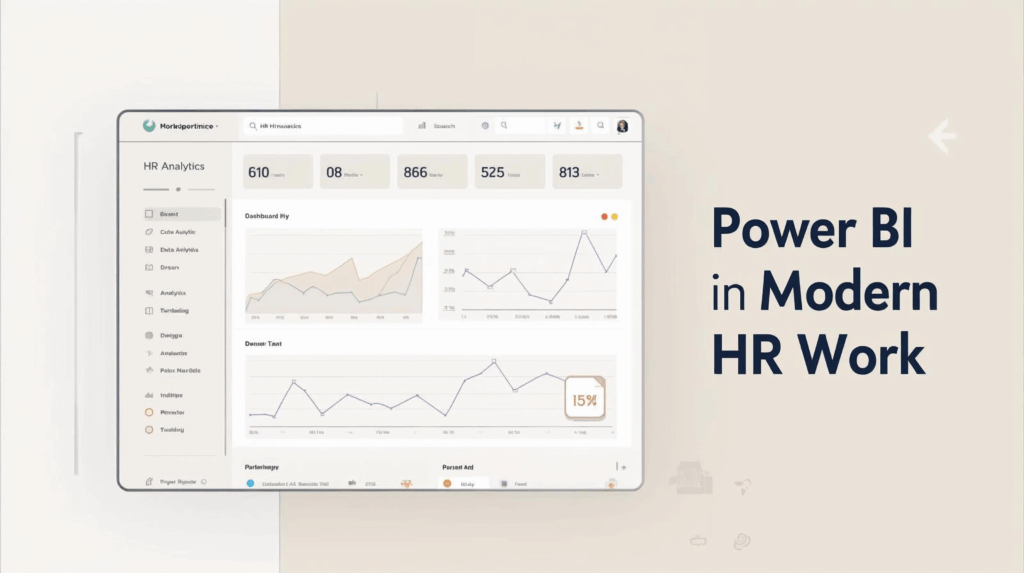
I work in human resources, where data-based decision making has become increasingly important. In my HR role, I use Power BI to analyze workforce trends, monitor staffing needs and support operational planning. The tool helps transform raw data into meaningful visuals that reveal patterns and developments over time. Before using Power BI, many of these tasks relied on manually updated spreadsheets, which required significant effort and made it harder to see connections in the information.
Power BI has changed the way I work by offering real time data updates and clear, interactive dashboards. This makes communication within the organization more effective and helps ensure that decisions are based on the most up to date information. At the same time, the tool has shown me that even sophisticated analytics cannot replace human judgement. Interpretation always requires context, experience and an understanding of how decisions affect people. Power BI supports my HR work, but it does not replace the human side of decision making.
Digitalization and the digital gap
Digitalization brings many advantages, but it also exposes inequalities between those who have strong digital skills and those who do not. As more services move fully online, the gap becomes more visible. People who struggle with technology may find it difficult to use online banking, fill out digital forms or access healthcare information. This can lead to dependence on others and a loss of privacy in tasks that should be personal. The digital gap is not only a technical problem but a social one.
Older adults and people with disabilities are often the most affected. Authentication methods, digital payments and online appointments may feel unfamiliar or overwhelming. At the same time, physical service points have become less common, which increases the pressure to use digital tools even when it does not feel natural. Ensuring that services remain accessible requires clear communication, inclusive design and support for building basic digital skills. Digitalization should benefit everyone, not create new barriers.
Digital Competence Test
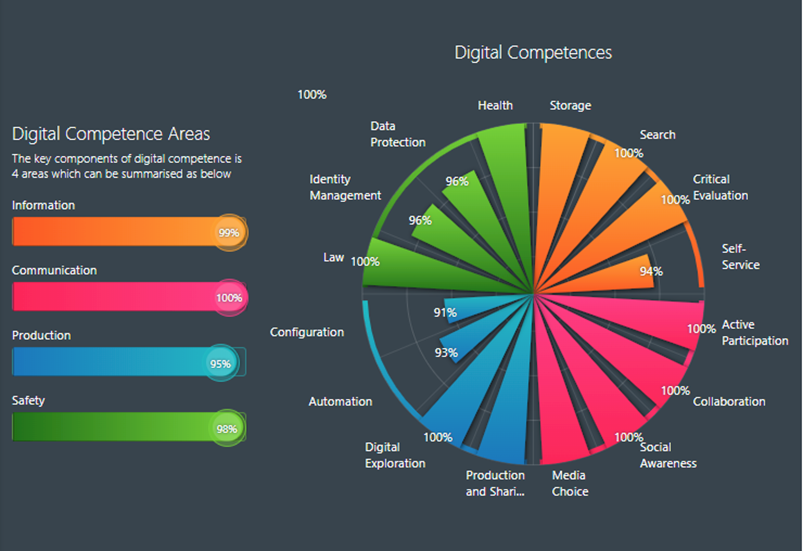
Taking the Digital Competence Test helped me understand my strengths and development areas in a more structured way. The test reflected strong skills in information handling, communication and safety, which matches my professional responsibilities and daily use of digital tools. These strengths have developed over time through continuous exposure to digital services, both in professional HR tasks and in personal life. The test confirmed that I am comfortable navigating digital environments and managing information responsibly.
The test also showed that my technical production skills are lower compared to other areas. This makes sense, as I am not very focused on creating advanced content or exploring every new tool that appears. Instead of seeing this as a weakness, I view it as an opportunity for growth when needed. The test reminded me that digital competence is not static and that it develops alongside technology. Staying open to learning is essential for keeping up with the rapid development of digital systems.
Self-reflection
Working on this assignment helped me become more aware of how many digital systems I rely on daily. I realized that I often take for granted the ability to handle tasks quickly through digital platforms. I also recognized how fragmented some systems can be, such as the pension services, and how important it is to understand where information is stored. The assignment encouraged me to think more critically about my own digital behavior and the responsibilities that come with it.
Reading other students’ reflections added an important layer to my understanding. Their experiences varied widely, from confidence and enthusiasm to frustration and concern. Some valued the efficiency of digital services, while others worried about privacy, exclusion or the loss of human contact. These different perspectives reminded me that digital citizenship is not a single experience but a collection of different realities depending on people’s backgrounds and circumstances. It helped me see digitalization not only through my own lens but also through the challenges others may face.
Disclamer: All visual materials and images used in this blog had been created by me using the paid version of Canva. By producing every illustration and design myself with licensed Canva assets, I ensured full compliance with copyright requirements and avoided any issues related to the use or publication of visual content.