Digitalization in Everyday Life
Picture: Ghat GPT 2026.
Digitalization is now a major part of everyday life. It can be seen almost everywhere – in healthcare, banking, education, and various public services. Many tasks that used to take time, such as paying bills or booking a doctor’s appointment, can now be handled quickly online. Digitalization is no longer just about technology; it is a central part of daily life and how society functions.
Experiences with Digital Services
Kela
Kela provides a wide range of benefits for different life situations. These benefits can be used by both individuals and families.
Based on my own experience, Kela’s services are particularly useful for things like medicine reimbursements and healthcare travel compensation. In case of illness, it is possible to apply for sickness allowance, which provides financial security and helps ensure that income is not significantly affected. I have studied several times, and student financial aid has allowed me to complete my studies faster because I have not needed to work as much. After starting a family, child benefit has been an important support for everyday expenses, helping to cover the costs of raising children. If necessary, I could also have applied for housing allowance if my housing costs had become too high in relation to my income.
Kela’s digital services work well. They provide a lot of useful information, and handling different matters is easy.
OmaKanta
OmaKanta is one of the most widely used digital services in healthcare. It is currently being actively developed at the national level. Through OmaKanta, people can access their personal health records anytime and anywhere.
I have personally used OmaKanta to review my health records and lab results. I have also renewed prescriptions and made decisions related to my self-care, which I have recorded in the system. OmaKanta works smoothly, and it has allowed me to better understand my own health information. Using the service also encourages me to take a more active role in my self-care and makes my health information more accessible and transparent, as I can return to it whenever it suits me best. I can also authorize another person to handle matters on my behalf electronically, which provides a sense of security if I am not in a condition to manage things myself.
Keva
Checking pension information can nowadays be done electronically. Through Keva’s online service, it is easy to check one’s retirement age and pension accrual.
I have checked my retirement age and pension accrual several times. The increasing retirement age makes me think about my ability to cope at work until retirement. Hopefully, employers will offer options such as reduced working hours or lighter duties closer to retirement age, as shift work will likely become more challenging with age.
Amazon – Online Shopping
Online stores like Amazon offer a wide range of products. Prices are often lower, and it is easy to find a lot of information, images, and customer reviews about products. Physical stores usually have a more limited selection, and prices may be higher.
Based on my experience, online stores are generally reliable. However, it is important to pay attention to delivery terms and seller information, as there is always a risk of scams. I personally like the wide selection and pricing of online stores and often use them when buying clothes. However, for larger purchases for the home, I prefer local stores because they often provide expert service and you can get the product immediately.
Terveystalo – Private Healthcare Provider
Private healthcare services have become highly digitalized. This is a major advantage for them and improves accessibility. Terveystalo’s online services are modern and user-friendly. Through the app or a web browser, it is possible to book appointments, search for available times, and estimate costs in advance. This makes it easier to compare different options. As an occupational healthcare customer, I find Terveystalo’s app particularly efficient, as it allows me to handle matters quickly.
Digital Divide
As digitalization increases, more services are available online, which makes everyday life easier for many people. At the same time, however, a digital divide is created. The digital divide refers to the fact that not everyone has the same skills or opportunities to use digital services.
Based on experience and observation, the digital divide particularly affects older people, those who cannot afford devices or internet access, and individuals with limited language skills or learning difficulties. Lack of trust in digital services can also prevent their use.
The digital divide can be seen in many ways in everyday life. For example, booking appointments or handling official matters can be difficult without digital skills. Banking can also become challenging without online services. In addition, people may become more isolated as communication moves online.
For this reason, it is important to provide both digital skills education and alternative ways to access services. Everyone should have the opportunity to use services in one way or another.
Digital Competence
My results of digital competence
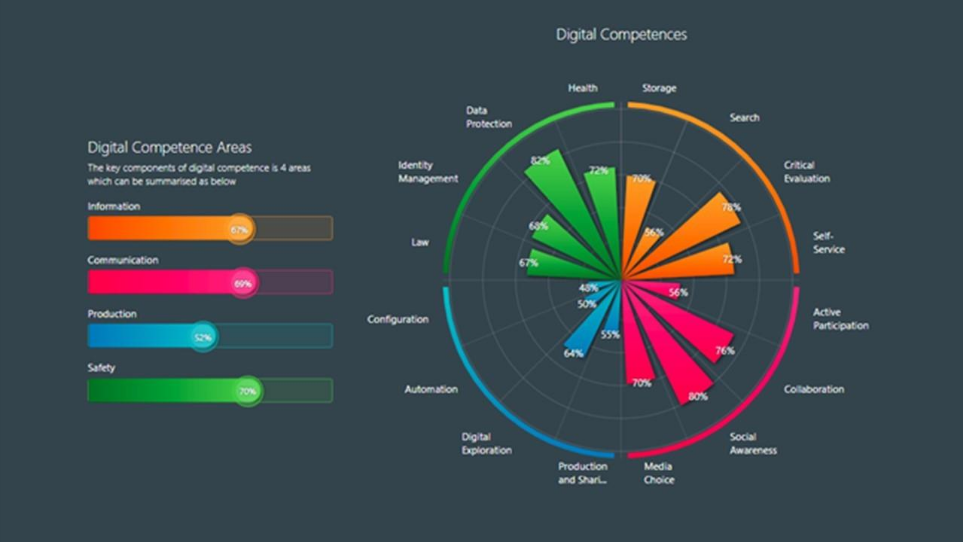
Based on the results, my strongest areas are security, communication, and information sharing. I still need improvement in managing production-related tasks.
Self-evaluation
The tasks related to digitalization helped me reflect on my own skills and my relationship with digital services. They made me think more carefully about my digital competence. Basic everyday tasks, such as online banking, appointment booking, and using different applications, are already quite easy for me. I feel that I am keeping up well with digitalization.
At the same time, I recognize that I do not know everything, and there is constantly something new to learn in order to manage personal matters effectively. In particular, data security and privacy are areas that require continuous attention, as they play an important role in the use of digital services. Without sufficient knowledge, one may unknowingly become a victim of a data protection breach.
I also found myself thinking a lot about the digital divide and how easily some people can be excluded from services. The digital divide is not just a theoretical concept; it is clearly visible in everyday life.
Another important realization was that digital skills are never “complete” but must be continuously developed. Critical thinking and the ability to evaluate information are also essential skills that take digital competence to a higher level.
Blogs where I wrote my comments
Good stuff. I keep on wondering on how can we close the gap on the digital divide, so that no-one gets left behind with our ever evolving world, especially in these uncertain times, where people need the help of others more than ever.
A clear and comprehensive reflection on digital citizenship in everyday life. I especially liked how you connected digital services like Kela and OmaKanta to real-life situations in your family, which made the topic concrete and relatable. Your discussion of the digital divide was also thoughtful and well-structured, clearly showing its social and practical impacts.
It was great that you reflected on your own digital competence and identified both strengths and areas for improvement—this adds depth to your blog. Overall, your text highlights well that digital citizenship is not only about using services, but also about continuous learning, critical thinking, and ensuring equal access for everyone.