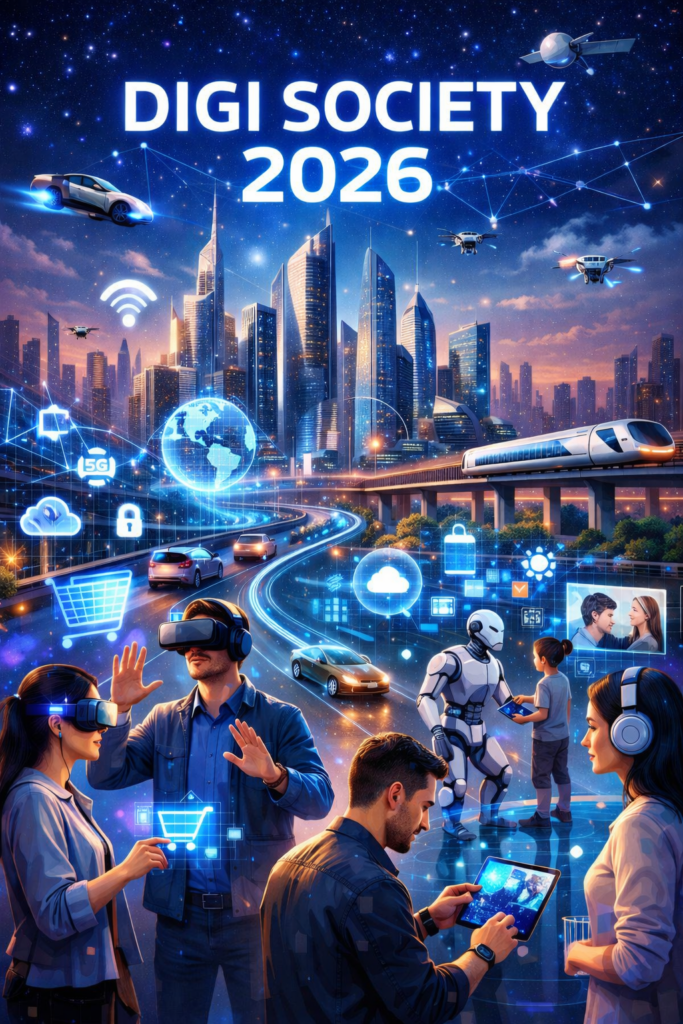
Picture: Ghat GPT: Digi Society 2026.
Digital Society
A digital society refers to a society in which information and communication technology is a central part of everyday life, services, working life, and decision-making. Digitalization is not merely a technical tool; it reshapes ways of operating, interaction, and the structures of society. Electronic services, online communication, automation, AI, and extensive collection and analysis of data are key features of a digital society.
As a result of digitalization, public services are increasingly available online. Citizens can manage taxes, healthcare services, banking, and study-related tasks electronically regardless of time and place. This increases efficiency and accessibility but requires functional systems and sufficient digital skills. At the same time, a digital society places new demands on employees and service providers, as utilizing technology requires understanding its possibilities and limitations.
In working life, digitalization is visible through remote work, digital tools, automation, and the increasing use of artificial intelligence. Many routine tasks are automated, and the nature of work becomes more expertise oriented. At the same time, new professions and skill requirements emerge, while some traditional tasks decrease or change. A digital society strongly relies on the use of data: by analyzing collected data, services can be developed, predictions can be made, and decision-making can be supported. This offers enormous opportunities but also brings challenges related to data protection, privacy, and cybersecurity.
One key issue in a digital society is equality. Not everyone has the same abilities or opportunities to use digital services. Therefore, support for developing digital skills and alternative service methods is needed for those who cannot or do not wish to use electronic services. When developing digitalization, it is important to consider ethical perspectives, security, and human-centered approaches so that society does not become divided based on digital competence.
Digitalization in Healthcare
Digitalization in healthcare is undergoing rapid development both in Finland and internationally. It means utilizing information and communication technology throughout the entire care pathway, from appointment booking and diagnostics to treatment implementation and follow-up. Electronic patient record systems, the Omakanta service, digital appointment systems, and remote consultations are everyday services for many citizens.
In Finland, wellbeing services counties are developing digital services as part of structural reforms. Remote appointments, chat services, and digital care assessments have become more common, especially in primary healthcare. The goal is to improve service availability, speed up access to care, and reduce the burden on healthcare services. National strategies also emphasize smooth information flow between different actors and the patient’s role in managing their own health.
Artificial intelligence and data analytics have become key development directions. AI is used, for example, in imaging analysis, risk prediction, and supporting treatment recommendations. Wellness applications and remote monitoring technologies enable the follow-up of chronic diseases at home, supporting prevention and more individualized care. Digitalization is therefore an important tool in addressing cost pressures and the challenges caused by an aging population.
However, digitalization also brings challenges. System compatibility, staff digital competence, data protection, and cybersecurity are key issues. In addition, not all citizens actively use digital services, which require maintaining parallel service models. Success requires continuous development, training, and building trust among both patients and healthcare professionals.
Digitalization in Nursing Practice
In nursing work, digitalization is visible daily in many ways. The biggest change relates to electronic patient record systems, where nursing documentation, medication lists, test results, and care plans are handled digitally. This has improved information availability and patient safety but has also increased screen time and documentation workload.
Remote services have significantly changed the nature of work. Nurses increasingly conduct remote appointments, phone and chat assessments, and video-based guidance. Care needs assessments are often carried out digitally, and patients are guided toward self-care through electronic services. This requires strong clinical competence as well as good communication and digital interaction skills.
The use of technology in patient care has also increased in other ways. Remote monitoring devices, smart meters, and automated medication dispensing systems support care, and nurses can monitor patients’ conditions in real time through digital systems. AI-based systems support decision-making, for example in identifying high-risk patients, but responsibility for care remains with the professional.
Digitalization has also changed work organization. Work is carried out in multidisciplinary teams where information moves electronically between units. This improves continuity of care but requires system management skills and collaboration abilities. Continuous technological development requires lifelong learning and updating digital competence.
Although digitalization brings efficiency and new opportunities, it can also increase workload. System functionality issues, downtime, and documentation requirements can cause stress. It is therefore important that technology supports nursing work and does not take too much time away from direct patient interaction.
The Future of Healthcare and Digitalization
In the future, digitalization in healthcare will mean increasingly intelligent, predictive, and personalized services. The focus will shift more from treating diseases to preventing them. Data will be collected from multiple sources — patient record systems, wellness applications, smartwatches, and remote monitoring devices — and used to predict health risks. AI can identify early changes in a patient’s condition and help target care at the right time.
Healthcare services will become more flexible and independent of time and place. A growing proportion of appointments, monitoring, and guidance will be conducted remotely. Physical visits will focus on situations requiring examinations or procedures. This may improve service availability, especially in sparsely populated areas, and reduce congestion.
In nursing work, digital guidance, remote monitoring, and technology management will become more prominent alongside traditional nursing care. Work will become more expertise-oriented, and some routine tasks will be automated, freeing up time for patient interaction, guidance, and holistic assessment. At the same time, ethical competence, data protection, and safeguarding patient rights in digital environments will be emphasized.
Risks of an Open Digital Society
An open digital society is based on the free flow of information and interconnectedness, but it involves significant risks. Cyber threats, data breaches, and denial-of-service attacks may target critical functions such as healthcare, banking, and energy supply. In healthcare, digital systems such as electronic patient records, telemedicine services, and hospital networks facilitate information sharing and speed up care processes. However, they also expose sensitive patient data to breaches and misuse, which may endanger patient safety and trust in the healthcare system.
Privacy and personal data protection are key issues, as enormous amounts of data about citizens’ activities and health are collected in a digital society. In healthcare, this means patient data must be handled carefully and in compliance with regulations such as GDPR to ensure that information does not fall into the wrong hands and that patients’ rights are protected.
Openness also increases the risk of misinformation spreading, which can influence public opinions, decision-making, and even democratic processes. In healthcare, false information about vaccines, treatment methods, or diagnostics may lead to incorrect care decisions, fear, or reduced treatment adherence.
Digital inequality is also a significant challenge: not everyone has the same skills, devices, or competence to use digital services. Without alternative service options, this may lead to exclusion. In healthcare, this can mean that elderly people, immigrants, or low-income individuals may not benefit from remote services, digital appointment systems, or teleconsultations, increasing health inequalities and limiting equal access to care.
GDPR and Data Protection
The General Data Protection Regulation (GDPR) is EU legislation that came into force in 2018. Its purpose is to protect citizens’ personal data and harmonize data protection across the EU. In healthcare, GDPR is particularly important because sensitive data such as medical history and treatment information is processed. Patient data must be protected, only necessary data should be collected, and it should be used solely for purposes essential to care.
Using Artificial Intelligence (ChatGPT) in My Field
The answers provided by artificial intelligence were mostly accurate and clear. It was able to summarize complex topics such as the effects of digitalization on healthcare, GDPR principles, and the use of AI in nursing. However, there were some challenges: for example, searches did not always focus on the correct issue, and emphases were sometimes incorrect. The text could also be long and difficult to structure.
In general, AI is a useful tool for brainstorming, organizing information, and summarizing content. It can speed up information retrieval, help draft essays or reports, and provide clear examples of complex phenomena. At the same time, it is important to remember that AI does not replace independent thinking, critical evaluation, or professional judgment; rather, it serves as support for learning and information processing.
Self-Evaluation
Addressing this topic has increased my understanding of the effects of digitalization on society, working life, and especially healthcare. I have learned that digitalization changes job content and skill requirements. In healthcare, digitalization transforms patients into active participants in their own care, and data protection (GDPR) and ethical considerations are central factors in digital healthcare. I also understood the possibilities of AI, such as supporting predictive care and improving efficiency in routine tasks, but also its limitations and data protection challenges.
In my experience, digitalization offers enormous opportunities, but utilizing it requires continuous learning, critical thinking, and responsible action. I would like to learn more about practical applications of AI in healthcare, data security, cybersecurity, and issues related to digital equality. At the same time, it is important that nurses and other professionals participate in developing digital services so that technology supports patient care safely and ethically.
I wrote my comments on the following blogs:
DIGI SOCIETY | Sirja´s Digitalized Working Environment
DIGI SOCIETY – Digitalized Workplace in Healthcare; Risks & Challenges