
I’ll start this post with sharing my thoughts about my visits in websites of the Social Insurance Institution of Finland (KELA), OmaKanta and Keva.
Finnish KELA takes care of settling benefits of nationwide social security programs like unemployment benefits and student financial aid. Thus Kela has big impact on Finnish social welfare and equality. My family currently uses child benefits and reimbursement for the costs of medicines. I personally have to pay the healthcare fee for Kela which gives me the student’s right to use the services of FSHS. Earlier my family and I have used multiple different other benefits anything from study grant, reimbursements for private medical care to maternity package. I have travelled a lot and I’ve got an European health insurance card already in order to complete my travel insurance. Still it was eye-opening to go through all the services and benefits Kela gives us during our lives. I feel lucky!
I have used OmaKanta a lot, mainly to check my prescriptions. It is easy to access on the kanta.fi page. Keva site calculates the amount of pension I’ll get. My age of retirement is 67 years 4 months. But the targeted retirement age was stated two years older. After two years with the same salary I could increase my montly pension 20%.

Visiting a digital shop
I visited Amazon’s online store, which I have used very seldom and never ordered anything from. I searched for Adidas women shoes. First, I found the prices were quite the same as in local shops. I realized after selecting the color, the prize was typically varied dozens of euros. It was difficult to see which sizes were actually available and at which price. I did not find this shopping experience very shopper friendly. Among Adidas shoes I was shown sponsored, extra shoe ads based on the product’s relevance to my search query. I did not find those suggestions very successful. The service seemed reliable, after reading section Security and Privacy. I had difficulties to find any customer service contact information (phone or email) which I could contact from Finland. Payment options included cards but unfortunately not PayPal. In general, Amazon is a huge, well-known global company which has resources for customer service. It emphasizes customers’ privacy and safety. There might be risk of buying fake products from Amazon’s third-party vendors but luckily there were customer reviews which could minimize that.
User experience from an application from health IT
I chose to explore the Terveystalo application as first-timer user. The private sector is generally held as a very efficient operator in healthcare so I wanted to check their application for patients. The company I work for has its own application for the public healthcare sector, which gave me a useful point of comparison.
Briefly the Terveystalo application is for booking appointments, viewing test results and medical records and messaging with health care providers. It enables online payments for remote appointments. My first impression with the application was neutral yet professional. Downloading and logging in was easy. It was initially said that identification is available only with online banking codes, but the mobile certificate and an electronic ID card were supported too. Upon launching the application, I got short introduction and a confident welcome text, emphasizing the application has been developed together with customers. The message also reminded to keep the application updated – not due safety reasons but because possible new features. I got informed that providers are available 24/7, which is relevant information. The interface is plain and simple in a familiar Terveystalo’s style with a blue and white color theme.
Navigating in the application was smooth and easy. The main view displays medical records, test results, sick leave certificates, prescriptions and vaccination information. Viewing all events, booking appointments and chatting with providers is possible via the bottom screen buttons. The application provides also timely news, for instance about preventing tick bites and TBE-vaccination. There’s a dedicated button for user settings where I can manage payments, contact and family information, language selection, identification, push notifications, consents and insurance details. The terms of use and privacy statement are available along with opportunity to give feedback or delete account. A feedback button appears also elsewhere in the app which makes it convenient to give it about the page I’m scrolling. I did not meet any bugs or technical issues during my experiment.
The privacy statement explains clearly what information it processes and for what purposes. The measures of protecting personal data protection were counted. Overall, the safety and privacy information were presented in a professional way. I found areas for improvement in accessibility that could help elderly or visually impaired users. I did not find any options or buttons for enlarging the view or font. I have understood that such features might be useful with external text-to-speech and speech-to-text applications.
Overall, the Terveystalo application offers smooth and good quality user experience for patients seeking private healthcare services. It’s clearly structured with no technical issues during use. It includes essential functionalities and also clear information on data protection and privacy. This all creates reliability towards the app.
Digitalization and digital gap
If and when most public services are primarily accessible via online, there is a significant risk of inequality for those who are not using virtual services. Online platforms are usually available 24/7, providing quicker – and often better – results, especially in healthcare. In contrast, face-to-face services tend to have limited hours. The longer essential services are delayed, the more the individual’s needs might increase which results in greater human suffering and significantly higher costs.
I wonder what happens when AI continues developing and is added to public services. Those who are already capable of using virtual services, will they eventually get better, more individual and versatile services? And when focus is developing online services, what happens to real life services? This might cause significant inequality between active, digital “natives” and those who are not.
Digital Competence Test
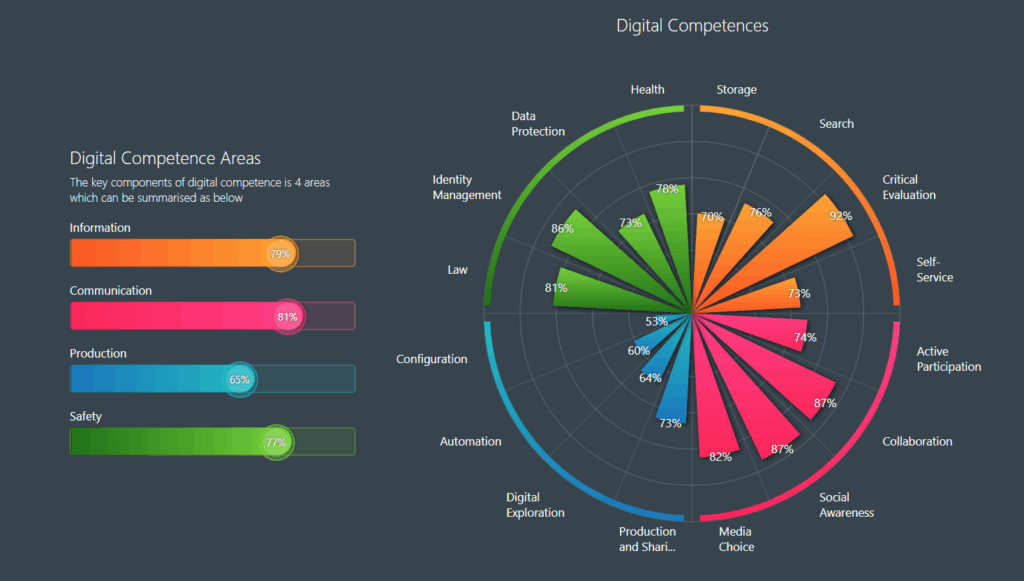
The test was eye-opening and a brilliant tool for evaluating my own digital behavior and performance. The numerous and diverse questions really made me reflect on my skills and how I apply them in a digital environment. Working in an IT company as a team leader and coach has contributed to my high-level competencies. I scored highest in critical evaluation skills, social awareness, and collaboration.
The main areas for improving my overall digital skills were configuration, automation, and digital exploration. Years ago, I worked as an application developer and tried coding, but I’ve always been more interested in areas like people, processes, and agile methods. I’m not very active on social media nowadays, which was reflected in the results as well.
In any case, like my fellow students, I found the test and its recommended exercises inspiring. I plan to continue monitoring my skills using this tool, and I think I’ll recommend it to my friends and team members as well.
Self-reflection
I did enjoy doing this assignment! It reminded me to think about the activities of digital service providers and whose services I want to use in the future. Critical evaluation is an important skill as a digital citizen! I was very motivated by the digital competence test and its concrete tasks to develop my skills.
I commented these three articles: