OMAKELA, OMAKANTA AND KEVA’S PENSION RECORD
I myself work at Kela, so our website is very familiar to me. In my opinion, it is actually quite well-designed. The contents have been renewed purposefully in recent years, and especially the pages for private customers have been made clearer and the structure improved. As a result, visitor satisfaction has increased: users of Kela.fi gave the site a score of 6.7 (on a scale from 0 to 10), when earlier the score was 6.2 and before that 5.5. Mobile usability has been improved, because over 60% of users use Kela.fi on their phone. The challenge of Kela.fi is the search function, which still needs development. It is especially good that at the end of every page you can give feedback, which is used in development work. Kela.fi also has easy-to-read and sign language pages. These have also been renewed so that information is accessible for as many as possible. In the survey for the easy-to-read pages, 84% thought the language was easy and 81% thought the layout was clear. In the improvement suggestions, people wished for more illustrative pictures and concrete examples.
Kela is renewing the benefit processing and customer service systems as well as their platforms and IT systems by 2032. The goal is faster and smoother service and a better customer experience. Electronic services are also expanding quickly. Decisions and letters are aimed to be sent primarily electronically, which speeds up information flow and saves costs.
In our family, we receive child benefit, but over the years many Kela benefits have become familiar, as well as OmaKela, where applying for benefits is easy or you can check the status of your application in your own data. I already have the European Health Insurance Card.
OmaKanta is also already familiar to me. In OmaKanta, you can find the information saved about you when you have visited health care, a pharmacy or social services. In OmaKanta, I can see for example the following information:
- Prescriptions (valid and expired)
- Laboratory results
- Medication information
- Allergies and hypersensitivities
- Vaccination information
- Living will and organ donation testament
- Patient information recorded by health care professionals
- In the future also social service information (e.g. client plans, decisions), if I would have such
- Information you have saved yourself (e.g. measurement results, your own notes)
You can also view the information of your underage child or another adult, if you have the right. In OmaKanta, you can also influence the use of your data and manage consents and refusals. You log in to the service with strong identification, like online banking codes or mobile certificate.
I have also used Keva’s service many times. In Keva’s pension service, you can see your work pension information, like how much pension you have accrued and your work history. In the service, you can check the amount of your pension and estimate your future pension with calculators. You can apply for pension and rehabilitation electronically, and you can follow the progress of your application. Payment information, like the amount of pension and tax rate, can be checked and changed if needed, for example your account number or tax information. You can also act on behalf of another person in the service, if you have the right. All transactions are done with strong identification.
COMPARING ONLINE AND LOCAL SHOPPING
I use the Booking.com site a lot, but I also use the Finnish Sokos Hotels site. Booking a hotel accommodation is nowadays easy, because there are plenty of options. One of the most popular international booking services is Booking.com, while Sokos Hotels is a domestic hotel chain, whose rooms can be booked directly from their own website. The own booking channels of Sokos Hotels are often cheaper and offer more benefits for loyal customers.
Booking.com provides extensive information on accommodations, including photos, amenities, location maps, guest reviews, and policies. Listings are generally detailed, and the platform uses a sophisticated filter system to help users find what they need (for example, Wi-Fi, breakfast, pet-friendly, etc.). Only guests who have booked and (supposedly) stayed at a property can leave a review, which adds a layer of credibility. However, some users have reported that not all reviews are published, and sometimes negative reviews may be removed if they are said to violate guidelines.
Pricing is usually transparent, with most taxes and fees included in the displayed price. The platform uses secure payment systems and complies with data protection regulations like GDPR. Your personal and payment information is generally safe.
As with any large platform, there are sometimes fake listings or scams. Booking.com tries to monitor and remove fraudulent properties, but some do slip through. Booking.com’s Trustpilot score is currently low (2.2/5), with many negative reviews focusing on customer service and refund issues. However, millions of bookings are completed successfully, and negative reviews may be overrepresented because dissatisfied customers are more likely to post.
Booking.com can offer competitive prices, especially during campaigns, but by booking directly from Sokos Hotels’ own site, S-Etukortti cardholders often get the best prices and bonuses. In terms of reliability, both are safe, but booking directly from the hotel’s own site ensures that all information and wishes go straight to the hotel, which makes it easier to solve possible problems. In service experience, Sokos Hotels’ own channels offer more personal service and loyalty benefits, while Booking.com’s advantage is ease of use and a wide selection. Sokos Hotels’ own booking is often cheaper and more flexible for loyal customers, but Booking.com is good for quick comparison and international bookings.
DIGITALISATION AND DIGITAL GAP
Digitalisation has brought many benefits, but it has also increased the so-called digital gap, meaning inequality between those who know how and are able to use digital services, and those who do not use them. For people who do not use virtual services, there are several risks and challenges:
They may be left without important services, such as health care appointments, benefit applications or banking services, because more and more services are moving online. This can lead to social exclusion and difficulties in managing everyday matters.
Information and instructions are often most easily available digitally. If you do not use the internet, you may miss up-to-date information, for example decisions and instructions from Kela, the tax office or other authorities.
Being outside digital services can cause loneliness and a feeling of being left out, because keeping in touch with relatives and society happens more and more electronically.
Many services are cheaper or faster in digital form. Without digital skills, you may have to pay more, for example for invoices, or miss out on quick benefits.
In addition, there is the risk that taking care of matters requires more time and effort, when alternative service channels (phone, visiting in person) are reduced or become congested.
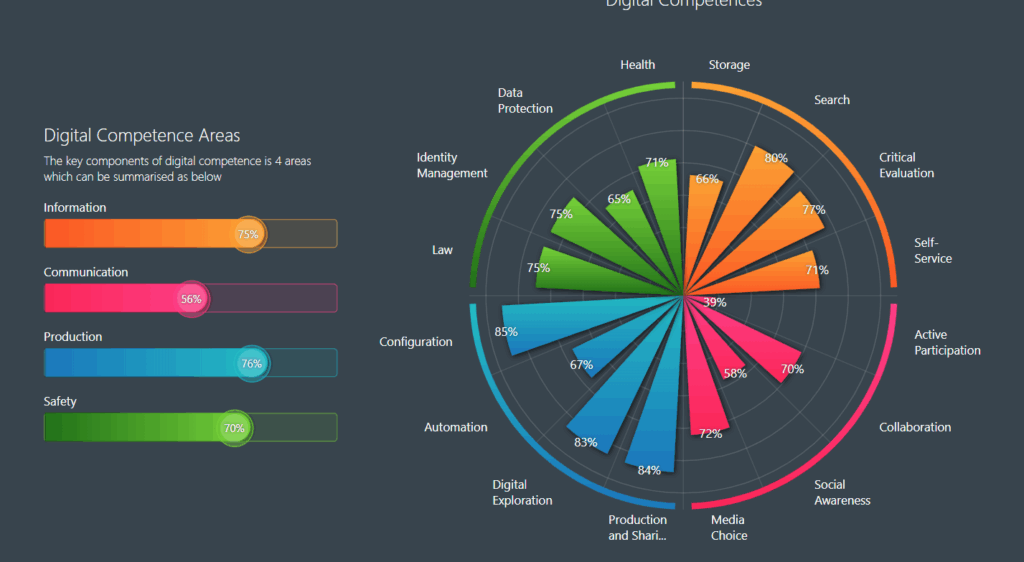
Digital Competence Test
OVERVIEW
I feel that digital systems are already familiar to me, and using them goes smoothly and naturally in everyday life. Different electronic services, such as Omakanta, online banking and appointment booking systems, feel easy to use, and learning new functions happens quickly. I know where to find the information I need and I can use the possibilities offered by the services, like electronic notifications and checking my own data. Also in problem situations, I can look for a solution independently or contact customer service. I feel that digital systems make it easier to handle matters and save time. Because they are familiar, I can focus on what is essential, and technology does not cause unnecessary stress. I am also ready to try new digital services, because previous experiences have been positive.
I commented :