
Kela, pension and accessing sites
I have found Kela to be there for me in my need. Can’t speak for other people since it seems the experience with Kela can be troublesome to say the least. I have used Kela mainly for student financial aid, but for other stuff as well like reimbursement for medicine costs. I had heard of the European health care card before, but never got it. Ordering the card was surprisingly easy knowing what a hurdle Kela can be sometimes. This was just few clicks and done. Though I do admit that being able to apply for Kela benefits online is very convenient.
All services that require authentication like Omakanta, I always access with my bank authentication. I don’t really like doing it, but it’s what I have been doing. I should take a look at Mobiilivarmenne, the mobile identity management service from Elisa, Telia and DNA. With that I could authenticate without offering my bank information.
My pension provider is apparently Elo. It used to be Ilmarinen a while back. At the moment my estimated lowest pensionable age is 68 years and 2 months while estimated highest pensionable age is 70 years. The difference between the pensions is few hundred euros.
Online stores
I buy stuff and things online few times a year. Really only when I can get something from a sale or its easier to buy online than go searching for them from physical stores. Recently I bought books from Adlibris, the Swedish online bookstore. I will use that as an example here.
One of the books I bought was the Nicomachean Ethics by Aristotle. In Adlibris you can choose from many different types of the same book, like paperback or bound versions and with different covers. Choosing which one you want changes the price and the delivery information. The prices vary from under 10€ to over 55€ for the same book. For the version I ordered, the cost was 13.10€ and its an order product meaning they didn’t have it in stock and it would take longer to be sent to me. The approximate delivery date was 7-11 business days. Adlibris has reviews for the books and basic information like author, translator, release date, page count and so on.
In Suomalainen kirjakauppa there are also few different versions of the book with different covers and editions, but all of them are paperbacks. The prices vary from cheapest 14.95€ to the most expensive 19.95€. The same version that I bought is found in both online stores. In Suomalainen it costs 19.95€ so around 7€ more expensive than in Adlibris. In Suomalainen the books is also an order product which they don’t have in stock in any store. The approximate delivery date in Suomalainen is 20-30 days which is way longer than in Adlibris. Suomalainen also has reviews and more basic information than Adlibris.
Overall the price difference is not huge between these two. The delivery price was also not much different. Adlibris does seem to be reliable store. The UX is intuitive and the site performs well. Reviews in Trustpilot are favorable. Adlibris has 3.8 stars out of 5 with most complains being about long deliveries and delays.
Using Ahfres in digital marketing
Ahrefs is a marketing tool that is used by digital marketers and content creators. It combines many features for search engine optimization, tracking, auditing and analytics.
I use Ahrefs for search engine optimization in my work which is why I use it as an example here. I use it to explore keywords and to check keyword volumes, difficulties and click potentials. Ahrefs can crawl websites to identify technical problems and problems with content. My main use for Ahrefs is the analytics and analysis. You can see any websites backlinks and organic search traffic. You can see competitors best performing content and keywords. You can track rankings and compare keywords to competitors.
Ahrefs has been very useful in SEO. This and other similar services make researching much easier and faster. The downside with the service is the high price which can be too much for small companies or individuals.
Digitalization and digital gap
Since society is becoming more and more digital by the day, this will cause challenges to those that won’t or can’t use digital services. Many services have been completely digitalized leaving them unable to use those services. Critical services, like banking and Kela, still have regular service at a physical office with letters and phone calls generally accepted as well. Over the years these services have been cut down and many places have been closed completely with others being open only for a few hours a week. How long till they are all closed? Healthcare is also making its way online slowly. Bookings and contacting can be done through online portals, but is still largely done through regular methods.
This shift into digital platforms can cause significant disadvantages to digitally excluded people, like elderly, people with disabilities, those with no internet access and people with low digital literacy. Challenges like exclusion from information and services, reduced access to services, increased inequality, and dependence on others are problems that would need to be solved.
Digital Competence
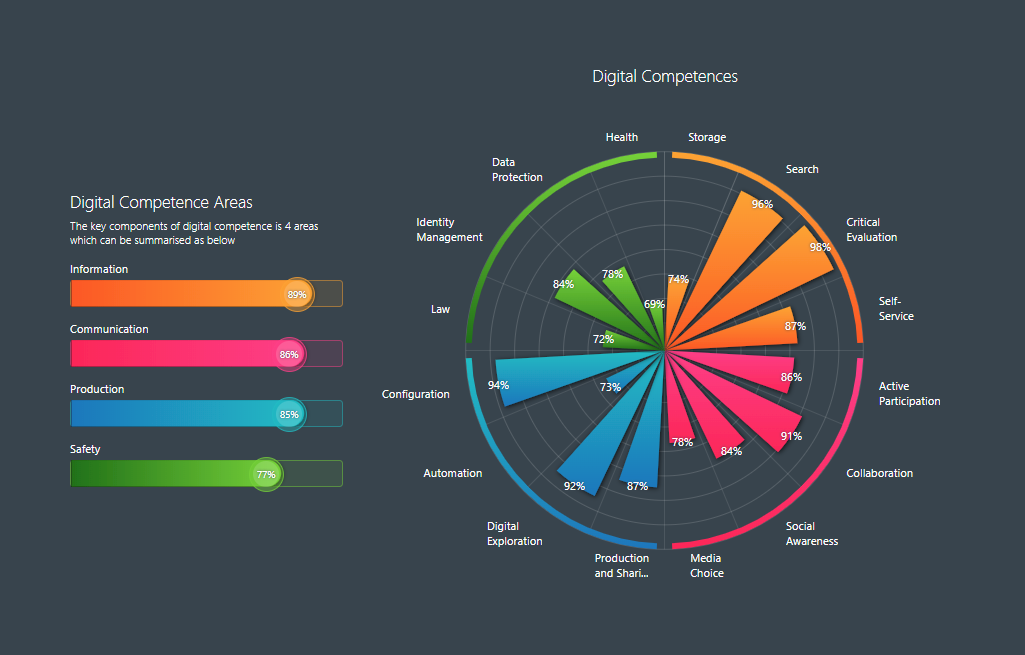
According to the test my digital competency total score is 84 %. The test puts me in level 7 “highly specialized” category according to the site.
The total score consists of:
Information 89 %
Communication 86 %
Production 85 %
Safety 77 %
Main areas that I should focus to improve my digital competency are in physical and mental health, law, and automation. It is true I don’t focus enough on physical and mental health when dealing with technology. Posture, ergonomics, online content, the time spent online and the time looking at screens all have an effect on the body and mind.
What I’ve learned
This task required me to think about myself and how I use digital services. It was insightful to think how I act and use certain things that you don’t normally think more of. Especially the digital competency test revealed areas to improve myself. Furthermore the task raised awareness of my own digital habits and choices with online shopping and work tools, and gave me insight into issues surrounding digitalization.
Blogs commented:

Leave a Reply