Me and Kela
Like probably all Finns, I have been in contact with KELA in many stages of my life. KELA provides assistance in various life situations, such as studying, disability, and retirement. My parents received child benefits for me from the moment I was born until I turned 17. After that, I applied for and received student financial aid and housing allowance for my studies. When my wife and I started a family, we began receiving various benefits for families with children, such as child benefits, maternity allowance, parental allowance, and home care allowance. As I write this, I am on parental leave due to my one-year-old son, so at the moment, KELA is paying my “salary”. Although KELA is often criticized for being a bureaucratic organization, it is still one of the cornerstones of the Finnish welfare society. I had never owned a European Health Insurance Card before because I had only traveled in Finland and the Nordic countries. I ordered it now through the service found on KELA’s website, so it should be delivered directly to my home address within two weeks.
Omakanta
Omakanta is a handy tool for managing one’s own affairs. You can check your current prescriptions, read medical records, doctor’s notes, and even make advance healthcare directives there. It is convenient to check, for example, what was agreed upon at the latest doctor’s appointment. Omakanta is accessed with online banking credentials and is a very user-friendly application. You can also view the affairs of underage children through Omakanta. I haven’t visited Omakanta in a long time because my wife usually checks the children’s affairs there. I had last visited Omakanta about 4 months ago. Logging in was easy with online banking credentials, and I have a valid authentication list. I went to see my current prescriptions. I rarely visit Omakanta, only a few times a year. However, I still think it’s good that the Omakanta service exists.
Keva
I had never visited Keva’s website before, so I logged in for the first time now. The service easily showed the current pension estimate. I was shocked when I noticed that my retirement age is 67 years and 1 month, at which point the pension would be 57% of my current salary. If I continue working until I’m 69 years and 2 months old, my pension will increase to even 66% of my current salary.
Reliability of online stores
I occasionally use various online stores to purchase various items. Mostly, I prefer brick-and-mortar stores on principle. However, sometimes I have to shop online if the product I need is not available in a physical store or if the product is significantly cheaper when ordered online. I mainly prefer Finnish online stores. I have never ordered anything from, for example, eBay or Temu. Temu markets very aggressively nowadays, but I don’t dare to order anything from there. According to the reviews, eBay seems very reliable. There was also a wide selection of products, and the prices were very competitive.
I have searched for and booked accommodations through Booking.com. The online store is convenient because you can easily choose the desired date and location for accommodation. The prices are also competitive. The only thing that annoys me about online stores is that I often receive a lot of advertisements from that particular online store in my email. Trivago is not a familiar online store to me.
I have never used Amazon’s online store. I have heard or read about it, but I have not wanted to shop there. Amazon seemed to be similar to other similar online stores, such as eBay. It seems that Amazon has such a wide selection that you could easily spend a day looking at its product range. However, I prefer smaller domestic online stores. I think items are bought out of necessity, not for the joy of buying.
Digitalization and the digital divide
Digitalization has increased significantly over the past few decades. Younger people have grown up in the midst of digitalization, so using digital devices is completely commonplace and usually easy for them. I think most Western people master the use of digital devices and services very well. I think a major problem with digitalization will arise in the near future. The problems of young people who have grown up with digital devices will explode. For example, various mental health problems have increased and will continue to increase, and social situations can cause problems when they are used to interacting with others mainly through social media.
I think, however, that the digital divide has grown for some people or groups of people. Many older people have learned to use digital devices and services very well. However, many very elderly people have been left out of digital technology. For example, my father-in-law does not have online banking credentials. He finds all kinds of transactions very difficult when he does not have online banking credentials. Ordering medical supplies independently, renewing electricity contracts, and paying bills are more difficult. People who have been left out of digitalization may feel inferior, and their services are worse because they cannot seek the necessary services without help. Another group that can easily be left out of digitalization is young people and the disabled. Due to their age, young people cannot or cannot manage their affairs digitally and may feel excluded. People with various disabilities may need help with digitalization, which makes them dependent on other people.
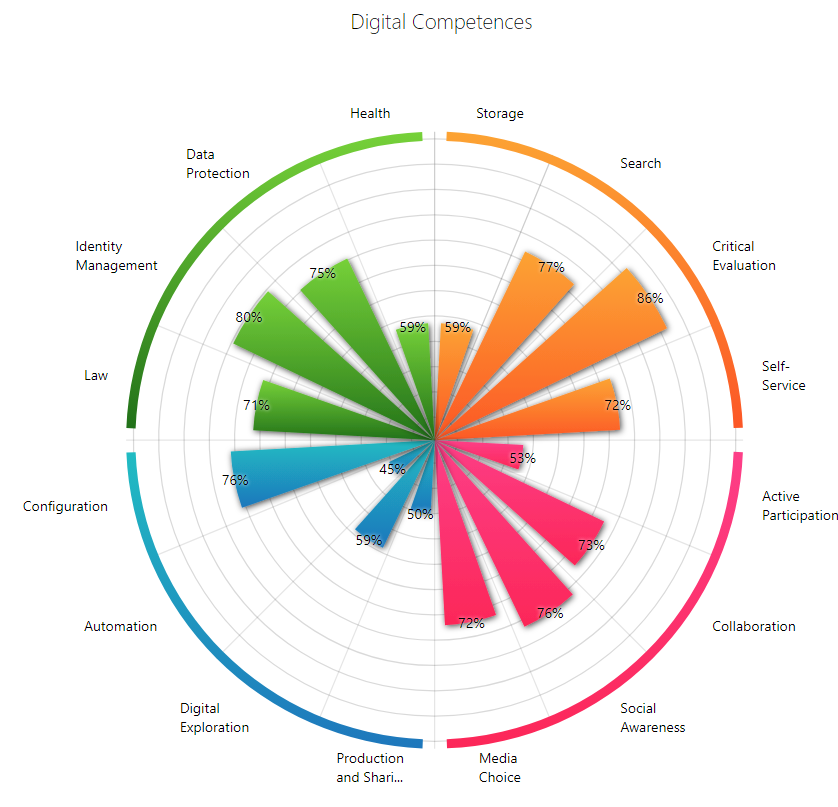
I took a digital skills test, which assessed proficiency in various areas of digital fundamentals. I had reasonably good digital knowledge, and the secure use of digital platforms was also reasonably well mastered. Digital production and communication were weaker areas of expertise for me, and it is therefore advisable to further develop them, even from the perspective of my work.
Self-assessment
It has been interesting to explore various websites. Some of the sites were familiar, such as the KELA website and Omakanta services. Completely new applications for me included Amazon and Trivago, among others. I have been hesitant to start using English-language websites because I feel that I am not proficient in English. However, thanks to this course, I gained the courage to try English-language websites as well. It was nice to notice that my language skills were sufficient for using them. Nevertheless, in the future, I still want to make use of physical stores and Finnish online stores as much as possible. However, if necessary, I am willing to use English-language websites as well.
I commented on the blog posts of Sanna Godard and Jari Karjalainen.
Hello, Juha!
I agree with you that it it very easy to fell off the wheels of digitalisation.
The vicious circle: no digital skills, no service at all or expensive old school face-to-face service and still no digital skills.
I think there should be some kind of national or international legislation that everyone should get familiarization to the services they’re entitled to. We are pushing all the people online all too fast sometimes.
Have a nice summer,
Juha
My blog here: https://blogi.savonia.fi/juharsite/
Great that the course encouraged you to use English! It is intresting what we learn in the courses, not just about the actual subject, but leaving our comfort zones.
But for the main topics of the assignment: I really value that that you brought up also the younger generation and the risks of digital life for them. I have been focusing maybe too much on the older generation without digital skills, as it is very much the reality I see daily. It has been a priviledge to read all the different points of view, and the downsides of digitalization are clearly visible in most blogs I have been reading. It will indeed be interesting to see how the “digital natives” do in the digital working environment, and will all of them really make it. And now I don’t mean just find jobs, or succee in their careers, but also do better than just survive considering their well being. As someone else pointed out, and also the sections of the digital competence test, the digital skills also include communication – the elements of social awareness and collaboration are needed both online and offline.
https://fearless-uasspringdwe2024.wordpress.com/
I agree. The development of digitalization has been tremendous in recent years, and I understand that sometimes it feels like you’re falling off the wagon. However, hold on tight! I believe it’s worth it!