Kela, Keva & OmaKanta
I lost my European Health Care Card and now I ordered a new one through Omakela. It has proven to be valuable as I did get once, or maybe twice, state-provided healthcare with presumably at the same cost as local residents. Last autumn, I received a letter to pay for health insurance, since I am now a degree student in Finland. I have not had to do this before. It seems the Finnish state pays 77 percent of the healthcare, and payments such as this make up for the rest 23 percent.
I visited Omakanta now with my computer instead of my smart phone for the first time, through the link provided on the course assignment page and signing in through my bank. There is not much else there than a visit I did when I moved back to Finland three years ago. I could not see information of the visits I did two decades ago. It seems you can only see registrations by HUS from 2014 onwards.
When I logged into Keva, I noticed I do not have the opportunity to check any possible pension I might some day receive. I called Työeläkelaitos and they informed me that as I have worked abroad in EU countries since I was 21, I can just contact them or a similar institution in a country where I will be when I am about to retire, and they will send queries to the countries I worked in and calculate the pension then. I cannot see online how much I might get yet.
I do find the possibility to use digital services convenient, I do not need to queue or travel to get service and I can access them wherever I might be located as long as I have the internet and a suitable device to access it. I cannot remember when last I used on location services in similar services, this was probably last time when it was required, which was when I purchased property. I have occasionally called, or chatted, to ask for something more specific or just to confirm what I might have already gathered from the internet.
Digital Commerce
Recently I ordered a hard-drive. I checked the prices online, found out that the cheapest ones would be available from German Amazon store. However, for the specific one I was after was not in stock, so I opted out to order one from Finland for about 20 euros more. If this would have been on German Amazon website the delivery for more costly item would have been free, and typically delivery has been reliable and fast. Spanish Amazon had the product in stock, but delivery costs would have been more and would have taken more time. For technology in general I do rely on online stores as doing so gives me a chance to look for more options and take my time to decide between available options, rather than being limited to one or two shops and their offers. If buying clothing I would prefer trying it on before purchase, but I often think I am too time-constrained to travel and look for them from shops nearby. To repeat myself, online shopping gives me easily a lot of options without leaving comfort of my home, or wherever else I would be.
I have used online food services, for example to order seasonable vegetables from farms and done some higher quantity shopping from supermarkets when I did not have a car. When I did this, the prices for delivery where nothing due to the amount I ordered. I also thought if more people would do this, would it be less less taxing for the environment.
As I have at times utilised hardware synthesisers and other instruments, I have now moved into the world of software versions of these, which is convenient, there is no need for cabling, moving and storing the devices, and I can download them repeatedly when I change computer. I also sold my collection of physical copies of movies and music, for music I subscribe to Apple Music where I have most of the same records I had and can easily get new ones with the subscription price and play them from devices I have at hand. Movies I have moved to an external hard drive. Books I did not sell, but I still managed to get most of them on my digital devices, which makes moving to different dwellings much more convenient. Not including the books, furniture, and some kitchen utensils, most of my belongings fit now in a large bag.
Reflection
By doing these assignments, I learned about my pension and looked more into the notion of ‘digital divide.’ I also got a change to ponder some societal changes we might face due to technological changes.
Issues relating to privacy and security are worrisome, as there is increasing amount of personal data who knows where now – all which can be abused. Holding our money, health records, tax-information and plethora of other personal information online can be convenient but also places all this vulnerable data to uses we might not approve of.
Being exposed to multitudes of world-views and other information, it can be counterintuitively more easy not to challenge oneself with narratives that do not fit our worldview and to encounter information that is not factual even if we do have the possibility to expose ourselves to a large amount of it around the world.
Environmental issues arising form energy needs of computing can also be alarming, however, at least travel can be thought to be less necessary as well as production of natural resource hungry physical objects. Maybe there will be also more XR technologies utilised so we can also immerse ourselves into different experiences without the need of leaving our more immediate surroundings.
Also, the ’digital divide’ is an issue that concerns acutely large amount of people in rural areas, people who do not know how to use quickly developing technologies and those who cannot afford to purchase and maintain this technology, and I suppose those who identify as luddites. If there is no possibility to engage with new technology the gap of this divide will continue to grow. One could miss potential employment opportunities, not access services considered vital nor connect socially to other people. Some form of education on how to use digital services and providing cheaper or free ways to do so would be beneficial for a more equitable future. On a positive note, some countries do offer free Wi-Fi. Additionally, if necessary, social security at least in Finland can provide financial assistance for a smartphone.
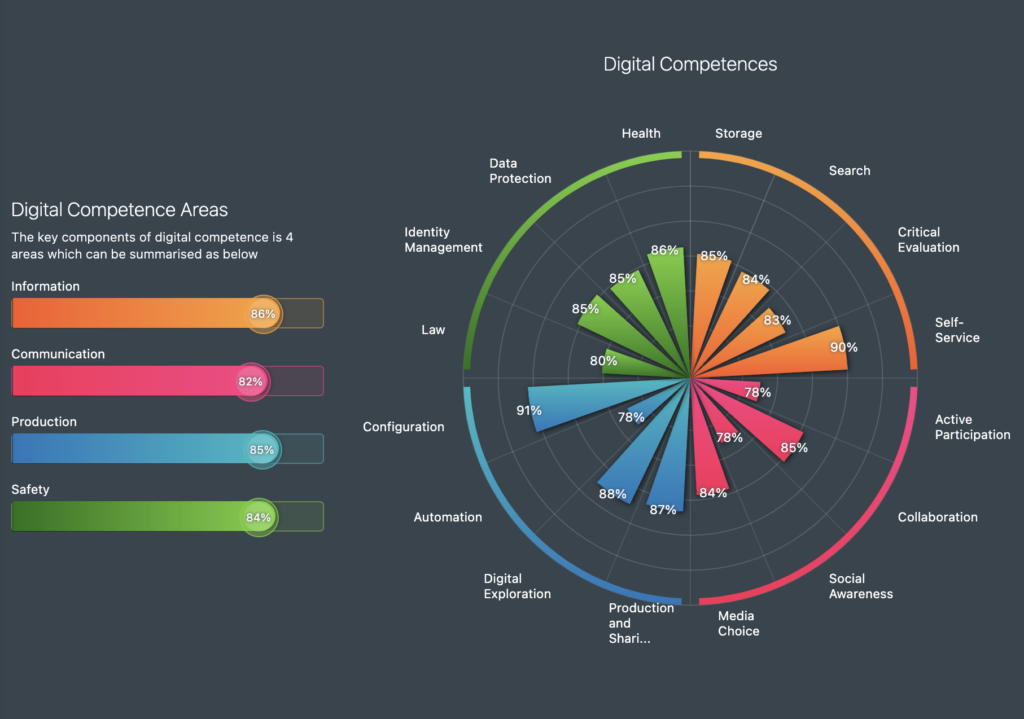
Here is my self-evaluation of my digital competence.
Comments
Interesting that ‘digital divide’ is mentioned, which I would think is one of the main obstacles to achieve more equitable future.
Not all have the financial resources to purchase and then maintain digital technology, which not only involve the initial costs of purchasing, but ongoing expenses for updates and keeping up the internet connection. It is stated, and easy to think, that most people on the other side of this divide are form rural areas and/or lack the financial means to partake in the ongoing societal change posed by technology. Although, at times it seems some people do seem to have at least a smart phone if not much else. Still, I think addressing this gap is essential for ensuring that technological progress benefits everyone, rather than amplifying existing inequalities.
I have noticed that shift to using almost solely digital services in areas considered essential as banking. There are no more banks nearby where I live and just few years ago there used to be many. Where there were these now is only a demolished place for a shopping mall, that probably won’t be built, maybe partly because people order their stuff online.
I can imagine people not used to digital devices, luddites or those preferring a bit more personal touch in dealing with these matters can feel that the times have changed for worse. I personally do not miss queuing or travelling to deal with matters such as these, at least on my day to day banking. But well I do wonder how is the world going to look like when commerce and services move online, more parks?
Interesting to hear about the French healthcare system. At times I do wish we had similar concept of having an appointed practitioner, who could have more holistic understanding of the patient. I can imagine it being rather tiresome to try to explain again and again what is the issue, duplicate tests, have conflicting prescriptions and probably listen varying, possibly hasty, possibly wrong, diagnoses. Not to say that maybe it can be not very great to have a just one person’s opinion of something that one still hopes could be objective. Presumably as technology and medical history sharing develops more, diagnosing patients will become more accurate and quicker. Who knows maybe we have one beautiful day chips installed into us, or/and our mirror can scan and inform us what needs attention.