

Analysis of My Digital Competence Profile
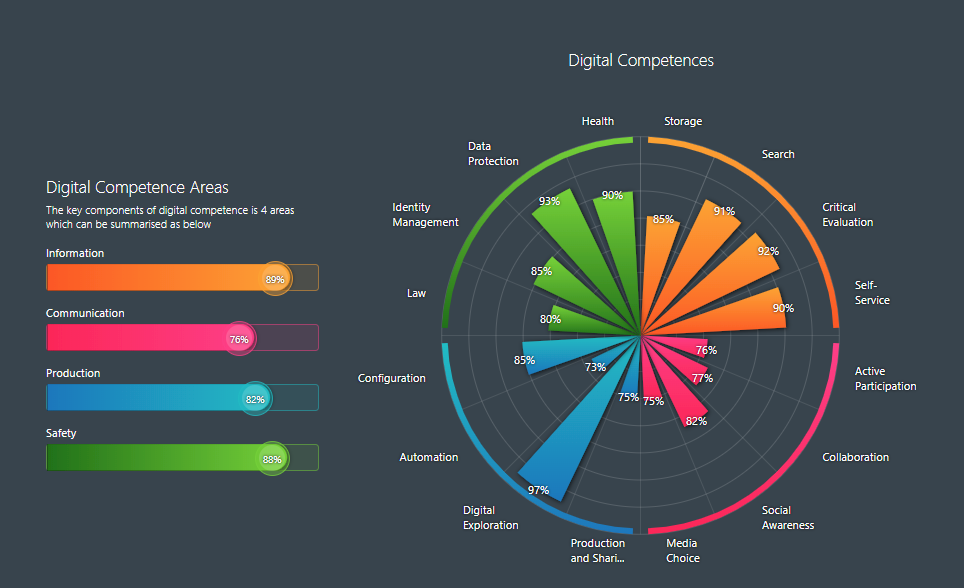
The results of the Digital Competence Test provided an accurate mirror of my strengths as an experienced professional, while also highlighting distinct areas for strategic development. My highest scoring individual capability was Digital Exploration at an exceptional 97%. In the context of my career and Master’s level studies, this demonstrates strong adaptability. I do not fear shifting digital workflows or adopting new software ecosystems; instead, I possess a natural agility when auditing and mastering new digital environments. Furthermore, my competencies in Data Protection (93%), Critical Evaluation (92%), and Search (91%) solidify my profile as an analytical, risk-aware digital citizen. In an era dominated by algorithmic biases, generative AI tools, and corporate data harvesting, these scores reflect a mature approach to information literacy. I know how to source high-quality data efficiently, evaluate its validity critically, and safeguard personal and organizational data boundaries. This is further supported by my solid main area scores in Information (89%) and Safety (88%).
Conversely, the test precisely highlighted where my digital friction lies. My lowest score was in Production and Sharing (73%), accompanied by moderate scores in Automation (75%), Social Awareness (75%), and the broader Communication area (76%). Reflecting on my daily habits, this diagnosis is correct. In my professional life, I excel at absorbing information, managing risk, and executing structured tasks, but I tend to be a passive consumer rather than an active digital creator. I often default to established corporate communication pipelines rather than pioneering creative digital content or building collaborative virtual communities. Writing this professional blog is a perfect exercise to directly target these weaker areas of digital production and interactive communication.
Evaluating Finnish Public Digital Services
In the next step, I looked at Finnish public digital services: Kela, OmaKanta, and Keva. Before looking at these services, I want to state one important point: I am not going to share my personal pension numbers or health data in this blog. My Digital Competence test gave me a high score of 93% in Data Protection. I believe that being a good digital citizen means knowing how to keep your personal and financial information private. Fortunately, it is very easy to evaluate these public services on a general level without sharing any sensitive data.
Kela and the European Health Insurance Card: Kela is a great example of how public paperwork and bureaucracy have been reduced in Finland. In their online service, sending documents, making applications, and tracking decisions is easy without visiting an office. I tested how smoothly the service works by ordering a European Health Insurance Card. The process was fully automated. The system checked my residence and insurance information directly from the background databases. The order was sent with just a few clicks without filling out manual forms.
OmaKanta: The national health data archive OmaKanta collects information, prescriptions, and laboratory results from both public and private healthcare providers in one place. The service requires strong electronic identification, like online banking codes or a mobile certificate, which is necessary for security. The best part about OmaKanta is transparency. Users can see exactly from the log data which doctor or nurse has looked at their health information and when. This builds strong trust in digital healthcare.
Keva and Pension Calculators: Pension matters can feel distant to many people, but Työeläke.fi and Keva offer good digital tools to plan the future. With their online pension calculators, it is easy to test how your retirement age and working time affect your future monthly pension. The calculators show the big difference between retiring at the minimum flexible age versus working longer until your target retirement age. The system is built so that working longer rewards you with a deferral increase, which raises your monthly pension and makes working longer financially smart.
Evaluating Global Digital Commerce
In this section, I looked at large international online shops and services like Amazon, eBay, and Booking.com, and compared them to local shops. The biggest advantage of global platforms is that they give a lot of good information to the consumer. You can read millions of user reviews, see exact product details, and use automatic price comparisons. Because global online shops sell so many items, their prices are often much lower than in local brick-and-mortar stores. The biggest and most famous platforms are very reliable and safe when it comes to payments. However, you still need to be careful as a consumer. Sometimes there are hidden shipping costs, import taxes, or unreliable third-party sellers that can change the final price. On the other hand, the best parts about local shops are that you can get the products immediately, you have clear local consumer protection laws, and returning items is much faster and easier.
Industry-Specific Application – myneva.nappula
In child welfare and residential care, the most important digital tool in my daily work is the Kanta-compatible myneva.nappula system. It collects all client data, care plans, and medication logs into one secure place.
The system makes our everyday work much easier through easy mobile entries and an internal digital notebook for safe communication between work shifts. In my competence test, my scores for digital communication and content production were slightly lower. However, a guided system like Nappula helps bridge this gap because the software ensures that our daily reporting is always high-quality and legally compliant. Ultimately, when digitalization makes paperwork faster, it leaves us more time for face-to-face support and being present for the children.
The Digital Gap and Risks
Even though digitalization makes life easier for many of us, it also creates a major problem called the digital gap. Society is moving online very fast, and this creates a high risk of exclusion for people who do not or cannot use virtual services. This group often includes elderly people, marginalized groups, or people who cannot afford modern smartphones, computers, or fast internet connections.
When banking moves completely online, when using cash becomes difficult, or when booking a doctor’s appointment requires a digital queue, these people face a closed door. The digital gap hurts social equality. Today, having digital access is no longer just a nice luxury; it is a strict requirement to get basic human rights, public welfare, and healthcare. It is very important that our society and public organizations keep human-centric and accessible alternatives available alongside digital tools.
Self-Evaluation and Conclusion
Combining the data from my Digital Competence Test with practical evaluations of public services like OmaKanta and my everyday work tool, myneva.nappula, taught me a very important lesson: being technologically literate is not just about knowing how to use applications. It is about understanding data privacy, security, and societal accessibility.
From these tasks, I learned that while I am highly capable of protecting my privacy (as shown by my 93% score in Data Protection) and exploring new digital tools, I must actively work on my digital content creation and online interaction with others. In the field of child welfare, digital software should always support human work, not replace it. Moving forward, I want to learn more about how upcoming digital trends could help reduce administrative work even further. True digital citizenship requires a continuous balance between technological capability, personal safety, and social responsibility.
References
Kanta.fi. (2026). My Kanta Pages. Kanta Services. https://www.kanta.fi/omakanta
Kela. (2023). The Social Insurance Institution of Finland. Kela. https://www.kela.fi/henkiloasiakkaat
Keva. (2026). Public Sector Pensions and Calculators. Keva. https://www.keva.fi/
myneva. (2026). myneva.nappula Client Information System. myneva Finland. https://www.myneva.eu/fi/ohjelmisto/myneva.nappula
Työeläke.fi. (2026). Earnings-related Pension Indices and Calculators. Finnish Centre for Pensions. https://www.tyoelake.fi/
My comments to other blogs: