
Virtual services
KELA
Kela offers Finnish social security for citizens in various life situations. Kela takes care of people’s basic income during unemployment, illness, pensions and studies. Kela’s services can be obtained via online forms without direct personal dealings. Online services have made it easier to apply for subsidies if a person has a computer with internet connection. I received child allowance from Kela when my child was small. Child allowance is currently 95 euros per month. Nowadays, child allowance is applied for online from OmaKela. I also received a maternity kit from Kela, which contains supplies for caring for a newborn. The last time I used Kela’s services was when I was on study leave and applied for a study grant. I have paid the university student’s healthcare fee to Kela. I have a Kela card, which is needed in health services.
European health care card is social insurance card in Europe. It is t is convenient when traveling or training in Europe because you get medical care at the same price as the locals.
OMAKANTA
OmaKanta (MyKanta in English) is nation wide online transaction service where I can renew my prescriptions or check laboratory tests. Occupational health has recorded my information in this database. It is good to know that there is even more information of wellbeing data. The online service contains personal data, so a strong login is required. It means identifying with a mobile certificate or bank credentials, and it is a particularly strong way to confirm identity electronically. Trusted sites use strong authentication. I logged in to OmaKanta with bank credentials because the identification is safe that way. If you don´t have bank credentials, you can also log in with a mobile certificate or separate certificate cards. Mobile certificate means suomi.fi identification, which is a public administration service for identification. To use the certificate card, you need an identification device and software. If a foreigner does not have a Finnish method of identification, they use an European identification or a Finnish Authenticator.
KEVA
Keva is a public pension service where you can check your own work pension information. I work at commune sector so Keva is my pension service. It also needs strong authentication. I can find out about different pension options, e.g. old-age pension or disability pension. I also get information about rehabilitation support if I would do physically demanding work. There is a calculator on the page that I can use to calculate my own retirement age and the amount of my pension. If I retire at age 63, I will receive early pension and at age 65 pension increase gradually. My actual retirement age is 68 years 3 months for full pension. I could work until I am 70 when the pension insurance ends. I think I will retire sooner.
Shopping online
I compared the hotels in Tampere on the Booking.com website and the prices offered by the hotels. I chose centrally located hotels for one night for an adult with breakfast. The price differences were around 20-30 euros. The easiest way to find a hotel room is through Booking.com, because all hotels are connected to it. Price comparison is easier through this online service. Many hotels present rooms on their own website, but direct the customer to a comparison site. The price depends a lot on the location, because the ones in the center are more expensive than those a little further away. The prices are different if you compare to Trivago’s prices. Prices vary daily and according to the season. You can get offers from hotel if you are a member of a store chain.
My favourite application
I don´t buy much from online stores. I prefer local grocery and buy discounted meals or fresh products. I usually buy clothes in a store because I want to try them on before buying. My favorite application is related to public transportation because I don´t have a car. I travel by buss and train to work. The applications include schedules and you can follow the arrival of the bus in real time on the map. You can buy ticket online and the ticket is there on your phone. Tickets for long distance trains are cheaper if you buy them as early as possible. The price is the same if you buy online or from a vending machine on the same day. The VR application has a new service because you can activate the ticket yourself without checking. Conductors can see the electronic tickets from their own computer. You also can buy online food from train restaurant to your place.
Digital gap
Finland has taken big step in digitalization. There still exist digital gaps when using electronic services. The idea is that everyone can use public services anywhere anytime for free but digital services has impediments and access is not possible to everyone. It is inequal between people who use digital services or don´t. Almost all public services are working online and it sometimes is harder do business face-to-face for exaple without an appointment. In order to use digital services, you must have a computer or smartphone with which you can log in to the service. You must know how to use the devices and know how to use those services. The gap may be due to social status, democratic situation, age or educational background. The biggest problem is not accessibility but using. People need knowledge how to use services. In libraries, you can use a public computer and the internet if you don’t have your own. Digi mentors will help you if you need guidance. Finnish education includes the teaching of information technology and media literacy.
Digital competence test
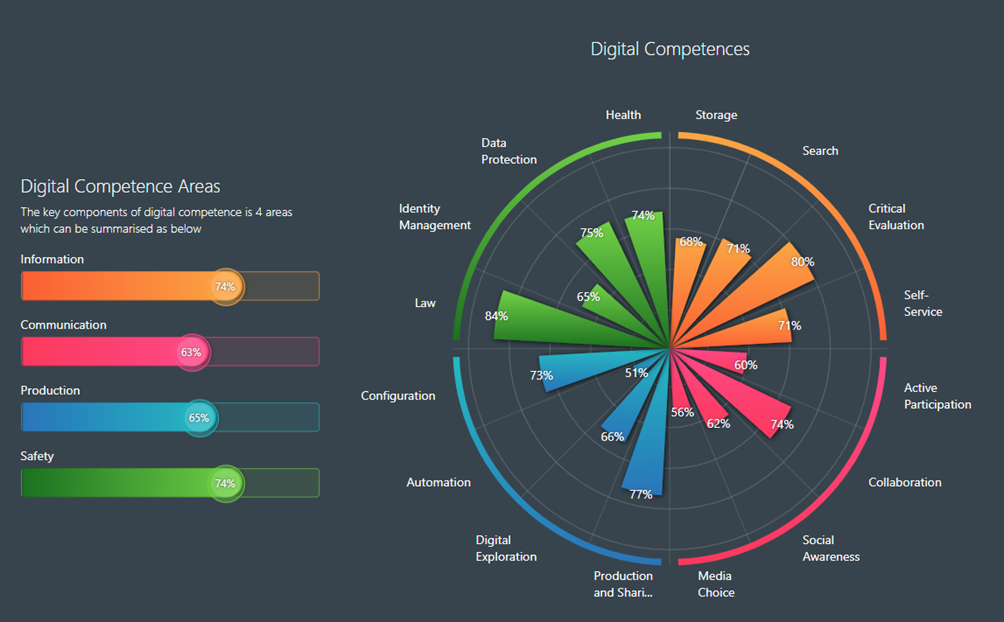
The Digital Competence Test shows that legistration and data protection are important to me because it is part of my job. I am quite critical what comes to information seeking. It is easy communicate with digital devices and software. The most difficult area is automation.
DID I LEARN ANYTHING FROM THIS?
It seems that I am advanced user of digital services and applications. It is good to know that I will receive support if I become unemployed or retire. In Finland public services are easily accessible online. Their usability has been improved and they are available but there are still barriers to getting online. In the online store, you can order goods and food directly to your door. People should have options to use online services or deal with customer service in person. I still have a lot to learn in digitalization because I have not ordered food with a delivery robot or used artificial intelligence.
Comments
https://jmdnaym.wordpress.com/digi-citizen/
You write interestingly about the digital social security services in your own country. Citizens also receive services digitally, although they face many challenges. Service providers also have challenges in producing reliable and safe digital services. The current trend is to offer services remotely and be accessible to customers online. People need to know what services can be reached digitally and how to use the services. In Finland, it´s easy to use banking services digitally for payment transactions and video calls. Banks´ have limited opening hours and nearby services are often used by older people who do not have access to the Internet. It’s great that you got a lot of ideas to use and develop digitization.
https://blogi.savonia.fi/pete/digi-citizen/
I agree with you that using the pages of some online stores is too complicated. Product descriptions do not always correspond to reality and returns are difficult. Returns are not environmentally friendly because we don’t know what happens to them. I agree with you that Digitization has made life a lot easier, but it narrows down the ability to make your own choices.
https://blogi.savonia.fi/julialyytinen/digi-citizen/
Hello. You had an interesting link to Tervesykylä, which is a new site for me. Here you can get researched health information without Googling. The sites look trustworthy. Terveykylä offers the opportunity to do digitization-related theses and research in its services.
It’s interesting to see how you’ve highlighted both the convenience and the challenges of digital services in Finland. I agree that while digital tools like OmaKanta and Kela make accessing services easier, there’s still a significant digital gap that needs addressing, especially for those without proper access or knowledge of technology.
Hello Terhi! Your post provides a comprehensive exploration of Finland’s digital services, from Kela to OmaKanta, and their impact on everyday life. I liked how you shared personal experiences with tools like the VR application, emphasizing its convenience for public transport users. Your discussion of the digital gap was very relatable, highlighting the inequalities faced by those without digital skills or access. I appreciate how you connected this issue to education and support systems, like digi mentors. Your suggestion for providing both digital and face-to-face options for public services is an important reminder of the need for inclusivity in digitalization. Excellent insights!
Hope you will visit my Blog
https://blogi.savonia.fi/sivamprasath/digi-citizen/
I found your thought similar about clothing services. It was nice to read about reflection of face-to-face interaction and the point about devices was good. That really can affect if you don’t know how to use devices and get the app you need.