
You are driving toward a little weekend getaway you have been looking forward to. You feel relaxed, and for the first time in a while, your mind is calm. Suddenly, your smartwatch buzzes on your wrist and flashes a warning: “dangerously high heart rate.” The peaceful feeling vanishes in an instant, and is replaced by tension, stress, and a rush of thoughts: What on earth? Why? Is something wrong?
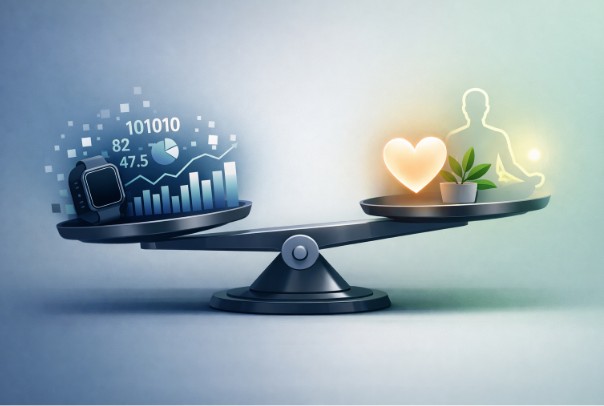
We have noticed that self-trackers can be found everywhere, from teenagers to seniors. More and more of us are getting curious about our bodies and daily habits.
But here’s the real question: what do we actually do with all this information — and can the data even be trusted? Does tracking health motivate us to make better choices for our well-being or is the result the opposite? Does tracking our health cause us to drift further away from what true well-being feels like?
Why are we tracking ourselves?
There might be just as many reasons to track health as there are people doing it. Some follow health conditions, others keep an eye on body weight, sleep quality, daily activity, nutrition, hormone cycles or even mood. Some use digital devices, some more traditional methods.
In the end, there are multiply reasons to track oneself. Gimbel, Niβen and Görlits (2013) have categorized people´s motives into five categories (Picture 2).
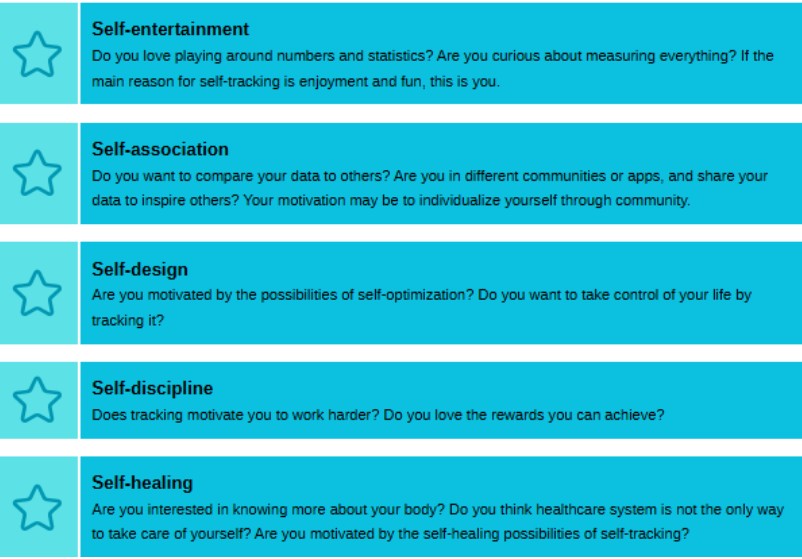
Do you find yourself in these categories?
At its best, tracking can increase awareness of well-being and support it. But there is a risk that by trusting devices too much, something essential will be lost.
So maybe it’s worth taking a step back and think about what well-being really means and how we can achieve it.
Do we know what makes our life good?
Have you thought about what makes you feel good today? Well-being is not a single figure or graph. It is a multidimensional and personal phenomenon which is built from the smoothness of everyday life, recovery, a sense of safety, relationships, and the meaningfulness of life – factors that can´t be measured. Data can offer useful indications, but it never tells the whole truth about a person’s well-being (Venhe 2020; Karavirta 2024).
The WHO (2022) reminds us that well-being is much more than data on a screen. It is a holistic and relational state that includes physical, mental, social, material and spiritual dimensions of life. This means that smartwatches and other devices can never fully tell us how well we really are doing. (WHO 2022, 5 – 6.)
Specialist in Sports and Exercise Medicine Pippa Laukka reminds that self-tracking devices should remain tools that support our well-being, not control it:
“As a support for well-being, smartwatches make excellent servants but poor masters. It’s wise to use the information they provide and compare it with how refreshed you actually feel when you wake up. Your own sense of well-being is almost always the most reliable, and the best measure.”
Pippa Laukka (2022)
Self-tracking devices can´t replace a person’s own experience. Often the opposite is true, especially if numerical data is given priority. Research has shown that constant self-tracking can create an illusion of control over life and distance individuals from their own bodily and emotional sensations (Venhe 2020; Karavirta 2024).
Once we start thinking about well-being more broadly, another question pops up: how much can we really trust the data provided by your devices?
Do we trust data too much?
Self-tracking devices promise precise insights into our sleep, recovery, activity, and stress – but can the data really be trusted? Short answer: not entirely. A whole mix of personal factors – from skin tone to blood circulation and gender, and even the position of the device on our wrist – can affect numbers in unexpected ways (Asif et al. 2025).
Take a skin tone, for instance. Or more precisely, melanin. It plays a surprisingly big role in how accurate smartwatch readings are. Because the green light used in most devices does not penetrate melanin-rich skin as effectively, the results can become less reliable, the darker the skin is. In other words: same device, different skin, different accuracy. And yes, the brand of the watch can change the story a little. (Asif et al. 2025.)
Another layer in the reliability puzzle is the user experience itself. If the device is clunky, uncomfortable or consistently off in its readings, we are far less likely to keep using it. This is why manufacturers need to do more than just innovate. They have to listen to what users actually need and want (Ehizogie, Chioma & Olumuyiwa 2024).
Even then, accuracy isn’t the only thing that matters. Even more important is to think about how all this tracking makes us feel. Does it motivate us or make us more stressed?
Active, more active, stressed?
Is part of your daily routine to check your self-tracking device to see how much you’ve moved, how well you slept, or when your stress levels raised?
Smartwatches and other devices can be great companions. They track our physical activity, heart rate and all kinds of body signals with impressive accuracy. For many of us, that information motivates us to move little more, and take better care of our well-being. (Karavirta 2024; Scudds & Lasikiewicz 2024, 283.) At its best, measuring different things supports comprehensive well-being in the long term.
But there is another side to it. These devices create huge expectations for better sleep, physical fitness and overall improved well-being. People can become stressed if their results don’t improve as desired or if they forget to track their workouts. Activity tracker users become frustrated when exercising without a wristband and they experience extra pressure when the wristband is on, but they do not have possibility to exercise. Excessive tracking can lead to obsession and start to control too much. (Scudds & Lasikiewicz 2024, 297; Kelley, Lee & Wilcox 2017, 637).
So how do we keep the good parts of tracking without letting it run our lives? Luckily, that part is in our hands.
Do not lose your well-being for trackers!
Self-tracking devices offer hints in the right direction. And that’s exactly how they should be used: with curiosity, critical thinking, and keeping an eye on the bigger picture. Maybe that means noticing how your body feels before you check your data or if you could go for a walk because it clears your mind—not because your number of steps is low.
In the end, we should take a deep breath and remember that we are more than the numbers our devices give us. We know ourselves and our well-being better than any device can. Self-tracking can support us in promoting and monitoring our well-being, as long as we remember that it cannot make our lives perfect. What matters most is that we use these devices in a way that supports, rather than controls, our everyday lives.
Writers
Kristiina Filev, Paula Lehtomäki, Salla-Maari Jumppainen, Heidi Prauda-Knuutila. Students of Welfare and Health Coordinator Master’s Degree Programme at Savonia University of Applied Sciences
Juha Peteri and Sanna Savela. Lecturers at Savonia University of Applied Sciences
Sources
Artificial intelligence was used in this work as follows: ChatGPT 2026. OpenAI. GPT-5.3. Used for image generation, language revision and structural editing of the text, March 2026. https://chat.openai.com.
Asif, S., Al Saafeen, A., Nadar, S., Nambiar, S., Dannawi, J., Korrapati, N. H., Wilkhoo, H. S. 2025. Photoplethysmography in Diverse Skin Tones: Evaluating Bias in Smartwatch Health Monitoring. https://pmc.ncbi.nlm.nih.gov/articles/PMC12592569/?utm_source. Accessed 20.1.2026.
Ehizogie, P., Chioma, A. & Olumuyiwa T. 2024. A review of wearable technology in healthcare: Monitoring patient health and enhancing outcomes. Open Access Research Journal of Multidisciplinary Studies, 2024, 07(01), 142–148. https://doi.org/10.53022/oarjms.2024.7.1.0019. Accessed 20.1.2026.
Gimbel, H., Niβen, M. & Görlits, R. A. 2013. Quantifying the quantified self: a study on the motivation of patients to track their own health. Completed Research Paper. International Conference on Information Systems. Volume 34. Milan 2013. https://www.researchgate.net/publication/260597252_Quantifying_the_Quantified_Self_A_Study_on_the_Motivations_of_Patients_to_Track_Their_Own_Health. Accessed 11.1.2026.
Karavirta, L. 2024. Minä vai mittarini – kumpi tuntee hyvinvoinnin paremmin? Internet publication. https://www.jyu.fi/fi/artikkeli/mina-vai-mittarini-kumpi-tuntee-hyvinvoinnin-paremmin. Accessed 18.1.2026.
Kelley, C., Lee, B. & Wilcox, L. 2017. Self-tracking for Mental Wellness: Understanding Expert Perspectives and Student Experiences. Research-article. ACM: Proceedings of the 2017 CHI Conference on Human Factors in Computing Systems. https://doi.org/10.1145/3025453.3025750. Accessed 23.1.2026.
Laukka, P. 2022. Voiko älykellon ja älysormuksen mittaustuloksiin luottaa? Apu-klinikka vastaa. Apu magazine. https://www.apu.fi/kysymykset/alykello-ja-alysormus-voiko-mittaukseen-luottaa-apu-klinikka. Accessed 9.3.2026.
Scudds, A. & Lasikiewicz, N. 2024. WAT’s up? Exploring the Impact of Wearable Activity Trackers on Physical Activity and Wellbeing: A Systematic Research Review. Journal of Technology in Behavioral Science (2025) 10:283–300. https://doi.org/10.1007/s41347-024-00442-6. Accessed 18.1.2026.
Venhe, N. 2020. Itsensä mittaaminen antaa illuusion elämänhallinnasta. Internet publication. University of Eastern Finland. https://www.uef.fi/fi/artikkeli/itsensa-mittaaminen-antaa-illuusion-elamanhallinnasta. Accessed 20.1.2026.
WHO 2022. Achieving well-being: A global framework for integrating well-being into public health utilizing a health promotion approach. Internet publication. https://cdn.who.int/media/docs/default-source/health-promotion/framework4wellbeing-(draft).pdf?sfvrsn=c602e78f_29&download=true. Accessed 22.3.2026