
Many indicators measuring the work life of Finns are giving warning signs of increasing mental distress in the workplace. Today, one in three sick leaves is due to mental health issues and the rise in mental distress is strongest among young adults under the age of 35. (Suomen mielenterveys ry 2025, 3.) An increasing number of employees are struggling with the same issue: constant changes and growing demands to perform their duties faster and better, are making working life more challenging. Employees are expected not only to complete their duties flawlessly, but also to take responsibility for their own resilience and well-being. (Vänskä 2022, 16–17). For this reason, it is important that leadership should be developed in ways that it focuses more on supporting mental well-being.
Leadership has a significant impact on employees’ well-being, safety, sense of belonging, feeling of being valued, and self‑actualization (Vänskä 2022, 50). The actions of a supervisor have been shown to influence employee well-being even more than the actions of colleagues; for example, low levels of supervisory support increase employee burnout (Perko 2017, 39–40). Fair and unbiased supervisory practices enhance employees’ well-being and commitment to their work. Even employees suffering from burnout benefit from good leadership, and high-quality leadership also promotes employees’ recovery during their free time (Perko 2017, 79–82).
Do you know how your leadership style impacts on your employee’s mental well-being?
As a rule, employees want to succeed in their tasks and receive the appreciation they deserve. Appreciation from a supervisor is one of the most significant factors promoting psychological health. Individual recognition, effective communication, and involving employees in decision‑making also enhance well‑being at work. For this reason, supervisors are expected to have strong interpersonal skills, the ability to create a positive atmosphere, to create clearly set goals and to support employees’ work ability. (Vänskä 2022, 38, 51–54.)
Harmful behavior from the supervisors can, according to Aalto university study, be reflected in employees through social learning. As a result, employees’ negative experiences become more emphasized, willingness to resign and burnouts increase and work efficiency decreases. As Niina Nurmi (Harju 2025), Professor of Management from Aalto University says: “An employee might think that if the organization isn’t on my side, why should I make any extra effort for the organization?”
Have you heard about Coaching Leadership, the Key to Improving Mental Well-Being?
Coaching leadership is one leadership style, and it is described as enabling and empowering, with its foundation in solution‑focused dialogue between the supervisor and the employee. From the employees’ perspective, a leadership style that encourages, motivates, and supports individuals and teams is a cornerstone of workplace well-being. A coaching leader empowers employees and seeks to unlock their full potential. (Lehto 2017, 3–4.) As Niina Nurmi, Professor of Management at Aalto University, says in an interview by Harju (2025): “Psychological safety is, and should be, the number one priority for the organization. It is the foundation of innovation.”
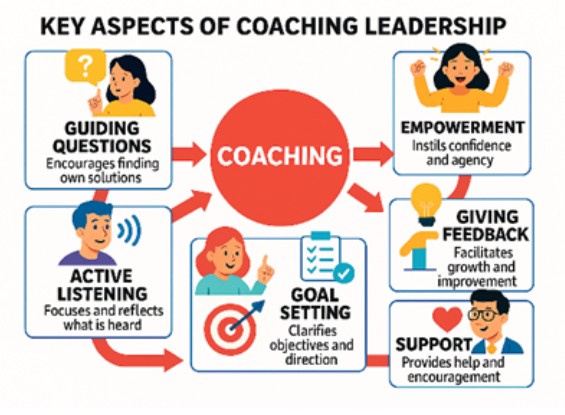
One method in coaching leadership is having practical conversations with employees about figuring out positive changes in their performance that would be beneficial for the workplace and their own productivity. Within the conversation, supervisors must find different ways to support the employees, implement new ways to improve their performance and find ways to keep learning. (Naude & Plessier 2018, 7.) Leaders can support the mental health of their work community through anticipation, regular and open communication, and making issues visible. Every leader naturally desires a functional work community with a safe atmosphere and mutual respect among employees. (Finnish National Agency for Education 2026.)
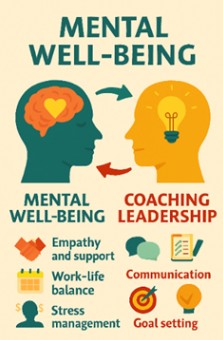
Maintaining a well-functioning work community requires conscious care and continuous development. However, the effort is worthwhile, as a well-functioning workplace is not only healthy but also safe and supportive. Moreover, when the workplace atmosphere is positive, employees are committed to shared goals — and, most importantly, the environment supports and sustains each employee’s mental well-being. One of the most important aspects of the connection between mental well-being and leadership is that mental health challenges can be discussed openly, allowing well-being to be strengthened through various supportive measures (Maunula 2024, 38).
Master the methods of Coaching Leadership!
Everything begins with the supervisor’s ability to internalize their role as a coach. Trust between the supervisor and employee, along with shared values, encourages a strong supervisor–employee relationship (Uutela 2019, 21). Interactive relationships and participatory leadership practices are essential components of coaching leadership, and these have been shown to improve workplace well-being. Through positive communication and behavior, supervisors can support employee well-being and its various elements (Uutela 2019, 42).
Development discussions are an important way for supervisors to support employees’ workplace and mental well-being. These conversations provide an opportunity to motivate and encourage employees, as well as to assess their mental and physical resources and resilience (Uutela 2019, 31). Strengthening employees’ resources in a systematic way is vital, as these resources serve as motivating factors at work (Uutela 2019, 37). Additionally, giving constructive and motivating feedback and helping employees recognize their own potential are essential components of promoting well-being (Uutela 2019, 31).
Through coaching leadership methods, employees’ experience of “work engagement” can also be enhanced. Work engagement is expressed as being energetic and deep absorption in one’s tasks. Experiencing work engagement has a positive connection to work ability — for example, through increased commitment and strong performance at work (Uutela 2019, 38).
Should you choose coaching leadership?
Now that you have read all of the research-based knowledge about coaching leadership we told you. You should think about your own style of leading. If you don’t care how your employees are doing healthwise or how they perform in their duties, you definitely shouldn’t choose coaching leadership. But if you want your business to succeed, minimize your employees’ sick leaves and make your workplace productive, positive and have trusting relationships throughout the company, then we recommend very strongly to choose coaching leadership style. If there is room for improvement try shifting your focus to coaching leadership and you will see positive results. It really matters how you boss around because it has a huge impact for your employees mental well-being.
Writers
Elisa Aarnio, Tiina Karelius, Julia Korpihete, Marianna Louhesto, Tanja Tikkakoski. Students of Welfare and Health Coordinator Master’s Degree Programme at Savonia University of Applied Sciences
Juha Peteri and Sanna Savela. Lecturers at Savonia University of Applied Sciences
Sources
Microsoft. 2026. Copilot – AI assistant. Used for correcting references, creating images, and supporting information retrieval, 9.1.2026. https://copilot.microsoft.com.
Harju, H-M. Kun pomo kiusaa, koko työpaikka kärsii. Yle. Article. https://yle.fi/a/74-20162199. Accessed 10.2.2026.
Lehto, K. Johda rohkeasti! Oivalluksia esimiestyöstä ja johtajuudesta. Vaasan yliopiston raportteja 6. Vaasa University. https://www.uwasa.fi/materiaali/pdf/isbn_978-952-476-770-5.pdf. Accessed 9.1.2026.
Maunula, K. Askel kerrallaan kohti parempaa työhyvinvointia. Helsingin Ekonomit, Jäsenlehti 4/24, 29.11.2024. Article.https://www.lukusali.fi/?p=Helsingin%20Ekonomit&ss=2330dc5a-aebc-4a13-9370-61d7a8a136cc&i=a21e67e6-87ab-4554-83de-b25ac08651c8. Accessed 9.1.2026.
Naude, J. & Plessier, F. 2018. Becoming a Leader Coach: A Step-by-Step Guide to Developing Your People: A Step-by-Step Guide to Developing People. Center of Creative Leadership. https://savonia.alma.exlibrisgroup.com/view/action/uresolver.do?operation=resolveService&package_service_id=4782164840006248&institutionId=6248&customerId=6245. Accessed 24.1.2026.
Finnish National Agency for Education 2026. Työhyvinvoinnin ja mielen hyvinvoinnin johtaminen. Internet publication. https://www.oph.fi/fi/koulutus-ja-tutkinnot/tyohyvinvoinnin-ja-mielen-hyvinvoinnin-johtaminen. Accessed 18.1.2026
Perko, K. 2017. Leadership and Employee Well-Being. A psychological perspective based on resource theories. Dissertation. University of Tampere Faculty of Social Sciences. Tampere University. https://trepo.tuni.fi/bitstream/handle/10024/101509/978-952-03-0463-8.pdf?sequence=1&isAllowed=y. Accessed 18.1.2026
Suomen mielenterveys ry 2025. Työelämän mielenterveys yhteiskunnan voimavaraksi –program. Interner publication. MIELI Mental Health Finland. https://mieli.fi/wp-content/uploads/2025/06/Tyoelaman-mielenterveys-yhteiskunnan-voimavaraksi-MIELI-ry.pdf. Accessed 9.1.2026.
Uutela, U. 2019. Valmentava esimiestyö työhyvinvointia ja työssä oppimista tukemassa. Fenomenografinen tapaustutkimus esimiesten ja työntekijöiden käsityksistä. Dissertation. University of Lapland. Faculty of Education. https://lauda.ulapland.fi/bitstream/handle/10024/63708/Acta%20electronica%20Universitatis%20Lapponiensis%20256.pdf?sequence=1&isAllowed=y. Accessed 17.1.2026.
Vänskä, M. 2022. Työhyvinvointi ja sen kehittäminen julkisessa organisaatiossa. Dissertation. University of Vaasa. School of Management. Social and Health Management.
https://osuva.uwasa.fi/bitstream/handle/10024/13779/978-952-395-018-4.pdf?sequence=2&isAllowed=y. Accessed 18.1.2026