The Power of Friendship: How Social Relationships Improve Your Well-being

Friendship is one of the most important aspects of life. It brings joy and meaning to our daily lives, but it also has a profound impact on our well-being. Faith, hope, and love are core values that together form the foundation of a strong friendship. As Samuli Edelmann once said, (nosto) a friend’s love is the purest and most understandable form of love – it is trust, loyalty, and the willingness to share one’s time with another.

But friendship is not just a pleasant addition to life – it is also a cornerstone of health. Studies show that strong social relationships positively affect both physical and mental well-being. Why is this the case, and what does science say about the power of friendship?
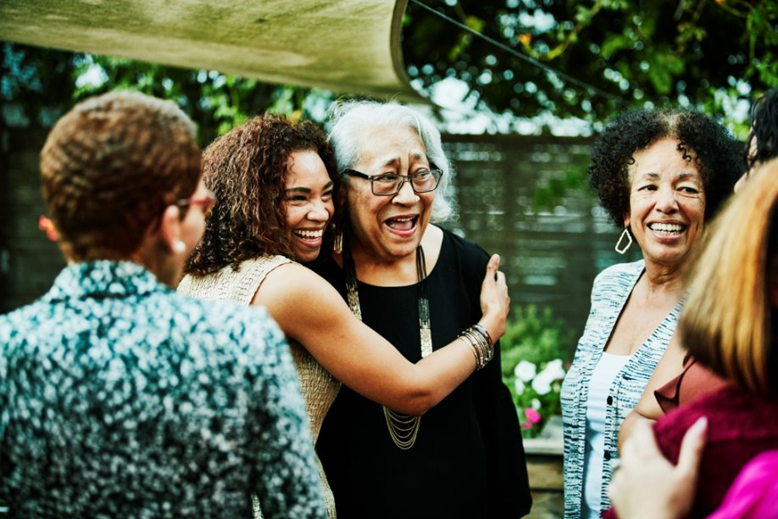
Friendship is a source of strength in life – shared joy, a warm hug, and genuine presence make moments meaningful. Picture: Powerpoint image bank

Sometimes in Our Lives, We All Have Pain – The Effects of Loneliness on Health

Loneliness and social isolation pose major health risks. Reseach had found that a lack of social connections increases the risk of illness, shortens life expectancy, and raises the likelihood of dementia, which demonstrates that loneliness negatively affects health (Umberson & Donnelly, 2023).

Loneliness is a greater risk factor for premature death than climate change or obesity (Junttila, 2015,  35). Junttila was involved in a study (Saari et al., 2020) in which one in four respondents stated they would be willing to lower their standard of living if it meant gaining even one friend. The next step for him and other loneliness researchers is to make everyone aware of the phenomenon – No one can change the situation alone, but everyone can do something. Loneliness is a subjective experience. A person can feel lonely even in a large crowd, while someone who spends a lot of time alone may not necessarily feel lonely. Being alone is a physical state; loneliness is psychological. Junttila (2015,15) describes social loneliness, where a person lacks a group of their own, and emotional loneliness, where a person has no close friend for support.

Lean on Me When You’re Not Strong – The Impact of Friendship on Physical and Mental Well-being

Research shows that strong social networks not only support psychological and emotional well-being but can also extend lifespan. Positive relationships protect against heart disease, strokes, and depression, and they have also been linked to lower mortality rates. In communities known for longevity and good health, such as Okinawa, Sardinia, and Ikaria, social connectedness and strong friendships play a crucial role. People in these regions tend to live longer and healthier lives, enriched by close social bonds, a strong sense of community, and an active lifestyle. (Buettner, 2024).

In Finland, the annual cost of treating memory-related diseases is nearly one billion euros, making prevention a significant public health goal. The World Health Organization (WHO) has identified social cohesion as a key factor in preventing memory disorders (THL, 2023). Supporting social inclusion and community engagement throughout life can play an essential role in maintaining overall health.

Furthermore, friendships have been shown to reduce the risk of mental health issues. Studies indicate that strong and supportive relationships can help prevent depression, anxiety, loneliness, and substance abuse. People with reliable friends and positive social experiences tend to experience greater happiness and well-being in their daily lives (Pezirkianidis, Galanaki, Raftopoulou, Moraitou & Stalikas, 2023). This highlights the importance of social relationships not only for individual well-being but also on a broader societal level.

For It Won’t Be Long ‘Til I’m Gonna Need Somebody to Lean On – One Conversation Can Work Wonders

A study by Hall, J. A. & co (2023) shows that even a single meaningful conversation with a friend can improve well-being. According to the Communicate Bond Belong theory, the need for belonging is fundamental to humans, and social interactions strengthen this feeling. Even a brief chat—such as exchanging updates or sharing a joke with a friend—can reduce stress and increase happiness. (Hall, J. A. & co., 2023.)

Participants of the Hall & co research who connected with their friends during the day reported feeling better than those who did not communicate at all. We can enhance our well-being simply by making time for our friends. As Hall (2023) states, our emotions and moods are shaped by how we interact with others.

Call Me If You Need a Friend – The Impact of Social Media on Friendship

Social media has revolutionized the way we maintain friendships. On one hand, it offers new opportunities for staying connected, but on the other, it can also increase loneliness and distort our perception of relationships. Many people compare their own lives to the carefully selected “perfect” moments shared on social media, which can lead to feelings of inadequacy.

While social media provides a way to stay in touch, true friendships are built on honesty and face-to-face interactions. Friendship doesn’t require perfect pictures or constant online presence—it requires trust, time, and genuine care.

It is worth putting value on social relationships because of health and wellbeing. Power is in friendship.

As Bill Withers sings in Lean on Me: “I’m right up the road, I’ll share your load, if you just call me.”

Real friendship is never far away—it’s always there when you need it.

Friendship is laughter, trust, and shared moments – the best memories are made together. Picture: Pixapay

Writers:

Heinonen, Jenni, Eho Tiia and Mäkelä, Soile. Students of Welfare and Health Coordinator Master`s Degree Program at Savonia University of Applied Sciences.

Pehkonen Pirjo, Peteri Juha and Savela Sanna. Lecturers at Savonia University of Applied Sciences.

Sources:

Buettner, D. (2024, lokakuu). Dan Buettner shares the secrets to longevity. Parks & Recreation. National Recreation and Park Association. https://www.nrpa.org/parks-recreation-magazine/2024/october/dan-buettner-shares-the-secrets-to-longevity/?utm_source=chatgpt.com

Edelmann, S. (2025, maaliskuu 13). Rakastuminen on aivojen häiriötila. Kotiliesi. https://kotiliesi.fi/ihmiset-ja-ilmiot/samuli-edelmann-rakastuminen-on-aivojen-hairiotila/

Hall, J. A., Holmstrom, A. J., Pennington, N., Perrault, E. K., & Totzkay, D. (2023). Quality Conversation Can Increase Daily Well-Being. Sage Journals. Communication Research, 0(0). Viitattu 9.2.2025. Saatavissa: https://doi.org/10.1177/00936502221139363

Junttila, N. (2015). Kavereita nolla: Lasten ja nuorten yksinäisyys. Tammi.

Mielenterveys on osa hyvinvointia ja terveyttä. 2021. Mieli ry. Viitattu 2.2.2025. Saatavissa: https://mieli.fi/vahvista-mielenterveyttasi/mita-mielenterveys-on/mielenterveys-on-osa-hyvinvointia-ja-terveytta/

Muistisairaudet. 2023. THL. Viitattu 1.2.2025. Saatavissa: https://thl.fi/aiheet/kansantaudit/muistisairaudet

Pezirkianidis, C., Galanaki, E., Raftopoulou, G., Moraitou, D. & Stalikas, A. 2023. Volume 14. Adult friendship and wellbeing: A systematic review with practical implications. Viitattu 9.2.2025. Saatavissa: https://doi.org/10.3389/fpsyg.2023.1059057

Saari, J., Helsingin Sanomat, Kauhanen, J., Karhunen, L., Lagus, K., Kainulainen, S., Pantzar, M., Erola, J., Junttila, N., Müller, K., & Huhta, J. (2020). Helsingin Sanomien yksinäisyyskysely 2014 (Dataversio 1.0) [Data-aineisto]. Yhteiskuntatieteellinen tietoarkisto. Viitattu 3.4.2025. Saatavissa: https://doi.org/10.60686/t-fsd3360

Umberson, D. & Donnelly, R. 2023. Social Isolation: An Unequally Distributed Health Hazard. Annual Review of Sociology Volume 49. Viitattu 30.2.2025. Saatavissa: https://doi.org/10.1146/annurev-soc-031021-012001

Social sauna instead of social media

Finland has ranked as the happiest country in the world for multiple years in a row. Could Finnish sauna culture have an impact on this high level of happiness? That might be the case.

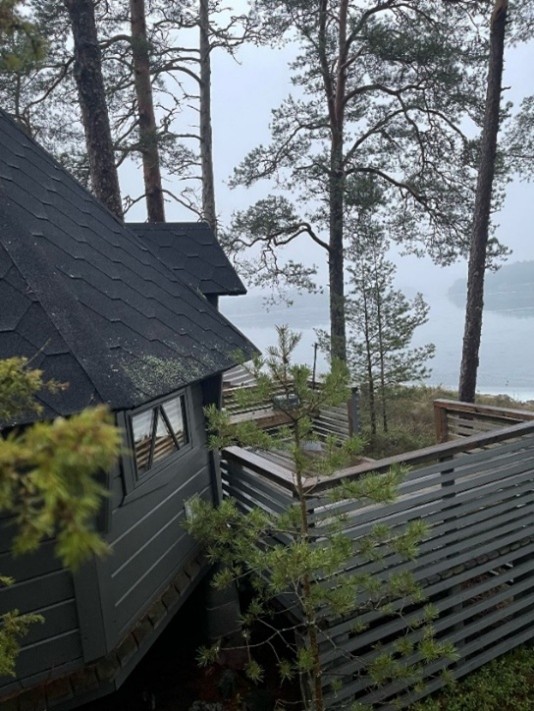
Figure 1. Saunas are usually in beautiful nature places. Picture: Annika Virtanen

The Sauna: Where relaxing meets tradition

Sauna is an essential part of Finnish culture and well-being. The roots of this thousands of years old tradition date back to the Bronze Age, when the sauna was operated with stones heated in a pit. The smoke sauna was developed during the Iron Age, and at the beginning of the 19th century the stove was equipped with a chimney. The sauna has served as a center of life in many ways: in addition to bathing, it has been used for childbirth, treating illnesses, and rituals that have brought people together. Bathing in a sauna has traditionally also been about cleansing and calming the mind, and the silence of the sauna has promoted spiritual well-being. Sauna culture is still an important part of Finnish life, although the customs associated with it have become more modern. (Laukkanen and Laukkanen 2020.)

Sauna bathing has become a common way to relax, cleanse the body, relieve stress, and it also causes hormonal reactions that may explain the stress release and health benefits. However, its effects, such as the feeling of relaxation, vary from individual to individual. (Henderson etc. 2021.) Sauna to Finns has been more than a place for bathing for generations. It has been the silent living room of the home where people have shared stories, silence and connections to each other. To this day, many social gatherings include a sauna, for example get-together with friends, midsummer sauna and a bridal sauna.

Screenless sauna- a place for true interaction

Figure 2. The screens don’t belong to the sauna. Picture produced with the help of AI. (tekoalykuva.fi)

Have you ever thought about sauna in its social sense, or more precisely, in its non-social media sense? We hadn’t before either. Nowadays, screens are everywhere and are present in everything, whether it’s in different social contexts or just being alone. Almost everyone has the need to check their phone in these situations or look for an answer to a thought or question that just came to mind.  Does it sound familiar, “hey, I’ll just quickly check this” or “wait a minute, I’m in the middle of this” and the true interaction is already partially ruined.

Are we slowly becoming slaves to the screen that controls so many situations in our everyday lives? This is where the importance of the sauna comes into play, perhaps as one of the only screen-free places where we can be present to ourselves and others without the distraction caused by a screen. In the sauna, people chat, talk about news, laugh, joke, or even cry. Everyone’s opinion is heard whether it’s family, friends, or even new acquaintances in a public sauna. Sauna fosters a sense of community and helps us strengthen social relationships, and we gain experience that we can cope without hiding behind a screen.

Lindfors (2007, 21 – 37) writes that communities have positive effects on health. Engström et al. (2022, 6) again highlight that the most important motives for sauna use are “social – meeting friends and chatting with them”. Finnish people are usually not very talkative, but in the sauna they tend to even talk to strangers. The sauna therefore serves as an excellent place without technological stimuli and helps us relax and calm down, as well as recover from the stress of the day.

“Have you ever thought about sauna in it’s social sense, or more precisely, in its non-social media sense?”

Connect, unwind, and heal – the social power of the sauna for your mental well-being

Studies show that sauna users have a positive outlook on life and have a higher perceived quality of life than those who use saunas less. Sauna has been found to increase feel-good hormones. (Laukkanen and Laukkanen 2020.) Engström etc. (2022, 5) also found greater levels of happiness reported by people who sauna bathed 1–4 times a month compared to people who sauna bathed less frequently. In some long-term studies, regular sauna users have also been found to live longer (Laukkanen and Laukkanen 2020).

According to Laukkanen and Laukkanen (2020), men who use the sauna 4–7 times a week have a 78% lower risk of developing psychotic symptoms compared to men who use the sauna once a week. Sauna promotes mental health and the feeling of belonging to a community, because you can be there without roles and titles. The sauna is a place of equality where people can meet each other without prejudice, and in more than one sense, naked. Taking a sauna together offers an opportunity to share experiences and strengthen the bonds of community and friendship. (Laukkanen and Laukkanen 2020.) Sauna is more to Finnish people than a place of relaxation. It could also be the secret to their happiness. Health benefits, stress relief and social connections make the sauna more than just a tradition.

Now, put your screen away, heat the sauna and relax!

Writers

Humala Saila, Kantanen Tiina, Paananen Elsi, Sutinen Noora and Virtanen Annika. Students of Welfare and Health Coordinator Master’s Degree Programme at Savonia University of Applied Sciences.

Pehkonen Pirjo, Peteri Juha and Savela Sanna. Lecturers at Savonia University of Applied Sciences.

Sources:

Engström, Å., Hägglund, H., Lee, E., Wennberg, M., Söderberg, S., &; Andersson, M. (2024). Saunominen Pohjois-Ruotsissa: MONICA-tutkimuksen tulokset 2022. Kansainvälinen sirkumpolaarisen terveyden lehti, 83(1). https://doi.org/10.1080/22423982.2024.2419698 Accessed 1.2.2025.

Henderson K., Killen L., O’Neal Eric. and Waldman H. 2021. The Cardiometabolic Health Benefits of Sauna Exposure in Individuals with High-Stress Occupations. A Mechanistic Review. Int J Environ Res Public Health. Jan 27;18(3):1105. 10.3390/ijerph18031105. Accessed 11.1.2025.

Laukkanen T. and Laukkanen J. 2020. Sauna, keho & mieli. Docendo Oy. Jyväskylä.

Lindfors, P. 2007. Tutkimuksia, kokemuksia ja ajatuksia yhteisöllisyyden terveysvaikutuksista. Psykoterapia 1/2007;26(1):2137.

Why wouldn’t you go to the forest?

International student, are you stressed about your studies, feeling restless, tired, unable to concentrate, not having time to exercise? Does your daily life feel miserable, are you feeling depressed, or suffering from noise irritation? Why not go to the forest? It’s proven to improve your well-being in many ways.

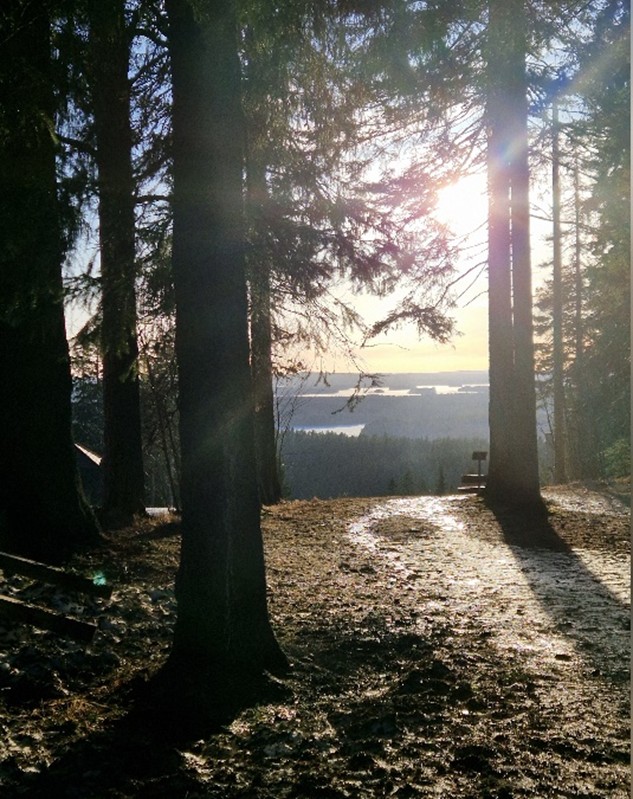
Caption: Landscape from Puijo, Kuopio. Picture: Pia Matinen 2024

Well-being from the forest 

A study (Tyrväinen, Lanki, Sipilä & Komulainen 2018) shows that even a short visit to the forest can relieve stress; just 15 minutes might be enough. Being in the forest improves your mood and self-esteem, helps you to understand your own health and escape from everyday life. In Finland, forests are the most popular environment for adults to exercise in their free time and people go to their favorite spots in nature to relax and clear their minds. In the forest people are less exposed to noise and air pollution. This might be one reason why health benefits of forest rise. Forests are a typical place for Finns to refresh themselves but attitudes towards forests vary across different cultures. (Tyrväinen, Lanki, Sipilä, Komulainen 2018.)

The sensations and stimuli provided by the forest heal the mind and body. Physical symptoms can decrease when you focus on the surroundings instead of yourself. Concentration improves, and heart rate and blood pressure might decrease. (Tyrväinen, Lanki, Sipilä, Komulainen 2018.) In the forest your stress levels decrease and your mood rises. Spending time in the forest also increases your self-esteem, a sense of competence and ability. (Tyrväinen et al. 2024, 11.)

Food for free

As a student, surely your money is tight. Forest food, for example berries and mushrooms, are widely used in Finland mostly because of their good taste and nutritional values. What is most important, they are free of charge. Especially berries are a good source of essential nutrients, for example flavonoids, and high antioxidant levels have been found in berries as well. (Karjalainen et al. 2010, 4.)

The forest is near and accessible for students in most Finnish cities like in Kuopio

Have you heard that the vision of the city of Kuopio’s resource wisdom program for 2035 aims for Kuopio’s diverse and appealing nature to be easily accessible to everyone, also to students? One of the goals is for residents to spend time in nature according to the recommendations of the program and for Kuopio to have the most attractive recreational services in Finland. (Ilmasto- ja resurssiviisas Kuopio 2035 2024, 7.2.)

In Kuopio, forests are near and free of charge. Forests provide an accessible space for everyone to enjoy physical activities. In the forest, you can also climb, cycle or ski. Some of the forest trails in Kuopio are also suitable for use with a wheelchair or a stroller. Most of them are reached by walking. Here is a link for you to get inspired: Hiking destinations and nature trails – Kuopio

Ali’s experience of Finnish forest

The number of international students has grown in recent years in Finland. Visiting forest in Finland can be an exotic experience for international students. We met Ali who studies nursing at Savonia University of Applied Sciences. He told us that he searched information on Finnish forests from the internet mainly to see if there is anything dangerous he should be aware of. Forest isn’t scary for him:
‒ I go to the forest regularly to pick berries and mushrooms and spend time camping. Forest is a relaxing environment for me and I like to go there with friends and also alone. In Iraq, where I am from, the nature is very different, and there are a lot of mountains and for example dangerous animals like scorpions, says Ali.

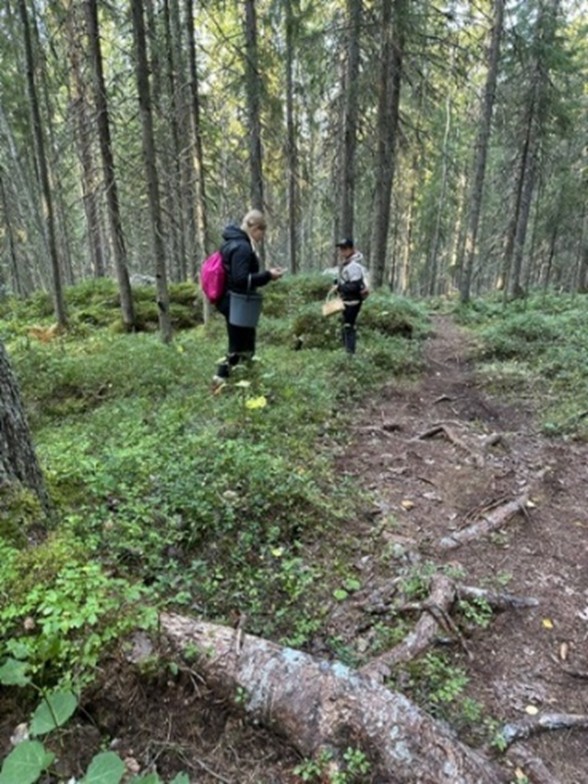
Caption: Picking berries. Picture: Pauliina Pekkarinen 2024

Did you get interested?

If you haven’t gone to the forest yet, take a friend with you and go together. You can also arrange a next student meeting in the forest in the city where you study and get to know each other. You can end the trip at a campfire site where you can enjoy good company and fresh air. Being with other students in forest promotes social wellbeing and community spirit.

You can also start by watching forest from the distance if going to the forest feels too much. It has been studied that even watching a forest landscape videos, has positive effects for your health (Ojala et al 2022, 5‒7). Put the sounds on and try it: Good Mood Forest Walk – Spring (Mieli n.d.).

Writers:

Feodoroff Piia, Kononen Sirpa, Matinen Pia, Mökkönen Niina and Saavalainen Jaana. Students of Welfare and Health Coordinator Master’s Degree Programme at Savonia University of Applied Sciences.

Pehkonen Pirjo, Peteri Juha and Savela Sanna. Lecturers in Savonia University of Applied Sciences.

Sources:

Ilmasto- ja resurssiviisas Kuopio 2035. 2024. Viksu Kuopio -ohjelma. Kaupunginvaltuusto 10.6.2024 § 48. https://www.kuopio.fi/uploads/2024/06/2024_viksu-kuopio-ohjelma_final.pdf. Accessed 23.3.2025.

Karjalainen E, Sarjala T, Raitio H. Promoting human health through forests: overview and major challenges. Environ Health Prev Med. 2010 Jan;15(1):1-8. https://doi.org/10.1007/s12199-008-0069-2. Accessed 13.2.2025.

Lindblom, T. 2017. Does sugar sweeten the pill of low income? Inequalities in the consumption of various foods between Finnish income groups from1985 to 2012. Research on Finnish Society Vol. 10 (2017), pp. 61–71. Available at: https://fjsr.journal.fi/article/view/110766/65116. Accessed 13.3.2025.

MIELI n.d. Hyvän mielen metsäkävelyt. Suomen Mielenterveys ry. Verkkojulkaisu. Updated 3.6.2022. https://mieli.fi/vahvista-mielenterveyttasi/harjoitukset/hyvan-mielen-metsakavelyt/. Accessed 23.3.2025.

Ojala, A., Neuvonen, M., Kurkilahti, M., Leinikka, M. Huotilainen, M & Tyrväinen, L. 2022. Short virtual nature breaks in the office environment can restore stress: An experimental study. Journal of Environmental Psychology. Volume 84 (101909): 1-11. https://doi.org/10.1016/j.jenvp.2022.101909. Accessed 20.3.2025.

Tyrväinen, L., Halonen, J.I., Pasanen, T., Ojala, A., Täubel, M., Kivelä, S., Leskelä, A.-R., Pennanen, P., Manninen, J., Sinkkonen, A., Haahtela, T., Haveri, H., Grotenfelt-Enegren, M., Lankia, T. & Neuvonen, M. 2024. Luontoympäristön terveysvaikutukset ja niiden taloudellinen merkitys. Luonnonvara- ja biotalouden tutkimus 76/2024. Luonnonvarakeskus. Helsinki. 89 s. Available at: https://www.sitra.fi/wp/wp-content/uploads/2024/10/luke-luontoympariston-terveysvaikutukset-ja-niiden-taloudellinen-merkitys.pdf. Accessed 26.1.2025.

Tyrväinen, L., Lanki, T., Sipilä, R., Komulainen, J. 2018. Mitä tiedetään metsän terveyshyödyistä? Katsaus. Lääketieteellinen Aikakauskirja Duodecim 2018;134(13):1397–403 https://www.duodecimlehti.fi/duo14421/mitä%20tiedetään%20metsän%20terveyshyödyistä. Accessed 16.2.2025

VRN. 2024. Valtion ravitsemusneuvottelukunta ja Terveyden ja hyvinvoinnin laitos.
Kestävää terveyttä ruoasta – kansalliset ravitsemussuositukset 2024.
Helsinki: PunaMusta Oy. https://urn.fi/URN:ISBN:978-952-408-405-5. Accessed 22.3.2025.

A referral for ice swimming to improve mental well-being – utopia or the future?

Pause for a moment and put yourself in your clients’ shoes—those who might be struggling with mental health issues. Now, take a look at the picture below. Imagine that you are dipping into icy water in the middle of winter in Finland. The cold bites your skin like a thousand tiny needles—but after a moment, your body fills with refreshing warmth, and a peaceful euphoria takes over your mind. Your breathing slows. A quiet, almost magical winter calm surrounds you.
What if ice swimming could be one way to support clients facing mental health challenges or dealing with various levels of stress—as a complementary treatment?

Picture 1: Descending into icy water – could that bring peaceful euphoria? Picture: Janne Heikkinen, CC BY-NC-ND 4.0

Ice swimming is becoming more and more popular as part of Nordic culture and health promotion. An ice swimming referral, or the idea of integrating ice swimming and cold therapy as an official part of healthcare practices, may seem futuristic – even utopian – at first. But what if the therapeutic benefits of cold water, especially in supporting mental health, could be part of the future of healthcare? Is an ice swimming referral just a dream, or could it be an important part of modern healthcare in future?

Entering the cold – A Wake-Up for the Body and Mind

Ice swimming triggers neurochemical and hormonal changes that affect mood. The process begins in the synapses of nerve cells, where stimuli are transmitted through connections with other cells. This releases neurotransmitters like noradrenaline, dopamine and serotonin, which regulate mood and emotional well-being. (Torppa 2021, 26.) There’s evidence suggesting that environmental stress that challenges our thermal equilibrium is beneficial. (Kelly & Bird 2021, 1.) Adaptation to thermal stress seems to cause an increase in tolerance to other stressful situations and diseases (Huttunen, Rintamäki & Hirvonen 2001).

Many Finnish ice swimmers report an improvement in their mood and a boost in their mental resilience during the winter swimming season. Numerous participants shared how ice swimming helped them manage stress, insomnia, depression, and even symptoms of ADHD. For some, the benefits have been so profound that they were able to discontinue their antidepressant medication. (Torppa 2021, 33.)

Would you rather visit a cold chamber or enjoy cold therapy outdoors?

Athletes might prefer cryotherapy, which is therapy given in a cold chamber that provides physiological benefits. Ice swimming outdoors provides cold therapy but also natural green and blue therapy, thus offering more holistic benefits to health and wellbeing. A stronger bond with nature is associated with better mental health and lower levels of anxiety and depression. One effective way to enhance this connectedness is through our senses, perceptions, and experiences. (Mental health foundation, 2021, 4-5.)

The positive effects of nature and also culture on health and well-being have already been recognized. Nature-based interventions as complementary care, along with cultural referrals, have been tested in social and healthcare services in Finland (Tyrväinen, L., Savonen, E-M. & Simkin, J. 2017, 18 & Innokylä, 2023). Traditionally, ice swimming also serves as a social gathering and is part of Finnish cultural heritage.

Is cold the new miracle treatment?

Ice swimming could be part of a self-care program. For example, a person suffering from depression and anxiety symptoms could be given a referral for ice swimming and a payment commitment for a winter swimming facility. In this way, ice swimming would serve as a complementary treatment in traditional mental health services.

“Ice swimming is seriously underused as a therapy!” (Torppa, 2021,30).

Torppa (2021,30) in her book Kylmä kutsuu interviews the psychotherapist Riikka Airo. She nicely highlights the advantages of ice swimming as a treatment: “In Finland, we have plenty of free opportunities to take advantage of this powerful treatment. We really should make use of them. Cold water swimming could totally be paired with psychotherapy—after all, the cold has a huge impact, and the effects kick in fast!”. Airo is also part of a research group in co-project together with University of Jyväskylä, Department of Psychology. The aim of the project is to develop a treatment model for anxiety and depression. The model combines a brief psychotherapy group and a communal winter swimming session. We will be anxiously waiting for the data analysis and reporting of the study in 2025 autumn. (University of Jyväskylä 2025.)

Although an ice swimming referral could be the future in the field of mental well-being, it is good to remember that it is not suitable for everyone and has not yet been thoroughly researched. As a health care professional, it is important to interview clients and assess their overall health and present circumstances before prescribing them to ice swimming to ensure their safety. Existing studies show promising evidence of the effectiveness of ice swimming on people’s mental well-being but more evidence is still needed. However, it’s hard to see why referrals for ice swimming shouldn’t be considered the future in the treatment of improving mental health rather than just a utopian idea. Maybe the future isn’t in a pill bottle or therapy room alone, maybe it’s waiting out on the frozen lake.

Writers

Marita Eskola, Mette Hämäläinen and Niina Kankainen, Students of Welfare and Health Coordinator Master’s Degree Programme at Savonia University of Applied Sciences

Pirjo Pehkonen, Juha Peteri and Sanna Savela, Lecturers at Savonia University of Applied Sciences

Sources

ChatGPT 2024. OpenAI. GPT-4.0. Used for language checking, April 2025. https://chatgpt.com/.

Huttunen, P., Rintamäki, H. & Hirvonen, J. 2001. Effect of regular winter swimming on the activity of the sympathoadrenal system before and after a single cold water immersion. https://doi.org/10.1080/22423982.2001.12113043. Accessed 7.2.2025.

Innokylä. Kulttuurihyvinvoinnin palveluohjauksen reseptikirja, 2023. https://innokyla.fi/sites/default/files/2023-10/231027_kuppi_palveluohjauksen_reseptikirja_FINAL.pdf Accessed 15.4.2025.

Kelly, J.S. & Bird, E. 2021. Improved mood following after a single immersion in cold water. DOI:10.1002/lim2.53. Accessed 11.1.2025

Mental Health Foundation. 2021. Nature. How connecting with nature benefits our mental health. https://www.mentalhealth.org.uk/sites/default/files/2022-06/MHAW21-Nature-research-report.pdf.  Accessed 22.3.2025.

Toivanen, P. 2023. Kylmäterapiaa: Talviuintia mielenterveyden haasteisiin. Latu & Polku 12.1.2023, uutinen. Verkkojulkaisu. https://www.latujapolku.fi/uutiset/kylmaterapiaa-talviuintia-mielenterveyden-haasteisiin.html. Accessed 29.3.2025.

Torppa, T. 2021. Kylmä kutsuu – hyvinvointia talvesta. Helsinki: Gummerus.

Tyrväinen, L., Savonen, E-M. & Simkin, J. 2017. Kohti suomalaista terveysmetsän mallia. Luonnonvara- ja biotalouden tutkimus 11/2017. Luonnonvarakeskus. http://urn.fi/URN:ISBN:978-952-326-366-6. Accessed 22.3.2025. University of Jyväskylä 2025. List of projects. From cold to mental well-being : Effects of combining brief group psychotherapy and winter swimming. https://converis.jyu.fi/converis/portal/detail/Project/194297205;jsessionid=lyHBZiag4gtN8_VdzGZWlHGpzUSHTpyZsllXd199.cnvr6rh8?lang=en_GB. Accessed 1.3.2025

Have you always been using your employee benefit the wrong way?

The scent of cognac, the clicking of high heels, the third call. The performance begins. Different kinds of cultural experiences are an essential part of promoting human well-being. Yet culture, that supposedly expensive hobby, is often considered out of reach. Meanwhile, tens or even hundreds of euros of employee benefits remain unused in Finland, as people typically either use them for sports activities or not at all.

People often assume that culture — whether it’s theater, concerts, museums, or festivals — is only for the elite, when in fact culture is for everyone and has been proven to have many positive effects on workplace well-being. Workplace well-being is a hot topic nowadays and an important goal for organizations of all sizes: when employees thrive, the company or organization is more successful. At the same time, well-being isn’t just about good ergonomics, healthy lifestyles, or professional development; culture also plays a significant role, from both an individual and a community perspective.

Image: Money invested in culture pays for itself in terms of work productivity and improved
well-being at work. Picture: AI generated by giz.ai

In this blog post, we will explore the importance of cultural well-being and offer ideas on how culture can support workplace well-being. We will focus on working adults, who often have limited resources but a great need for recovery and self-development. That’s why it’s worth making the most of your employer’s cultural benefit—both employees and organizations will gain.

Culture may be the key to well-being

Art and culture are part of life and belong to everyone, regardless of age or life situation, throughout the human lifespan. All of us experience and engage with culture in one way or another. Cultural well-being means that culture and art bring people good feelings and well-being.

According to the Taikusydän network, cultural well-being particularly involves
customer- and need-oriented forms of cultural and artistic activities
that clearly have health- and well-being-promoting objectives.

Cultural well-being can manifest in many ways, for example:
• Positive emotional experiences: Feelings of joy, excitement, and meaningfulness. For instance, music can be used to make one’s emotions visible to oneself and to others.
• Strengthening the sense of participation: Shared experiences and collective enjoyment increase positive team spirit and a feeling of togetherness. Do you remember the last time you shared a movie experience with a friend?
• A resource in everyday life: Listening to music, visiting museums, going to the theater, or engaging in handicrafts all help with recovery and stress relief. They also promote and maintain functional capacity.

WHO’s report on the health impacts of arts and culture (see links at the end) and numerous Finnish projects (such as Parasta Pohjois-Savoon!) have shown that culture has positive effects on well-being and health. Moreover, health care has also recognized the positive impacts of cultural well-being.

Culture affects the entire work community

According to a comprehensive WHO report (2019), art and culture strengthen mental health and a sense of happiness. Research shows that communal activities, such as singing in a choir or participating in a theater production, reduce loneliness. In such settings, we meet people, form meaningful social connections, and feel we belong to something larger.

Culture also breaks up routines and encourages new perspectives on everyday challenges. Creativity is a skill increasingly needed in working life; during change, the ability to solve problems in innovative ways is crucial. Arts and culture-based methods — such as drama exercises or using music — can help work teams address changes or conflicts in a safe environment.

A sense of community and participation are also foundational pillars of workplace well-being. When people enjoy each other’s company, trust and more open communication emerge. This kind of atmosphere supports solution-focused thinking and lowers the threshold for sharing ideas. Culture acts as a social “glue” that can strengthen team spirit and a sense of belonging.

Many organizations have used artistic methods to navigate transitions, such as improving collaboration between teams or reinforcing a new corporate culture. Artistic methods have been shown to foster openness, innovation, and empathy. The results include not only more creative problem-solving but also a work environment where everyone feels confident expressing ideas and trying new things.

Culture is for everyone and is proven to support workplace well-being. It promotes joy, social belonging, and helps with recovery. Music, theater, and other art forms reduce stress and reinforce a sense of belonging. Yet the cultural benefit offered by employers often goes unused, even though it can boost resilience and creativity.

How Are Cultural Benefits Used, and Why Are They Left Unused?

Many employers offer cultural benefits as a tax-free perk to employees. Popular ways of using this benefit each year include tickets to movies, museums, the theater, and various events. In many adult education centers, it’s also possible to pay for courses with your cultural benefit, meaning you could use it to start a new hobby, whether in handicrafts or the arts.

Incredibly, but true: a significant number of cultural benefits go unused every year. Many people don’t know if they have a cultural advantage or how to use it, which leads to the benefit going untapped. A lack of time or motivation can prevent people from taking advantage of it. Some individuals simply have no interest in the available cultural events. If the benefit is small or has restrictions, it may not incentivize users to utilize it. Even if it covers part of the costs, the benefit can still remain unused if travel or other additional expenses make participation expensive.

Culture isn’t merely entertainment, it strengthens a team’s atmosphere, trust, and innovation, which supports both individual and organizational success.

So be brave and choose cultural activities with the employee benefit and increase your well-being with the help of culture! Give cultural activities a try with no financial risk. You’ll surely find other ways to fund your sports hobbies as well. Culture can bring new energy into your life and, through that, promote your work well-being. How much do you still have left in your cultural benefit balance? Use it courageously and explore different forms of culture! Will you choose ballet or a rock festival? The choice is yours.

Writers:

Hanna-Mari Hakulinen, Pirita Mattila, Suvituuli Riihimäki, Pauliina Rissanen and Heli Rytkönen Students of Welfare and Health Coordinator Master’s Degree Programme at Savonia University of Applied Sciences

Pirjo Pehkonen, Juha Peteri and Sanna Savela Lecturers at Savonia University of Applied Sciences

Sources:

Lääkärilehti: Miten taide vaikuttaa? Kulttuurisia näkökulmia hyvinvointiin ja terveyteen. 2021.

Lilja-Viherlampi: Mitä on kulttuurihyvinvointi? 2021.

WHO: What is the evidence on the role of the arts in improving health and well-being. 2019.

Kulttuuri ja taide hyvinvoinnin edistäjinä sosiaali- ja terveydenhuollossa, työelämässä ja koulutuksessa. 2019.

Jansson: Mittaamattoman arvokasta? Taiteen ja kulttuurin vaikutustutkimuksia ja -metadologioita 2014.

Taide muutoksen mahdollistajana työelämässä – THL

Kulttuurihyvinvointi – tutkimusryhmä – Turku AMK

TOGETHER FOR A BETTER TOMORROW, VISIT IN INDONESIA

There are a lot of charity organizations these days, and one of the biggest ones focused on helping
children and youth is World Vision. At the heart of this organization is Christian love for others.
Their vision is that every child should have a chance in life and be part of a greater mission.
Improving living conditions for children in target countries and providing humanitarian aid to victims
of natural disasters and conflicts are just some of the tasks World Vision takes on. The main focus
is acting out of love for others, promoting hope and a sense of partnership.


World Vision started its work in Finland in 1983 when translator Ulla Tervo began a sponsorship for
a young boy in the Philippines. International sponsorship efforts, however, kicked off way earlier, in
the 1950s, thanks to an American correspondent and pastor, Bob Pierce. He began giving $5 a
month to help an orphaned girl in Asia, ensuring she could go to school and receive healthcare.
Even today, the organization helps nearly 2 million children worldwide, working with local partners
in places like Africa, Asia, and Latin America.

Picture 1. Indonesia.


INTERNATIONAL COURSE AT THE DIACONIA COLLEGE IN HELSINKI
My thoughts go back to the fall of 1994 when I was studying an advanced studies in
internationalization of social welfare and health care at the Diaconia College in Helsinki. The
course covered a wide range of topics related to international development, like refugee work,
global systems, multiculturalism, the work environment in Europe, and world religions, as well as
language and communication.


After all the exams and lectures were done, there was still a six-week international practical
training ahead. My classmate Tarja (a radiographer) and I ended up choosing Indonesia as our
destination, specifically projects run by World Vision in Jakarta, Semarang, and Bali.
Our choice of destination surprised many since the organization wasn’t well known to most of our
fellow students or even to our teachers. World Vision wasn’t one of the institute’s typical aid
partners at that time.


After many phone calls, letters and telefaxes, we finally arranged with World Vision’s Jakarta office
to participate in their local aid projects, some of which were located in the slums around the city.


MEETINGS IN JAKARTA, A MULTICULTURAL METROPOLIS
After a long 17-hour flight, we arrived in the warm, tropical city of Jakarta, which immediately made
a huge impression on both me and my friend Tarja. With over 10 million residents, this huge
metropolis made Helsinki seem like a small town. Our next big surprise came when we got into a
taxi and navigated through Jakarta’s chaotic traffic, filled with thousands of cars and motorbikes.
Traffic in the city was noisy and overwhelming, so you have to take more time to move one place to
another.


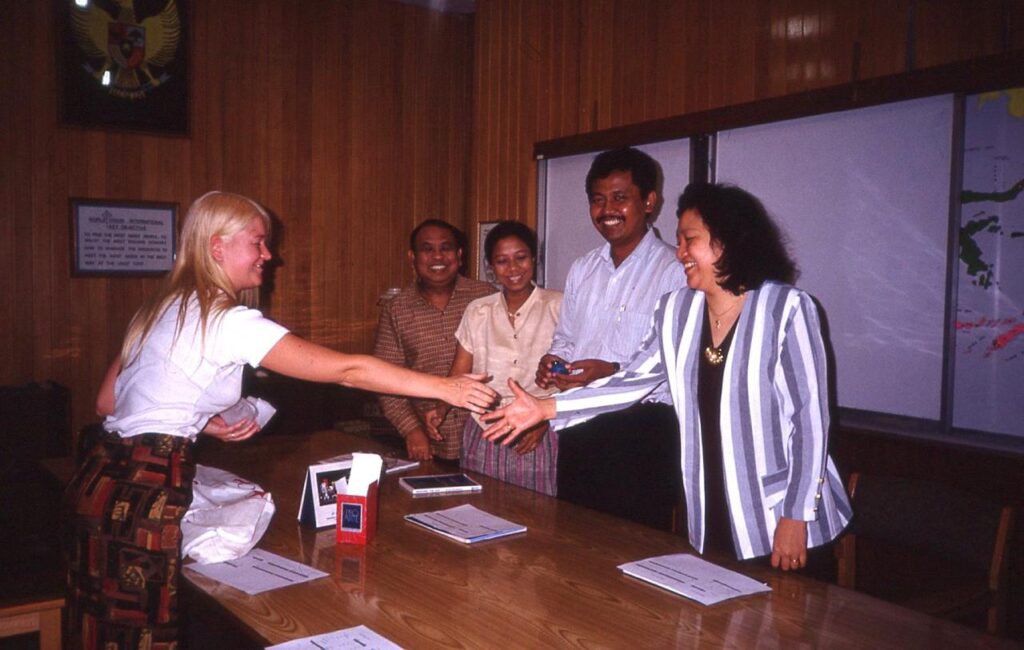
The next day, we met with the staff at World Vision’s Jakarta office, who warmly welcomed us. We
brought a gift from Finland – an Oiva Toikka glass bird – which they greatly appreciated. After a
warm meeting, we continued to a large slum area near the city, where they had several projects in
progress.

Picture 2: Co-operation


We first visited a family whose smiling mother told us that thanks to World Vision’s help, one of
their children could attend school every day. During this visit, we also got to know two small
businesses supported by World Vision, one a small general little shop and the other a bicycle
repair shop in the slum.


Before we left the area, we took a closer look at a sewer and toilet improvement project that had
been started years ago. Improving the sewage system is essential for improving the living
conditions of those in the slums, helping to reduce health issues by preventing the spread of
diseases. We could already see several completed outdoor toilet buildings in the area.


IN THE JUNGLE AT SEMARANG
After a week, we moved on from Jakarta to Semarang, a city on the northern coast of Java, where
a local Catholic priest and his wife greeted us. Our mission was to visit a local orphanage run by a
Finnish woman. The personnel was mostly made up of foreign nurse-students doing volunteer
work. The location of the orphanage in the middle of the jungle, far from everything, surprised us,
even the Catholic priest was a bit confused by our plan to visit there.


Since we had brought along medicines, books, and small toys donated by the Diaconia college
Helsinki, we decided to go with our original plan and made the long journey to the orphanage deep
in the jungle.


Our stay there was short, though, as the living conditions were very basic. We slept in bunk beds,
the toilet was just a hole in the floor, and the showers were outdoors, with the sky as the roof.
Thankfully, we had mosquito nets with us, which we hung over the beds to protect ourselves from
mosquitoes, spiders, and small black geckos.

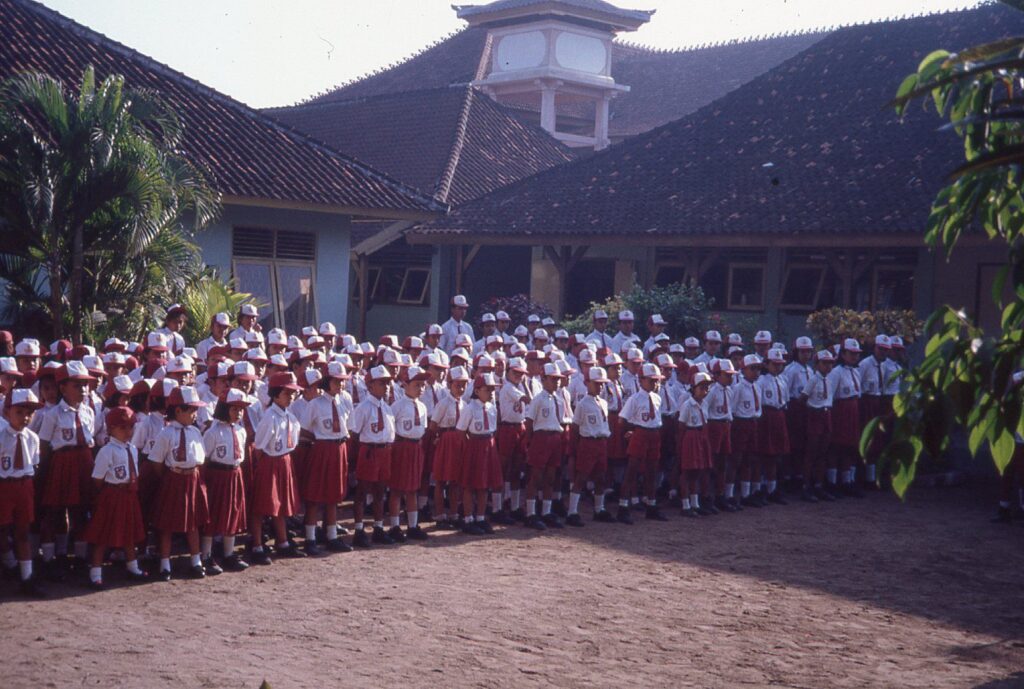
Picture 3: Courtyard


Our return from the jungle was quite an adventure. We traveled back to Semarang in several
different horse-drawn carts with our big suitcases. Once we got back to the city, all the emotions
from the trip came out, and we both cried some tears of relief. A warm shower, a nice hot meal at
the hotel, and even a sauna helped us recover our energy after the jungle adventure.

BACK IN FINLAND
With our experiences, we returned to Finland as the first students from the Diaconia college to visit
Indonesia World Vision. We gave a presentation at the college about our trip. We wore the batik
dresses and local wooden jewelry we had brought back from Jakarta to give the audience a little
taste of the Indonesian culture.


Now, twenty years later, it’s wonderful to see that World Vision’s work is still going strong, bigger
and better known in Finland and around the world. The need for aid hasn’t disappeared, and
support is still needed. The work continues with great heart, respecting human dignity and human
rights. The journey goes on.


WRITER:
Marjo Lomperi-Ääri, Student of Welfare and Health Coordinator Master’s Degree Program at
Savonia University of Applied Sciences (UAS)


SOURCES:
World Vision. https://www.worldvision.fi/meista/suomen-world-vision/. Referred. 15.10.2024
Jakarta, Indonesian capital. https://fi.wikipedia.org/wiki/Jakarta. Referred. 14.10.2024

Online meetings are increasing, how do we take care of our well-being?

Online meetings are here to stay. People often feel exhausted in online meetings. Therefore we all should, both for ourselves and for others, to take into account the common rules of the game, which help us survive in online meetings. By knowing and following the rules of the game is how we can manage our own work. Do we really know what makes us exhausted in online meetings? Can we change our working methods in online meetings so that we support our health and well-being? There are several instructions and checklists related to the topic, but there is usually no researched information behind them. However, there is still little research available on the effects of online meetings on wellbeing.

There are a few international studies on methods that promote the well-being of online meetings. For example, Shoshan and Werth’s study Understanding “Zoom fatigue”: A mixed-method approach investigated whether online meetings are more tiring than meetings held via other means of communication They also studied whether the duration of the online meeting, the number of participants or the presence of a supervisor affects the amount of fatigue. The term Zoom Fatigue, describes exhaustion in online meetings. According to the study, online meetings were experienced as more exhausting than meetings organized in other ways. (Shosan & Werth, 2021).

What exhausts us in online meetings?

Shosan’s and Werth’s (2021) study also collected information on what reduces the risk of burnout in online meetings. They noticed that in an online meeting with camera on, it’s as if we are constantly looking closely at each other, and it creates a similar feeling as if we were speaking to an audience that is staring at us. Usually, in face-to-face meetings, our gaze wanders among different people and objects and we don’t look at every participant all the time, and thus we don’t have the feeling that everyone is looking at us all the time. In online meetings, the number of glances is many times higher than in a face-to-face meeting. If the cameras are not in use, we have to work harder to replace nonverbal communication, because we don’t always see each other’s expressions or gestures (Bailenson J. 2021). If the camera is on, then being the object of attention is exhausting, and if the camera is not on, we use energy to interpret nonverbal communication. So in online meetings both the presence of the camera and the meetings without the camera burden us more than when attending the face-to-face meetings.

When nonverbal communication strains our thinking, we also strain through our eyes when we try to follow the events on the screen. Did you know that Computer Vision Syndrome (CVS) occurs with excessive computer work? Eyes have to work harder if your computer has glare, reflections, low contrast, or poor resolution. Symptoms of CVS include blurred vision, dry and irritated eyes, eye fatigue and headaches. Healthy and safe display computer work is safety if the glare-free lighting of the work environment is good. For example, it is good to filter the light coming from the windows with blinds, curtains or window tinting or screen reflection protection. Or we can look for own sweet spot, i.e. viewing the display computer optimally, where the gaze is directed downwards and outwards. (CooperVision, 2024).

What really positively affects survival in online meetings?

A study by Shosan and Werth (2021) found that participants felt that good management and coordination of meetings helped them cope better. Well-planned meetings, where permission to speak is requested, are less tiring. In such meetings each participant is well prepared for the meeting, and care is taken to manage time and stay on topic. Also, the fact that only necessary people are present helps to avoid being exhausted. The more participants there were in the meeting studied, the heavier the meeting seemed. Taking breaks was also felt to be important.

Seija Moilanen’s blog published by the Finnish Occupational Safety and Health Center provides support and tips for the practical implementation of Shosan and Werth’s (2021) research results. Good preparation helps reduce the risk of getting tired. Agreeing on common rules of the game is important so that we participate equally. We can agree in advance on using the functions of the online meeting application or preparing for the use of the camera, and when camera can be turned off. It is good to schedule time for the meetings and be really present without simultaneously multitasking. It is also good to agree on taking breaks and telling about them in advance. Even in short online meetings there should always be time to take a short break. We should vary activities, share the material, as well as use chat and reaction functions such as thumbs up and hand clapping. It enables everyone to express their opinion. Let’s all attend as if we participate in face-to-face meetings by smiling and nodding, for example.

The guidelines for healthy and safe display computer work are also supported by the previously mentioned Shosan and Werth’s (2021) study, where it was found that the flawless functioning of the technology and the working space is a significant factor in reducing fatigue. Participants should have sufficient equipment and an environment suitable for working equally, for example in terms of lighting and good quality sound and image reproduction.

It’s not only what happens between us and computer what helps us really improve our well-being in online meetings

If we think that we can fiddle around at work and charge batteries in our spare time, let’s think again. Pesola, Pekkonen and Finni (2016) write ”Why is excessive sitting dangerous?” in their article that there is plenty of research evidence that excessive sitting is a health risk. Exercising in free time in accordance with the recommendations does not reduce sitting time. Increasing exercise does not affect all the mechanisms underlying the health risks of sitting, such as the increase in insulin resistance and the oxidation of muscle tissue. (Pesola, Pekkonen and Finni, 2016). So let’s remember to take a break and get up from the chair even in online meetings or, for example, go out and attend a meeting with headphones on.
Based on research data, we already can influence how to take care of our well-being in online meetings, but more information is still needed. The Working Life Research Center and Tampere University are launching a wide-ranging research project, where the aim is to find out the functionality and effects of different types of meetings from the perspective of the participants and organizers, and to produce suitable tools for the evaluation of meetings for the development of Finnish working life (Tampere University, publishing time unknown). So maybe soon we will get tips that suit the Finnish mentality, with which we can tune our online meetings to be effective and also take care of our work well-being.

But in fact, we already have a lot of effectiveness data. We can all influence our future working conditions and effectiviness in online meetings. We should follow together agreed ground rules and take care of our own well-being in the ways we know to be effective. We should also participate in researches of this topic, if there is chance to do so and that way promote amount of information of effective online meeting habits.

Here are some tips based on research evidence to promote coping in online meetings:
• Good preparation.
• Agreeing advance on common game rules.
• Agreeing advance on using the functions and turning on or off the camera.
• Reserve time and avoid overlapping.
• Vary what you do and how you share the material.
• Use chat and reaction functions, such as thumbs up and hand clapping, to express their opinion.
• Participate, smile and nod like in attendance meetings.
• Take note lighting and resolution, the center of the screen 5-10 cm below the eyes and 50-70 cm away from the face.
• Eye rest every two hours and looking away from the screen every 20 minutes.
• Good network connections and optimal working environment.
• Take a break, move and go outside for a meeting.

Writers

Annukka Tuovinen and Marika Lätti, Students of Welfare and Health Coordinator Master’s Degree Programme at Savonia University of Applied Sciences  

Jaana Hämäläinen, Pirjo Pehkonen and Sanna Savela, Lecturers at Savonia University of Applied Sciences 

Sources

Arto J. Pesola, Mika Pekkonen ja Taija Finni. 2016. Article; Why is excessive sitting dangerous? Medical journal Duodecim 2016;132(21): 1964-71. https://www.duodecimlehti.fi/duo13381.
Accessed 3.3.2024.

Finnish Occupational Safety and Health Center, 2022. Seija Moilanen`s blog 19.5.2022. https://ttk.fi/2022/05/19/kohdataan-verkossa-2/. Accessed 10.3.2024.

Bailenson Jeremy N. 2021. Nonverbal Overload: A Theoretical Argument for the Causes of Zoom Fatigue. Online publication. Published 23.2.2021. Nonverbal Overload: A Theoretical Argument for the Causes of Zoom Fatigue · Volume 2, Issue 1 (apaopen.org). Accessed 10.3.2024.

CooperVision, 2024. Computer Vision Syndrome: new problem nowdays. https://coopervision.fi/silmien-hoito-terveys/nayttopaatenakohairio-uuden-ajan-uusi-ongelma. Accessed 18.3.2024.

Shosan Nesher & Wehrt Wilken, 2021. Understanding ”Zoom fatigue”: A mixed method approach. Online publication. Published 1.11.2021. Understanding “Zoom fatigue”: A mixed‐method approach – Nesher Shoshan – 2022 – Applied Psychology – Wiley Online Library. Accessed 20.3.2024.

University of Tampere publication date unknown. From palaverism to productive meetings. Online publication. Palaverismista tuottaviin kokouksiin | Tampereen korkeakouluyhteisö (tuni.fi). Accessed 25.3.2024.

Nursing leadership’s Impact on Employee Retention and Well-being

In today’s healthcare landscape, nursing leadership has evolved into a more complex role (Hyrkäs, Appelqvist-Schmidlechner & Kivimäki 2005, 209). Simultaneously, the global nursing workforce faces a critical shortage, threatening healthcare system stability and staff welfare. This shortage of healthcare personnel increases care demands and challenges organizations because retaining nurses often leave due to job dissatisfaction. (Scammell 2016, 226.) 

Job satisfaction is essential in a nurse’s decision to continue in the profession or to depart

Various elements contribute to this satisfaction, including salary, interpersonal relationships, career advancement opportunities, managerial practices, and workplace autonomy. (Li et al. 2019, 54.) Effective nursing leadership involves fostering job satisfaction through supportive leadership that prioritizes professional development, equitable evaluations, autonomy, and resource enhancement. (Karami, Farohzadian & Golnaz 2017, 11-12.)

Cohen et al. 2009 indicated that nurses leaving the profession often cite a lack of managerial support and an environment resistant to innovation. Therefore, fostering a sense of equity in managerial interactions and decision-making processes can significantly improve job satisfaction and reduce turnover rates. (Zahednezhad et al. 2021, 1746.) 

Picture 1. One unburnt, ten burnt. Picture: Pixabay 

Leadership’s Impact on Fostering Well-being and Health in Healthcare Settings

Leadership within healthcare realms is fundamentally intertwined with the well-being of its workforce, whose dedication to the art of healing is paramount. Effective leadership is the foundation for creating a supportive working environment that reduces stress, supports the balance between work and personal life, invests in continuous professional development and promotes open communication. By valuing healthcare professionals’ well-being, leaders not only reinforce the satisfaction and fulfilment of their teams but also significantly elevate the quality of patient care, marked by compassion and competence. At the heart of exceptional, empathetic nursing care lies a commitment to promoting health and well-being. Therefore, job satisfaction stands as the cornerstone in effectively implementing and ensuring the quality of health and well-being initiatives. (AdventHealth 2020.) 

Optimal Leadership Styles for the Healthcare Domain 

The essence of superior nursing care lies in promoting health and well-being. Thus, job satisfaction is crucial for the successful implementation and quality assurance of health promotion initiatives. 

In the healthcare domain, transformational leadership is often the most effective approach, fostering employee engagement and satisfaction. (AdventHealth 2020.) This leadership style inspires staff towards a common vision while providing personalized support and feedback. Transformational leaders cultivate a culture of accountability, innovation, and quality care, essential for the success of healthcare organizations. (Indeed.com 2023.)

Servant leadership, characterized by its humanistic and empathetic approach, enhances nurses’ ability to express themselves and innovate. Transformational leadership is a proactive style that inspires and motivates employees to exceed expectations and embrace change. It works hand in hand with transactional leadership, a more managerial style based on a system of rewards and punishments, to boost motivation, intellectual stimulation, job satisfaction, and performance. (Ariani, Sansuwito, Prasanth & Novera 2022.) 

Paternalistic leadership treats nurses as family members and laissez-faire leadership allows for independent decision-making. Both improve performance, but the influence of paternalistic leadership is more significant. Entrepreneurial leadership promotes innovation and risk-taking, fostering innovative behaviors that improve performance. (Alsadaan, Salameh, Reshia, Alruwaili RF, Ali, Alruwaili M, Hefnawy, Alshammari, Alrumayh, Alruwaili AO & Jones 2023.) 

Lastly, a head nurse’s leadership competence is shaped by their professional experience and academic pursuits, as highlighted in Räsänen’s 2022 research. This leadership competence is crucial in managing and guiding nursing teams effectively. (Räsänen 2022, 113.)

Writers

Kati Karjalainen, Elisa Leinonen, Haniyeh Ozroudi & Sonja Seppänen, Students of Welfare and Health Coordinator Master’s Degree Programme at Savonia University of Applied Sciences 

Jaana Hämäläinen, Pirjo Pehkonen and Sanna Savela, Lecturers at Savonia University of Applied Sciences 

Sources

AdventHealth University 2020. 5 Types of Leadership Styles in Healthcare. Internet publication. https://www.ahu.edu/blog/leadership-styles-in-healthcare. Accessed 11.3.2024.

Alsadaan, Nourah, Salameh, Basma, Reshia, Fadia Ahmed Abdelkader, Alruwaili, Reem F., Alruwaili, Majed, Ali, Shaimaa Ahmed Awad, Alruwaili, Abeer Nuwayfi, Hefnawy, Gehan Refat, Alshammari, Maha Suwailem S., Alrumayh, Afrah Ghazi Rumayh, Alruwaili, Alya Olayan, Jones & Linda Katherine 2023. Impact of Nurse Leaders Behaviors on Nursing Staff Performance: A Systematic Review of Literature. INQUIRY: The Journal of Health Care Organization, Provision, and Financing; Volume 60, January-December 2023. Internet publication 2.1.2023. DOI: 10.1177/00469580231178528. Accessed 19.4.2024.

Ariani Nita, Sansuwito Tukimin, Prasanth Rames, Novera Milya 2022. The effect of leadership styles on nurse performances and job satisfaction among nurses in Dumai Public Hospital: technological innovation as mediator. Malays J Medicine Health Sci. PDF file. https://www.researchgate.net/publication/358503766_The_Effect_of_Leadership_Styles_on_Nurse_Performances_and_Job_Satisfaction_Among_Nurses_in_Dumai_Public_Hospital_Technological_Innovation_as_Mediator. Accessed 19.4.2024.

Cohen, Jayne, Stuenkel, Diane & Nguyen, Quyen 2009. Providing a Healthy Work Environment for Nurses: The Influence on Retention. Journal of Nursing Care Quality 24(4): 308-315, October 2009. DOI: 10.1097/NCQ.0b013e3181a4699a. Accessed 17.3.2024.

Hyrkäs, Kristiina, Appelqvist-Schmidlechner, Kaija & Kivimäki Kirsti 2005. First-line managers views of the long-term effects of clinical supervision: how does clinical supervision support and develop leadership in health care? Journal of Nursing Management 13, 209–220. https://doi.org/10.1111/j.1365-2834.2004.00522.x.  Accessed 17.3.2024.

Indeed 2023. Leadership in Health Care: Definition, Qualities, and Styles. Internet publication. https://ca.indeed.com/career-advice/career-development/leadership-in-health-care. Accessed 11.3.2024.

Karami, Abbas, Farohzadian, Jamileh & Golnaz, Foroughameri 2017. Nurses’ professionas competency and organizational commintment: Is it important for human resource management? Journal of PLoS One, Nov 8;12(11). Doi: 10.1371/journal.pone.0187863. eCollection 2017.  Accessed 17.3.2024.

Li, Na, Zhang Lichuan, Xiao Guangqing, Chen Jie & Lu Qian 2019 The relationship between workplace violence, job satisfaction and turnover intention in emergency nurses. International Emergency Nursing, 45, 50–55. https://doi.org/10.1016/j.ienj.2019.02.001.  Accessed 17.3.2024.

Räsänen, Marjo 2022. Tampereen yliopisto. Dialoginen johtaminen lähijohtamisen kompetenssien kehittäjänä terveydenhuollossa. Hoitotyön johtamiskompetenssi ja sen vaikutukset lähijohtamiseen: premissi 5/2014 Vo.9 52. https://trepo.tuni.fi/bitstream/handle/10024/140775/978-952-03-2466-7.pdf?sequence=2&isAllowed=y. Accessed 14.3.2024.

Scammel, Janet 2016. ’Prioritise people’: the importance of anti-oppressive practice. Bristish Journal of Nursing, 25(4):226. Doi: 10.12968/bjon.2016.25.4.226 Accessed 17.3.2024.

Zahednezhad,  Hosein,  Hoseini, Armin, Ebadi, Abbas,  Farokhnezhad  Afshar, Pouya &  Ghanei, Reza 2021. Investigating the relationship between organi-zational justice, job satisfaction, and intention to leave the nursing profession:  A cross-sectional study.  Journal of Advanced Nursing, 77(4), 1741–1750. https://doi.org/10.1111/jan.14717  .Accessed 17.3.2024.

Physical Exercise class for workplaces – Is that the solution to coping at work?

Have you heard of an adult PE class? It’s an ingenious idea by two advertising agency entrepreneurs to get people moving during working hours and restore the Finnish people’s physical activity. The entrepreneurs Elovaara and Lehtinen initially launched the experiment in their own company, where they exercised with their staff for an hour a week for three months. The results were great, and the experiment became a permanent part of their company’s personnel policy, although the duo became so enthusiastic about it that they now offer their employees the opportunity to exercise for an hour during the workday – every single day. The adult PE class caught public attention at the 2023 Finnish Sports Gala, where the former world elite skier Sami Jauhojärvi starred a video to promote the joys of physical exercise in the workplace.

Inactivity is expensive

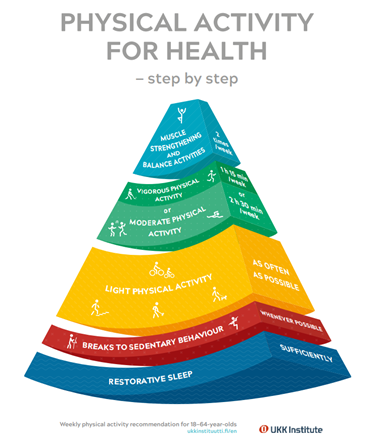
In Finland, the working-age population is decreasing, leading to the fact that there is already a severe shortage of skilled workers in some fields of work. Part of the solution to this societal problem is to raise the retirement age and therefore people would need to be able to sustain their ability to work longer. The physical endurance of Finns has been deteriorating for decades and will pose challenges in the future if this trend is not halted. People will face increasing challenges especially in physically demanding jobs, leading to labour shortages and labour productivity problems. According to the prognosis for decline of physical condition of working-age Finns the number of people in a good physical condition will decrease in the future. The cost of physical inactivity and sickness absence in Finland is several billion euros annually. (Ahokas etc. 2023.) In 2022, according to the Healthy Physical Activity Recommendations, 56% of our population aged 20-64 were insufficiently physically active (Sotkanet sine anno).

Picture 1: Weekly physical recommendation for 18-64 -years-old. By UKK Institute

How to get effectiveness?

Several studies show the positive effects of physical activity on work performance and recovery from work (Ervasti etc 2022). The effects on physical and mental health are positive. Regular physical activity prevents and treats many common diseases such as cardiovascular disease, type 2 diabetes and musculoskeletal disorders. (UKK-instituutti 2024.) Positive effects can be achieved by, for example, replacing an hour of sitting still with light physical activity during the day (Garthwaite etc 2022). There is also growing research evidence on the positive impact of physical activity in the treatment of depression and anxiety (Kukkonen-Harjula & Laukkala 2019).


There are signs of an awakening at the national level in Finland to physically activate the population. The government programme puts a strong emphasis on the efforts to promote physical activity. One of the objectives of the Suomi liikkeelle -programme is to integrate aspects of physical activity and health promotion into the strategies and plans of wellbeing services counties and municipalities. In addition, the Suomi liikkeelle -programme highlights the aspect of supporting people’s ability to cope at work and calls for the employer’s role in supporting coping at work. The aim is to find effective methods to increase physical activity among employees. (Valtioneuvosto 2023.) According to Rütten & Pfeifer, the most effective ways to promote physical activity at work were achieved by combining many different methods. Examples of effective ways include encouraging to walk or bike to and from work, providing exercise facilities, restructuring work processes to support physical activity for example by adding active breaks to workdays, as well as offering various exercise programs and utilizing the pedometer. (Rütten & Pfeifer 2016).

Raahe – a promoter of well-being at work

The message of the adult PE lesson is strongly targeted at employees in the private sector. However, businesses employ only a fraction of our working age population. We wanted to find out whether local public employers have recognized to the need to get working-aged people moving and found an interesting example in North Ostrobothnia on the shores of the Bothnian Sea. The city of Raahe started in 2022 to develop staff well-being at work based on the needs of the employees. The members of the staff expressed the need to have more breaks during the working day and wanted to find ways to prevent exhaustion. The city’s entire 1150 employees participated in a one-year trial period, which allowed them one hour of weekly physical activity during working hours. (Ojala & Sarlin 2024.)


According to Seppo Sarlin, Head of Human Resources of Raahe City, and Toni Ojala, Head of Sports Services, the feedback was generally excellent, and they wanted to make it a permanent policy. This required the will of the municipal decision-makers and a local agreement between the employer and the employees. In addition to the weekly physical exercise class the city of Raahe employees have access to an exercise voucher, a break exercise app, a cycling benefit, free use of the gym and free access to the city swimming hall once a week. Employees are also offered group exercise classes and opportunities to participate in a running school and various sporting events paid for by the employer. The city encourages employees to take care of their well-being in a variety of ways, offering extensive occupational health services, physical activity counselling, opportunities to get physical activity prescriptions and encouraging different types of rehabilitation. (Ojala & Sarlin 2024.)


– Sickness absence rates have dropped considerably, especially long periods of absence. The savings through sickness absences have been around 975 000 €, Sarlin says. This saving was obtained by comparing the sickness absence costs for 2022 with those for 2023.

The Raahe experience has also presented challenges for the implementation of the weekly physical exercise programme, and participation has varied between different occupational groups. Good staff management has helped to overcome these challenges. Feedback from the staff on the weekly physical exercise classes has been positive and the employees feel that the employer cares for and looks after them. In Raahe, the weekly exercise and investment in well-being at work are thought to be factors of attraction and retention. (Ojala & Sarlin 2024.)

Now it’s time to get down to work!

Interventions that motivate healthy lifestyles bring savings for both employers and society. In such difficult economic times as we now are facing, cost-effective measures should be invested in (Ervasti etc 2022). In Raahe, this has already been boldly implemented and the positive effects of physical activation speak for themselves. Physical activity benefits individuals, employers and society as a whole. It is well-stated in the government programme (Valtioneuvosto 2023): ”A strong and caring Finland is built on concrete and honest solutions. Hope for the future is built through action.”

Let’s work together to bring physical activity into the workplace and build a better future – it’s an investment that pays off.

Writers

Anna Helin, Heidi-Maria Kannas, Elina Lehikoinen & Johanna Leskelä, Students of Welfare and Health Coordinator Master’s Degree Programme at Savonia University of Applied Sciences 

Jaana Hämäläinen, Pirjo Pehkonen and Sanna Savela, Lecturers at Savonia University of Applied Sciences  

The work has used AI as follows: DeepL Translate 2024. Used for language correction, April 2024. https://www.deepl.com/translator.

Sources

Ahokas, Ira, Heikinheimo, Vuokko, Helminen, Ville, Hurmerinta, Leila, Kokko, Sami, Lyytimäki, Jari, Tapio, Petri & Vasankari, Tommi 2023. Kunnon rapistuminen haastaa hyvinvointi-Suomen 2023. Pdf-file. Published 2/2023. https://www.aka.fi/globalassets/3-stn/1-strateginen-tutkimus/tiedon-kayttajalle/politiikkasuositukset/politiikkasuositukset/23_06_kunnon-rapistuminen-haastaa-hyvinvointi-suomen.pdf. Accessed 7.3.2024.

Aikuisten liikuntatunti sine anno. Yritys menestyy kun ihmiset voivat hyvin. Internet publication. https://www.aikuistenliikuntatunti.fi/aikuisten-liikuntatunnin-tarina. Accessed 5.4.2024.

Ervasti, Jenni, Kausto, Johanna, Leino-Arjas, Päivi, Turunen, Jarno, Varje, Pekka & Väänänen, Ari 2022. Työkyvyn tuen vaikuttavuus. Tutkimuskatsaus työkyvyn tukitoimien työkyky- ja kustannusvaikutuksista. Valtioneuvoston selvitys- ja tutkimustoiminnan julkaisusarja 2022: 7. https://julkaisut.valtioneuvosto.fi/bitstream/handle/10024/163779/VNTEAS_2022_7.pdf?sequence=1&isAllowed=y. Accessed 28.3.2024.

Garthwaite, Taru, Heinonen, Ilkka, Knuuti, Juhani, Laine, Saara, Sjöros, Tanja & Vasankari, Tommi 2022. Effects of reduced sedentary time on cardiometabolic health in adults with metabolic syndrome: A three-month randomized controlled trial. Journal of Science and Medicine in Sport 25, 579–585. https://wwms.org/article/S1440-2440(22)00083-4/fulltext. Accessed 7.3.2024.

Kukkonen-Harjula, Katriina & Laukkala, Tanja 2019. Liikunta tukee mielen toipumista. Lääkärilehti 74, 2650–2654. https://www.researchgate.net/profile/Tanja-Laukkala/publication/337388170_Liikunta_tukee_mielen_toipumista/links/5dd4f20da6fdcc37897a6dbd/Liikunta-tukee-mielen-toipumista.pdf. Accessed 7.3.2024.

Ojala, Toni & Sarlin, Seppo 2024. Head of Sports Services and Head of Human Resources of Raahe City. Interview 2.2.2024.

Rütten, Alfred & Pfeifer Klaus 2016. National Recommendation for Physical Activity and Physical Activity Promotion. https://www.sport.fau.de/files/2015/05/National-Recommendations-for-Physical-Activity-and-Physical-Activity-Promotion.pdf. Accessed 7.3.2024.

Sotkanet sine anno. Tilasto- ja indikaattoripankki. Internet publication. https://sotkanet.fi/sotkanet/fi/taulukko/?indicator=szbMzQcA&region=s07MBAA=&year=sy5zsTbS0zUEAA==&gender=t&abs=f&color=f&buildVersion=3.1.1&buildTimestamp=202309010633. Accessed 7.3.2024.

UKK Instituutti 2024. Liikkumisen vaikutukset. Internet publication. Updated 16.2.2024. https://ukkinstituutti.fi/liikkuminen/liikkumisen-vaikutukset/. Accessed 7.3.2024.

UKK Institute 2023. Weekly Physical Activity Recommendation for 18-64 -year-olds. Internet publication. https://ukkinstituutti.fi/en/products-services/physical-activity-recommendations/weekly-physical-activity-recommendation-for-18-64-year-olds/. Accessed 7.3.2024.

Valtioneuvosto 2023. Vahva ja Välittävä Suomi. Pääministeri Petteri Orpon hallituksen ohjelma 20.6.2023. Pdf-file. http://urn.fi/URN:ISBN:978-952-383-763-8. Accessed 7.3.2024.

Rules of the game – pet friends at the workplace

What are the real benefits and impacts of pets among employees? Can we find new ways to help employees recover from work better and faster? Is there a way to reduce mental health problems among working-age? For a long time, there has been discussion and research about the effects of animal assistance on client well-being. Could we use this information to improve also occupational health in all workplaces? For some people, these best friends are the benefits of the work but at the same time, some coworkers cannot stand any animals at the workplace.
People’s experiences with animals in the workplace have been studied recently. Qualitative research is often used to describe and analyze experiences with animals, so evaluating the effectiveness is a little more challenging. Measuring effectiveness is usually associated with quantitative research (Vataja 2020).

Jane at work. Photo: Lis-Mari Kivelä.

Advantages for well-being

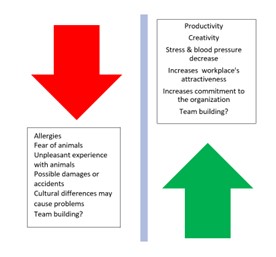
One of many ways to increase occupational well-being effectiveness is the arrival of pets at the workplace. A cat or dog isn’t only an animal, but a member of a family.  It’s also a way to combine the worker’s working life and leisure. There is evidence in the research that pets improve their owner’s productivity and enhance creativity. The animal’s presence decreases stress and for example, reduces blood pressure. In addition, pets can contribute to the interaction with other employees. It has been noticed that people are more friendly to others when there are pets around. This may be significant to the organization’s image and even bring more customers. (Wilkin, Fairlie & Ezzedeen 2016, 96–109; Foreman, Glenn, Meade & Wirth 2017, 498.) The employer’s positive approach to pets has added to the interest in the workplace. It has been noted that a pet-friendly workplace could manage recruitment better. Some will choose a job with a lower salary than a workplace that forbids animals. The permit of pets can contribute to the growth in productivity and the employee’s commitment to the company. Employees are less absent from work and they also have greater satisfaction with the job. (Wilkin, Fairlie & Ezzedeen 2016, 96–109; Foreman, Glenn, Meade & Wirth 2017, 498.)
Junca-Silva (2023, 3) developed the so-called Furr-recovery method and integrated it into micro-breaks. The studies show that taking a short recovery break from work is even more effective if you can take it with your furry friend. Micro-breaks that include animal interaction help recover energy, regulate emotions and minimize the effects of negative events. Animals also detach employees from work better than for example just a normal coffee break, so micro-brakes are more efficient. (Junça-Silva 2023, 3). It is acknowledged that the urge to touch a pet can even be a biological need and neuroscience studies show that even looking or talking to a dog releases oxytocin and reduces feelings of fear or anxiety. (Junça-Silva 2022, 5).

Potential challenges

When the management of the organization allows animals in the workplace, certain things must be taken into account. Some legislation must be followed at the workplace and insurance issues must be clear. If the property is rented, permission must be asked from the property owner. For example, a dog may cause dangerous situations by accidentally knocking people over. If the animal causes danger in the workplace, the owners are always responsible for their animal. Just like humans, animals also need breaks from work. The rest area should be peaceful and fresh water should be available there. Employees must know how to observe the signs of stress in the animal. (Hautamäki, Ramadan & Vilhunen 2021, 33–34; Nevala 2022, 45-50.) Some people don’t like pets or animals in general. For them, dogs in offices, restaurants, or shops is almost an unbearable thought. There might be some fear, some diseases, or other bad experiences with the dogs. They cannot be blamed for that. If a person has a bad memory about someone’s four-legged friend, there’s no help if the owner says that my Hannibal is such a nice fellow, you don’t need to scare him at all. Or there might be some serious allergies, which can activate from small amounts of animal dandruff. Luckily, research indicates that allergies are quite a small threat. Dogs visit elderly homes, hospitals, and other public places and the benefits are greater than the risks for any disease to activate. (Yleisradio 2018.)

Which scale matters the most when we are thinking about bringing the pets to work, the pros or the cons?

Conclusion

Qualitative research shows clearly that pets in the workplace have more advantages than disadvantages. Now that we have opened the discussion about whether or not pets should be allowed in the workplace, should there be a discussion about what all we can bring to the workplace next? Maybe kids or elderly? Should this be mentioned in the job advertisement? Is it the future that animals are already talked about in job advertisements? Can the employer ask in a job interview if you like animals?

So, it needs much talking in our communities about the rules of the game, and what is allowed in our shared places and what is not.

Writers 

Miia Hallikainen, Sari Hoffren, Sini Karhunen, Päivi Parviainen & Anu Särkkä, Students of Welfare and Health Coordinator Master’s Degree Programme at Savonia University of Applied Sciences 

Jaana Hämäläinen, Pirjo Pehkonen and Sanna Savela, Lecturers at Savonia University of Applied Sciences   

Sources

Foreman, Anne, M., Glenn, Margaret, K., Meade, Jean, B. & Wirth, Oliver 2017. Dogs in the Workplace: A Review of the Benefits and Potential Challenges. International journal of environmental research and public health 14, 498. https://doi.org/10.3390/ijerph14050498. Accessed 5.2.2024.
Hautamäki, Lotta, Ramadan, Farid & Vilhunen, Tuuli 2021. Millainen on hyvä eläinavusteinen interventio? Käsikirja eläinavusteisten menetelmien laadukkaaseen toteuttamiseen eri toimintaympäristöissä. Kansaneläkelaitos. http://urn.fi/URN:NBN:fi-fe2021061738238. Accessed 14.2.2024.
Junça-Silva, Ana 2002. Unleashing the Furr-Recovery Method: Interacting with Pets in Teleworking Replenishes the Self’s Regulatory Resources: Evidence from a Daily-Diary Study. https://doi.org/10.3390/ijerph20010518. Accessed 8.2.2024.
Junça-Silva, Ana 2023. ´Pawing’ uncertainty! how dogs attenuate the impact of daily hassles at work on uncertainty. https://doi.org/10.1186/s40359-023-01295-z. Accessed 8.2.2024.
Nevala, Niina 2022. Toimistokoirien merkitys työntekijöiden kokemaan työhyvinvointiin. Johtamisen ja organisoinnin pro gradu-tutkielma. Turun yliopisto. https://www.utupub.fi/bitstream/handle/10024/154300/nevala_niina_opinnayte.pdfsequence=1. Accessed 14.2.2024.
Wilkin, Christa, L., Fairlie, Paul & Ezzedeen, Souha R. 2016. Who let the dogs in? A look at pet-friendly workplaces. International Journal of Workplace Health Management 9 (1), 96–109. https://doi.org/10.1108/IJWHM-04-2015-0021. Accessed 5.2.2024.
Vataja Katri. 2020. Vaikuttavuusarviointia monimutkaiseen maailmaan. Sitra. https://www.sitra.fi/artikkelit/vaikuttavuusarviointia-monimutkaiseen-maailmaan/. Accessed 9.2.2024.
Yleisradio 2018. Toimistokoira voi luoda työpaikalle rennon ilmapiirin – ”Ennemmin positiivinen ongelma kuin työajan syöppö”. Published 16.1.2018. https://yle.fi/a/3-9954229. Accessed 12.1.2024.